Can Dual Citizens Be Good Citizens?

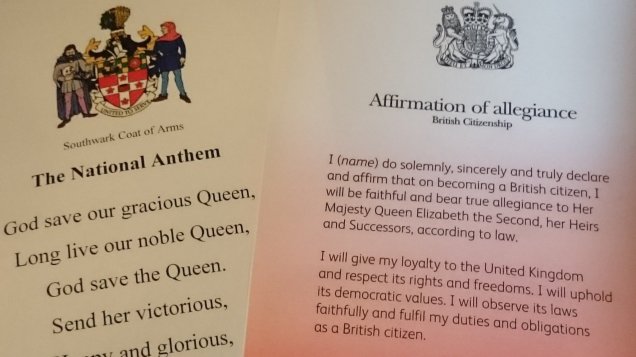
British citizenship ceremony 2

What does it mean to be a dual citizen in the Age of Brexit?

Following my recent blog post lamenting our society’s devalued and transactional concept of citizenship in the Age of Brexit, I was asked by a reader to write a companion piece on the topic of dual citizenship, a form of recourse which may ultimately be taken up by many EU residents currently living in Britain.

The request was as follows:

Brexit has caused (we are told) applications for passports from people who already hold passports – that is, people who are citizens of one European country seeking to become a citizen of a second country too.

This apparently includes UK citizens applying for Irish passports (without abandoning their UK passports) and people from continental countries who live in Britain applying for a British passport too (presumably this means going through the naturalisation process?). One wonders how many people who announce that they are planning to do it actually do – but it is evidently happening.

It is questionable why people should be able to be dual citizens if they live in democracies and are free to travel and work abroad. The ability to claim benefits in a second country seems to be one impetus. But it can cause people costs, like two tax liabilities. Some countries do not allow their citizens to take another citizenship without renouncing their existing one, but there seem to be many countries which are happy to agree to dual citizenship.

Your article of 12 September explains well how citizenship is becoming a sort of transaction – benefits for taxes, and no longer an allegiance to a nation. The large increase in people obtaining (why not triple?) citizenship could further undermine the significance and value of being a citizen of a country.

My reader seems to build on my assertion that citizenship is increasingly seen (particularly by educated, globally mobile elites) as very much a transactional affair with perks received in exchange for taxes paid, and extrapolates that dual citizenship is necessarily a further dilution of the bond between citizen and nation state.

This is a tricky subject for me to discuss, primarily because I will ultimately be emigrating to the United States with my Texan wife (who is herself currently in the process of applying for British citizenship). Therefore, to rail against the concept of dual citizenship would be hypocritical, while approving too strongly might be seen as merely attempting to justify my own personal circumstances. All I can do when setting out my views, therefore, is to make people aware of this potential bias and lay out my thinking on the matter as it currently stands.

In short, I do not believe that dual citizenship is either inherently good or inherently bad. Though there is undoubtedly a correlation between those who hold dual citizenship and the kind of fleet-footed “Citizens of the World” who feel that they have transcended national identity altogether, it is perfectly possible in my mind for somebody who holds dual citizenship to be a model citizen of both countries, while somebody without an international lifestyle can just as easily be a terrible citizen of the only country they call home.

Therefore, I don’t think it is a question of whether dual citizenship as a concept is right or wrong. The more interesting question to me is what makes somebody a good citizen of their home or adopted country, and what makes somebody a bad or negligent citizen.

One could probably define this a thousand different ways, but for immigrants seeking to naturalise as dual citizens surely it includes a mixture of more tangible qualities (being economically active, law-abiding, involved in the community) and intangible qualities (genuine interest in and acceptance of the country’s culture and values). Immigration authorities typically only look at the tangible aspects – what else could they do? – but while this scrutiny can reveal whether somebody is likely to be an economic burden or a danger to society, it is the intangible (and largely immeasurable) qualities which really determine whether or not somebody will make a good citizen.

From my own experience, I have loved the idea of America since I was an early teenager, and the reality of America just as much, ever since first experiencing the country in my late teens. The architecture, the art, the (classical) music, the landscape and the sheer optimism of America captivated me well before I was politically aware, and the Constitution, federal system and that strange but compelling contradiction between individualism and great community-mindedness equally appealed to me as I came to understand them.

America is a country that I feel I know well. Not just in the sense that frequent holidaymakers might be able to direct somebody to their favourite restaurant in New York City, or the way that US-based foreign correspondents come to know the political and cultural elites with whom they rub shoulders, but at a much deeper level.

I have visited and worked in towns and cities across that great land, from New York to Chicago to Kansas City to Austin to San Antonio to Seattle, and many smaller places in between. I have seen and savoured some of the best of urban and rural living in America, from hearing the New York Philharmonic play John Adams, riding a stranger’s horse in Colorado and experiencing the Catholic Mass with Mariachi music in my wife’s south Texas hometown to eating fried food on sticks at the Illinois State Fair. I have spoken with people from the most left-leaning liberals to the strictest social conservatives and found nearly everyone to be unfailingly polite and welcoming – though a couple of men I once conversed with at a hotel bar in Arkansas were none to happy that America had a black president (they used a different word).

I have seen (some of) the best of America, and glimpsed the darker side, too. And so when the day finally comes that I raise my hand and take the oath of allegiance to the Constitution and laws of the United States of America I will be aligning myself with a country that I know and love, for all its greatness and its imperfections.

I will not become an American to join a closed community of fellow British expats, clustered together in one locale and unwilling to integrate with American society. I will not become an American to try to make the United States more like Britain. I will not become an American because the taxes are lower (though they are), or because I think I can get more from the welfare system (I certainly won’t). I will not become an American merely because the United States is a temporary work posting, a brief stopover as part of a transnational career. No, I will become an American because I will one day make that place my home and want to share that bond of citizenship and fraternity with my fellow citizens; because I want to participate in American democracy and every facet of civic life open to citizens.

But even as I do so, I will not lose affection for the United Kingdom, my homeland. I will remain connected to Britain not only through ties of family and friends, but because I am proud to be British and have been an engaged citizen of this country for so long, politically and culturally. When my wife and I have children we may well want them to spend some years growing up in London so that they know the rich culture that is also their inheritance. Far be it from me to brag about myself, but as an abstract ideal for the model dual citizen this would seem like a decent enough template.

But the diluting effect of loyalties mentioned by my reader is undoubtedly a real phenomenon. I would think it highly unlikely that anybody could maintain such strong connections as the number of countries and citizenships involved ticks upward. I have to tread carefully here, because I have a number of dear and longstanding friends who hold multiple citizenships, and uncontestably have strong attachments to and affection for each country in question. One cannot make judgments about individuals from population trends, or infer population trends from observing individuals, but at a macro level I think it is generally the case that deep attachment to a nation state decreases as the number of citizenships in play increases.

The degree to which the cultures in question differ from one another probably also determines whether it is possible to form a deep bond to multiple countries. I would imagine that growing up in a Middle Eastern theocracy would make it at least somewhat harder to form deep bonds of attachment to a country with Western values and culture while maintaining undiminished affection and loyalty to one’s homeland, though there are undoubtedly many such dual citizens who do not experience (or at least overcame) any cognitive dissonance in this regard.

Many residents holding a particularly high number of citizenships are likely to have acquired at least one from birth or through their parents, and may have very little connection to the culture of that country if they grew up without living there. I know several people who hold Spanish citizenship through birth, though the closest connection they have with Spain is having occasionally vacationed there as a child. Does this make them bad citizens? I wouldn’t necessarily say so, since their citizenship is passive – they do not live in Spain or participate in Spain’s democratic process, and so their effect on Spain is neither positive or negative.

And of course there are particularly mobile members of the economic elite who often tend to have more in common with elites from other developed countries than with their less affluent neighbours. Benjamin Schwarz is the latest to pick up on this particular trend, over at The American Conservative:

Reflecting and exacerbating the cultural divide, these cities have increasingly become culturally homogenous echo-chambers. The consumption patterns and cultural and political attitudes of, say, London, central Paris, the westside of Los Angeles, the northside of Chicago, Manhattan, Seattle, Northwest D.C., Toronto, and San Francisco resemble each other more than they do their outlying districts and suburbs.

As befits these engines of global capitalism, these cities and their inhabitants are pulling away with growing momentum from their native countries and cultures. Untethered from their localities, they are being transformed into an archipelago of analogous islands.

Again, does this mean that a well-travelled, prosperous knowledge worker with an international career cannot be a good and conscientious member of his or her community and country? Of course not. But it seems highly likely that people who are rooted Somewhere will have a greater sense of belonging and loyalty to their country than people who are rooted Anywhere. This is not intended as a moral judgment, but simply a statement of probability.

This hypothesis was proved in the EU referendum, where the vast majority of the foreign-born Anywheres living in Britain were strongly for remaining in the European Union and dumbfounded to the point of trauma at the vote for Brexit. For example, many Americans living in London simply couldn’t understand why Britain would want to secede from a supranational political union in the name of nation state democracy, even though their own country would never in a million years submit to the same kind of incursions on sovereignty inflicted by the European Union. In this regard at least they clearly have more in common with the transnational elite than the majority of citizens of their own country (or Britain, as it turns out).

In all of this, I feel like something of an outsider. I have enjoyed an international career myself, will one day be a dual citizen and in most ways am very much part of the “elite” that I spend an increasing amount of time thinking and writing about. My wife and I live in West Hampstead, an area of London which voted overwhelmingly for Remain in the referendum, and in which French is probably the second-most common language heard on the high street. We have become snobs about good coffee, visit food trucks on the weekend and (God help us) occasionally shop at Whole Foods.

Yet I am not at one with the hive mind of my demographic, which leans strongly toward the pro-European, trendy Left. I don’t think that this makes me any better or worse than people who hold the prevailing views of my social circle, but whether by the circumstances of my childhood or some quirk of the brain I do seem to be able to empathise with those who fall outside my demographic or otherwise think differently. I see the condescending, insular selfishness of the centre-leftist metropolitan worldview even as I personally benefit from many of the resulting policies.

This is probably why my stance on dual citizenship is nuanced to the point of sounding tortured. But since the ability to empathise with people of all circumstances is to my mind an essential part of being a good citizen, to this extent I do consider myself a better citizen (though by no means a better person) than those who hold the typical pro-EU, metro-leftist worldview.

Personally, I feel rooted emotionally and circumstantially to only two countries – Britain and America. There are other countries which I know well, love and respect. I have enormous affection for France, from the scruffy Pas-de-Calais to the trendy Marais district of Paris. I know and like the French culture and character. But I do not feel French, nor would I, even if I were to take a job in France for a number of years. If I were ever to take French citizenship it would only be the result of a need to formally codify my status there for administrative reasons, or because I wanted to participate in the democracy of my host nation. It would very much be the more transactional approach to citizenship that my reader decries. By contrast, I already feel part-American – the only thing which lags behind is the paperwork.

Others may enjoy the rare ability to feel real, abiding love for multiple countries, to hold six or seven passports and be willing to fight and die for each represented flag, if necessary. I am not one of those people, and as a tenuous member of the so-called elite I can report that very few of them cross my path. Therefore I think it almost self-evident that there is a negative correlation between citizenships held and deep attachment to each – but it is a trend with many many outliers, and one cannot prejudge anybody based on this factor alone.

So is it possible for dual citizens to be good citizens of both countries? Yes, of course – or at least I hope so, for my sake. But the qualities that make a good citizen cannot be measured or screened for during the immigration and naturalisation process (even attempting to do so would veer into draconian thought-policing of the worst kind), and so we are left struggling to promote the concept of citizenship to a group of people many of whom have lost faith in the very concept. But just as one hopes that people take the institution of marriage seriously while simultaneously recognising that many people will not do so, so one must accept that some people will become citizens of a new country thinking only of the benefits and not the obligations.

At present, many of those who oppose Brexit – both British citizens and EU residents – declare themselves “Citizens of the World”, meaningless phrase though it is, as a way of signifying their disdain for what they see as an insular and parochial worldview.

But as I wrote last year:

In my experience, self-described citizens of the world have tended to describe their outlook in terms of what they get from the bargain rather than what they contribute in return. They call themselves citizens if the world because being so affords them opportunities and privileges – the chance to travel, network and do business. Very few people speak of being citizens of the world because of what they give back in terms of charity, cultural richness or human knowledge, yet all of the people that I would consider to have been true citizens of the world – people like Leonard Bernstein or Ernest Hemingway – fall into this latter, rarer category.

If the former, more parasitic attitude is what comes to represent dual citizenship then I have no desire to be associated with it. But it need not be like this. Dual citizens can be among the very best citizens of a country, holding a deep appreciation for their new home that many natural born citizens lack or take for granted, while also bringing with them the best values and traditions of their homelands.

And these people we should welcome with wide-open arms.

 

Dual citizenship - US and British passports

Support Semi-Partisan Politics with a one-time or recurring donation:

Agree with this article? Violently disagree? Scroll down to leave a comment.

Follow Semi-Partisan Politics on TwitterFacebook and Medium.

Brexit Opposition And The Quiet Death Of Citizenship

It is difficult to have a serious conversation about citizenship in the Age of Brexit when so many people hold a such transactional, materialistic and reductionist definition of the concept as meaning little more than benefits received in exchange for taxes paid

One interesting and overlooked aspect of the Brexit debate is the extent to which the basic concept of citizenship has decayed and virtually evaporated from our public discourse, right under our noses, with barely any note of alarm being sounded in the process.

This decay reveals itself in manifold ways, from the furious pushback one inevitably receives when pointing out the obvious fact that citizens should (and do) have more rights than non-citizens to the outraged, moralising vitriol hurled at anybody who dares to suggest that illegal immigrants are technically lawbreakers and therefore maybe not universally worthy of respect, sympathy or amnesty.

These are now controversial positions to hold. To be steadfast in the belief that British citizenship confers more rights than those held by permanent residents or temporary visitors is to mark oneself out as something of an extremist, at least as far as the media and chattering classes are concerned. Yet many politicians in Britain and America who now wrap themselves in the mantle of conspicuous compassion for all illegal immigrants and effectively agitate for open borders could themselves not so long ago be found calling for tougher immigration enforcement.

This applies to the likes of Hillary Clinton in America, who once supported and voted for the same strengthening of the United States’ southern border which she now denounces as being tantamount to racism. Of course, Clinton has since positioned herself as a tireless champion of the “undocumented”, together with virtually all of the American Left. Similarly in Britain, many commentators who once dared to express reservations about uncontrolled immigration from within the EU have now taken up rhetorical arms against anybody who proposes a more rigorous immigration policy.

In both countries, but particularly in Britain, citizenship is increasingly regarded (to the extent that people think of it at all) as a transactional affair, services rendered for taxes paid – or even rendered with no reciprocity at all in the case of the modern welfare state. The argument goes that by the sole virtue of paying taxes or drawing benefits here one deserves a full voice in the country’s affairs, even if one is a non-citizen or is present in the country illegally.

This very transactional approach has frayed the contract or bond between citizen/resident and the state. Of course, people still expect the state to protect them from foreign foes, guard against domestic security threats, provide healthcare, offer a welfare safety net and distribute various domestic and EU services. But even as they make these demands they offer rapidly diminishing loyalty to the state in which they live. People are increasingly insatiable for the benefits while being less and less willing to accept the responsibility.

This responsibility goes much deeper than just paying one’s taxes. It means making a serious commitment to community and, ideally, the enthusiastic acceptance of and assimilation into one’s home (or adopted) culture. Traditionally, the sign that an immigrant was willing to accept these broader responsibilities was their decision to apply for naturalisation as a citizen. Historically, if an immigrant were to build a life in another country, working and raising a family there, they would ultimately become a citizen of that country in most cases.

But today, many people demand the perks without accepting the responsibilities – hence the outrage of and on behalf of EU citizens who have built permanent or semi-permanent lives here yet refuse to see why they should formalise that commitment through the naturalisation process (or at least the acquisition of permanent residency following Brexit). They forget that the European Union is an aberration, that nowhere else in the developed world would countries offer so much while asking for virtually nothing in return.

Yet to point this out is to invite accusations of callousness and amorality. Of course there are exceptional cases where joint citizenship cannot be taken or some other bureaucratic or financial obstacle stands in the way of an EU migrant formalising their commitment to the United Kingdom. Such cases should be treated generously, with the aim of reducing any uncertainty for the migrants involved.

But this blog has very little sympathy when people demand something for nothing. Freedom of movement and other EU benefits are political entitlements. They are not – repeat, NOT – fundamental, inalienable rights.

A fundamental right is intrinsic to one’s humanity, as applicable to somebody in China, Russia, North Korea or Venezuela as to someone living in Britain. These are best summed up in the US Declaration of Independence as “life, liberty and the pursuit of happiness”, though one can also drill down a level further and acknowledge the universal human right to property, due process under law and so on. Fundamental rights are inherent; political entitlements are nice-to-haves, often given (in the EU’s case) partly as a means of securing support for a dubious political project which would otherwise be utterly unloved.

Of course we should have a degree of natural sympathy for anybody at risk of losing their current political entitlement to live and work in the United Kingdom without going through the arduous and expensive process of applying for permanent residency or citizenship – though a deal between Britain and the EU to secure reciprocal ongoing rights for UK and EU citizens is all but inevitable. Personally, I would offer expedited indefinite leave to remain to all current EU migrants at a greatly reduced fee. But others’ rights as EU migrants do not trump the sacrosanct (though not quite exclusive) right of British citizens to participate in our democracy and determine the course of the country.

The decision of the British people to secede from the European Union can not and must not be vetoed by or on behalf of people who refuse to assume the responsibilities and privileges of full citizenship. That such an obvious statement now sounds harsh or controversial is itself an indicator of how deeply corroded and devalued the concept of citizenship has become in our society. Yet this would have been the mainstream view in Britain a decade or more ago, and still very much is the accepted wisdom nearly everywhere else in the world.

Many Brexiteers – myself among them – did not spend 2016 tirelessly campaigning for Brexit because they hate immigrants, want to kick out existing migrants or even significantly lower net migration. But neither will we allow the protestations of those who refuse to share the commitment and mutual connection of citizenship with us to overshadow or overrule our vote.

This is not extreme, nor is it unreasonable. It is merely the consequence of adhering to the same traditional definition of citizenship which allows us to flourish as a society precisely because we are all bound to one another by something deeper than momentary convenience.

It remains to be hoped that Brexit will spark a renewed discussion about citizenship and the proper relationship between citizen, resident and government – indeed there are some early encouraging signs that such conversations are starting to take place.

But the furious reaction of the establishment Left to political developments both in Britain and America suggests that defenders of the concept of citizenship will be starting at a considerable disadvantage.


A British citizenship certificate is seen in London

Support Semi-Partisan Politics with a one-time or recurring donation:

Agree with this article? Violently disagree? Scroll down to leave a comment.

Follow Semi-Partisan Politics on TwitterFacebook and Medium.


Theresa May’s One Chance For Redemption: Sacrificing Her Leadership For A Sane Brexit

Theresa May - Brexit - Article 50 declaration signing

Theresa May will never be remembered as a great prime minister because she is timid, calculating and lacks any positive vision for the country. But she can still redeem her failed premiership by sacrificing it in order to achieve a sane Brexit

The fate of Brexit hangs in the balance, primarily because two equal and opposing forces are selfishly attempting to hijack Britain’s negotiating stance for their own purposes.

One one hand there are the Brexit Ultras (or the Brexit Taliban, to use the less charitable but evocative phrase) who insist, like religious fundamentalists, that theirs is the One True Brexit, the only route to heaven, while all other interpretations are dangerous heresy. These people – your Steve Bakers, John Redwoods, Jacob Rees-Moggs and Suella Fernandeses – do not see Brexit as meaning departure from the political entity known as the European Union. To them, Brexit means severing virtually all ties and treaties with the EU while retaining nearly all of the current perks, while making up for any economic shortfall by effortlessly completing a series of swashbuckling free trade deals with countries often far less important to the UK economy than our nearest neighbours.

But on the other hand, there are forces who are arguing passionately for a “soft Brexit” with strong and enduring ties to the Single Market, not because they believe in Brexit or have accepted it, but because they see this as the first step to reversing the result of the EU referendum and keeping Britain in the European Union (generally by means of a second referendum, which they believe – erroneously, I think – that they could win). These people are not to be trusted. During the referendum campaign they could be found loudly insisting that any change in Britain’s relationship with the EU would result in political isolation and economic Armageddon, yet now they claim (somewhat more plausibly) that it is only separation from the Single Market which will cause harm. Their old argument was therefore a lie, a fig leaf to justify their determination for Britain to remain part of European political union at any cost.

And sandwiched between these two fanatical, opposing forces, are the saner Brexiteers – such as those connected to the Leave Alliance – who have been arguing all along that Brexit is not a sudden event but a process of unpicking 40 years of political and regulatory integration, and that the best way to achieve our political ends without causing undue economic damage is by means of a transition that involves rejoining EFTA and trading with EU member states on the terms of the EFTA-EEA agreement.

At the moment, however, Theresa May’s inability to exert control over her own party means that the government’s negotiating stance is effectively held hostage by the Brexit Ultras, who see the slightest moderation on trade as a “betrayal” of Brexit, despite laws relating to the EEA accounting for just 20 percent of the total EU acquis. Despite having languished in the political wilderness for decades, getting 80 percent of what they want on the back of a tight referendum result is somehow not good enough for the Brexit Taliban – and their selfish greed for the full 100 percent needlessly imperils the whole endeavour, and our economy with it.

But it need not be like this. As Stephen Bush points out in the New Statesman, there is no shortage of MPs willing to work with Theresa May to achieve a softer, saner Brexit (at least for a transitional period) if only she was willing to work in a bipartisan way rather than remaining a hostage to her own backbenchers.

Bush writes:

As Parliament has ratified Article 50, passed May’s Queen Speech and thus lost control of its ability to directly influence the government’s negotiations, when the final Brexit deal comes before the House of Commons, the option they will be voting on will be “Theresa May’s Brexit deal or no deal”. As I’ve written on several occasions, no deal is a great deal worse than a bad deal. No deal means, at best, exit on World Trade Organisation terms, no deal to allow British airplanes to fly to the European Union or the United States, chaos at borders and an immediate and hard border between Northern Ireland and the Republic.

This all has one massive upside for May: while there are many Conservative MPs who don’t accept this to be true, the opposition parties all know it to be the case. May will always be able to count on enough MPs from the parties of the centre and left being unwilling to make their own constituents’ lives drastically worse.

But the snag remains:

But that would require her to pursue a Brexit deal that wasn’t focused on keeping her government on the road –  one that saw getting the best deal as more important than preventing May being removed by her own backbenchers. The difficulty is that Theresa May displayed precious little desire to pick a fight with her own party before she threw away their first parliamentary majority in 23 years and she has even less of one now.

This is one of those times when a presidential-style system of government would actually aid Britain enormously. With a separately-elected head of government, more autonomous and less beholden to the rank and file of their political party, it would be easier to forge a winning coalition in Parliament to pass a more sensible, measured Brexit bill. Unfortunately, with the British parliamentary system, any attempt by Theresa May to make overtures to pragmatists across the political aisle would immediately put her premiership in grave peril. A leadership challenge would all but certainly be triggered immediately, and it would then be a race against time to pass the bill before the self-destructive forces at work within the Tory Party concluded their ghastly business and replaced May with a One True Brexit fanatic.

But at this point, there is precious little to lose – not for the country, anyway (though Tories with medium-term hopes for future political careers may feel somewhat differently). And there is precious little for principled conservatives to lose either, given that Theresa May’s government has given every indication from Day 1 that it intends to fight a rearguard retreating battle against encroaching statism rather than take it on with a bold, alternative vision.

The prime minister and her Conservative Party have had all summer to dwell on the reasons for their disastrous election campaign and their their growing unpopularity among people with their original hair colour, and to come up with at least a sketched outline of a new approach. And what was the best scheme they managed to cook up between themselves in all that time? A puny, derisory pitch to reduce interest rates on student loan debt, in the risible hope that doing so might win the affections of young voters currently seduced by Jeremy Corbyn.

The ambition has gone from this Conservative government, together with any semblance of intellectual rigour in their policymaking. Rather five years of Jeremy Corbyn, constrained by his own centrist MPs and a Tory party in opposition, than any more of this decay and damage to our reputation. At least the government’s approach to Brexit might be somewhat more pragmatic if led by people who do not expect the European Union to freely offer all of the benefits of the Single Market for none of the costs or commitments. And then, when Corbyn’s Labour Party have proven themselves to be a shambles in every other respect, the Conservative Party might bounce back into government under the direction of a leader more worthy of respect.

What great development are Theresa May’s supporters hanging on for? What great new policies or achievements do they imagine her accomplishing with her puny non-majority in the time before she is inevitably toppled by one of her Cabinet members? There is nothing. So better to bring the suffering to a close and stop deferring the inevitable.

If the prime minister were better advised, she might also see the advantages of this option. Theresa May is a weakened leader, barely in control of her directionless party which itself is unpopular with voters after seven wasted years in government. At present, her premiership is set to come to an ignominious close with no significant accomplishments to her name. But this need not be so.

In a final act of defiance – and as an extravagant and substantial gesture to help bring the country together after the EU referendum and its fallout – Theresa May should stand up to her backbenchers and to the Brexit Taliban, and work with willing MPs from the opposite benches to ensure that a more considered Brexit Bill is passed by Parliament. This need not and should not be a formal arrangement with the Leader of the Opposition, who will have his own motives. Jeremy Corbyn’s support remains shallow within the Parliamentary Labour Party, and willing supporters could be found by going round the Labour whips.

At present, the very future of Brexit is being imperilled by zealots who foolishly insist that forty years of political and economic integration with the EU be unpicked in the space of just two years. These people need to be sidelined, and if the price of doing so is the end of an otherwise hopeless premiership and the provoking of a long-overdue existential crisis within the Tory party then it is a price very much worth paying.

There is nothing else that Theresa May can do which would impact so positively on her legacy at this point. The prime minister should consider her options.


Britain - UK - European Union - Referendum - Brexit - Punishment Beating

Support Semi-Partisan Politics with a one-time or recurring donation:

Agree with this article? Violently disagree? Scroll down to leave a comment.

Follow Semi-Partisan Politics on TwitterFacebook and Medium.

The Left’s Self-Serving Hypocrisy On Immigration And Free Movement

Labour - controls on immigration mug - general election 2015

The Left’s extreme attachment to the principle of free movement of people speaks volumes about whose interests they really serve

This, by trade unionist and Blue Labour activist Paul Embery, really gets to the heart of the modern metro-Left’s extremist stance on immigration and free movement of people within the EU, so divorced from the fears, priorities and aspirations of the Labour Party’s traditional working class base:

“Access to the single market and freedom of movement are inextricably linked, and it would be wrong… to put the economy anything other than first,’ Diane Abbott told The Andrew Marr Show on Sunday.

Leaving aside that there is, in fact, no inextricable link between access to the single market and free movement (she may be confusing access with membership), what is most striking is that Abbott’s argument here – that everything must be subordinated to economic imperatives, that policies must ultimately be judged not by their impact on society or quality of life but according to whether they boost GDP or make someone somewhere a fast buck – is the very embodiment of market-obsessed Thatcherism.

Abbott isn’t a Thatcherite, of course. Anything but. She is, on virtually all things, on the side of the angels in a head-to-head with Thatcher. Yet it is weird how, when it comes to the subject of immigration, she and so many others on the Left are willing to suddenly embrace the philosophy of a woman they have spent their lives opposing.

When did it become the norm for the Left to put the demands of the market above what was right for wider society? To allow the dictates of the balance sheet to trump all? To know the cost of everything but the value of nothing?

When Thatcher closed the mines and destroyed whole communities, didn’t she do so because she wasn’t prepared to ‘put the economy anything other than first’?

We can argue until the cows come home about whether particular policies or strategies do indeed bring economic advantages. But, for the Left especially, that should never be the sole consideration – and certainly not when those policies or strategies give rise to profound consequences for society.

It is certainly very telling when the Left pivots from disparaging corporations and viewing business as evil (their standard M.O.) to fawning over multinational corporations and anxiously tending to the every care and concern of their CEOs.

I noted this point over two years ago:

Isn’t it funny how the voice of big business – usually the object of scorn and hatred from the left – suddenly becomes wise and sagacious when the short term interests of the large corporations happen to coincide with those of the Labour Party?

Labour have been hammering “the corporations” relentlessly since losing power in 2010, accusing them of immoral (if not illegal) behaviour for such transgressions such as not paying enough tax, not paying employees enough money, paying employees too much money and a host of other sins. In Labour’s eyes, the words of a bank executive were valued beneath junk bond status – until now, when suddenly they have become far-sighted and wise AAA-rated pronouncements, just because they have come out in support of Britain remaining in the EU.

(In fact, I wonder whether the Left’s eagerness to talk about the economics of immigration is actually a classic piece of misdirection designed to sway conservative or swing voters; that in actual fact, they don’t give a hoot about the economy but rather want to ensure maximum immigration levels for cultural and political reasons that they dare not speak out loud. Why else would Diane Abbott of all people, hardly the sort of person who you would picture fretting about a multinational corporation’s labour costs and investment decisions, be speaking about economics, well outside her comfort zone?)

Embery is quite correct, though – the Labour Party did indeed once value additional metrics beyond raw GDP when evaluating public policy. This formed a large basis of their objection to Thatcherism, bordering on hatred. (While this blog remains convinced that the Thatcher reforms were entirely necessary and hugely beneficial on the balance, it must be acknowledged that too little was done to ameliorate the harsh impact of deindustrialisation on many Northern, Welsh and Scottish communities – the Left actually has a valid critique here, and a reasonably strong moral point).

Yet large elements of the Left, driven mad by Brexit, now seem willing to squander any moral high ground they may once have held by openly contradicting their former principled critique of the Thatcher government. According to the new post-Brexit leftist playbook, Thatcher was completely correct to sacrifice close-knit industrial communities in order to save the overall British economy. The needs of the many outweigh the needs of the few, after all, and if a few livelihoods have to be crushed in order that the City of London continues to prosper then so be it. These are strange sentiments indeed to hear emanating from people who usually won’t shut up about how kind and compassionate they are.

It continually astonishes me that so many leftists – the type of urban, metro-left progressive who wear their political opinions like this season’s latest fashion and consider themselves to be super woke and compassionate – can be so callously disregarding and downright heartless when it comes to acknowledging legitimate concerns about immigration from an important segment of their collective movement.

And yet it should not be so surprising. Britain’s membership of the European Union, and free movement of people specifically, has greatly benefited this class of people – the young creative professionals working in the city and the Labour MPs who share the same outlook. These people have an extremely consumerist outlook on politics, always asking what their country or government can do for them rather than dwelling on their own responsibilities and obligations as citizens.

They are sworn adherents to the politics of Me Me Me. And a super-streamlined process for moving to another European country for work is to their great benefit, while the fact that many of the people for whom they claim to speak probably do not have glittering international careers in their future barely seems to register. This isn’t compassion – it is pure selfishness.

Embery goes on to make this very point:

How depressing it has been to witness so many on the Left fall into the trap of defending free movement almost unconditionally, presenting it as some kind of advancement for working people. One wonders whether they have ever stopped to ask themselves why the multinationals are so enthusiastic about it. In this case, they are guilty of defending a system which, in the quest for greater profits, commodifies humanity, uproots families and fragments communities. When that happens, the bonds of solidarity, mutuality and community are weakened, and instead we get loneliness, alienation and atomisation. ‘Migrants are not to blame,’ the free movement defenders will often retort. Well, of course they aren’t. But that was never the argument. It’s as meaningless as saying ‘The unemployed are not to blame’ as a response to opposition to unemployment.

A few other brave souls, such as Richard Johnson, have dared to tentatively make the same criticism of the Left:

People’s concerns about immigration haven’t been invented out of thin air. The real experience of immigration in Britain since the EU expanded into Central and Eastern Europe has been one of rapid change, over which people have felt little control. As Geoff Evans and Jon Mellon have shown, the salience of people’s concerns about immigration has closely tracked actual levels of net migration since 2004. Areas which saw the fastest increases in migrant populations were more likely to vote Leave. In areas where the migrant population increased by 200 percent or more between 2001 and 2014, there was a 94 percent chance of voting Leave.

[..] To oppose new controls on immigration is to speak for, at best, the 4 percent who want higher immigration and the 17 percent who are satisfied with current levels. It is not a 48 percent strategy; it is a 21 percent strategy. Too many in Labour seem to want the party to become the Lib Dems of c2005 – one which appeals to liberal, university-educated, cosmopolitans in big cities and university towns. It’s a fine strategy, but only if you want to win 60 seats in Parliament.

All too often, working class people only now exist in the eyes of the Labour Party to be used as convenient props when a political attack on conservatives needs to be made. The progressive left will happily get all weepy about the impact of gentrification and “social cleansing” on working class people, but then treat those same people like lepers if they dare to offer any political ideas or opinions of their own – especially those relating to Brexit and immigration. And almost nobody calls them out for this rank hypocrisy.

Thanks to Paul Embery for having the courage to do so. We may come from opposing sides of the political spectrum, but Embery clearly believes strongly in self-determination and the idea that British democracy should be accountable first and foremost to British people, not transnational elites or Labour’s progressive clerisy.


Labour 2015 General Election Mug Control Immigration - Immigration Policy

Support Semi-Partisan Politics with a one-time or recurring donation:

Agree with this article? Violently disagree? Scroll down to leave a comment.

Follow Semi-Partisan Politics on TwitterFacebook and Medium.

The Left’s New Cunning Plan: Pretend To Support Brexit, Then Sabotage It Later

Brexit Saboteur - Remain - Establishment

Someone needs to tell the pro-EU centrist establishment that plotting an establishment usurpation of democracy in public isn’t the smartest strategy

You have to admire the chutzpah of the establishment centre-left right now. Last week they publicly advanced their super clever idea for Remainers to pretend to make peace with Brexit in order to regain credibility with the public (but only in order to sneakily backstab the whole enterprise a few years down the line).

No, seriously:

An increasing number of Remainers are attracted to an alternative strategy. After a lengthy transition, they argue, voters should be offered a choice between a new EU trade deal and re-entry under Article 49 of the Lisbon Treaty. By the mid-2020s, Remainers calculate, the risks of Brexit will be clearer and the original referendum will be a distant memory. The proviso, they add, is that the EU would have to allow the UK re-entry on its existing membership terms (rather than ending its opt-outs from the euro and the border-free Schengen Area).

Rather than publicly proposing this plan, MPs are wisely keeping their counsel. As they know, those who hope to overturn the Brexit result must first be seen to respect it.

Interesting. So let me get this straight:

Step 1: Pretend to accept the EU referendum result.

Step 2: Work furiously behind the scenes to overturn it in a few years’ time.

Step 3: Keep the whole dastardly plot a secret, so that nobody finds — oh, too late.

And today we see another confession from the Left, this time that they plan on pretending to be on board with the outdated and embarrassing ideas of patriotism and pride in Britain – because their stupid, backward working class base insist on clinging on to those foolish notions. Again, this was done in public.

Alessio Colonnelli over at LabourList begins by stating exactly what he thinks of the backward and dangerous concept of patriotism:

Brexit is a bout of extreme patriotism; an angry Pamplona bull you can’t really grab by the horns. You run away from it, then hide and watch it thunder past. Overwhelmed by it all, gasping for air, the only question left is: how to make the best out of this situation?

This is a promising start – not merely suggesting that the patriotism felt by a majority of Brits is irrational or a hankering for lost empire (the familiar trope from Remainers), but that it resembles an angry charging bull.

Colonnelli continues:

Having lost millions of voters in northern England, Wales and Scotland in between 2010 and 2016, the red party has started doing “patriotism” a bit more. It would be very worrying if it were not so. It’s a card one has to play, given the circumstances. Make no mistake: Machiavelli would pat you on the back for doing that. Whatever it takes, so his lesson goes. Besides, it’s not as if a dash of mild jingoism was ever alien to Labour throughout its history – Hugh Gaitskell was never enamoured with Europe either, after all.

The thing about Machiavelli, though, is that he didn’t advocate that politicians announce their dastardly plans in public before executing them, or make it painfully obvious that they are only pretending to get along with the target of their deception. He assumed that geopolitical actors would have a sufficient baseline of intelligence that pointing this out wasn’t necessary.

Not so for Alessio Colonnelli though, who tells us exactly what he thinks about patriotism, declares that he sees it as a form of “mild jingoism” in which the metro-left should nonetheless pretend to partake for the sole purpose of tricking Brexiteers, and then titters to himself that he is somehow pulling one over on those of us who campaigned and voted for Brexit on the grounds of democracy, sovereignty and patriotism.

He continues:

Occasionally, as we all know, the centre of politics shifts, and momentarily weaker outfits are forced to follow the changes – the zeitgeist. It happens everywhere. In Britain, the centre has moved towards the right over the past seven years (with Ukip’s crucial help), and you would expect social democratic organisations to do something to counter this while playing along to the new tune for a bit and sneakily carving out a new space.

How brave. How principled, to pretend to agree with a current political trend that you find objectionable rather than standing up to it with courage and conviction. First I am astonished that Colonnelli believes that the political centre of gravity has shifted to the right lately, given the fact that Theresa May completely blew the general election, Jeremy Corbyn surpassed expectations and the public seem to be signalling that they are getting tired of this whole austerity thing. But presumably he is talking exclusively about Brexit, which in his two-dimensional mind he sees as being a right-wing phenomenon rather than a democratic one.

In all seriousness, though, there is an interesting contrast between the way that the Left is responding to populist setbacks on either side of the Atlantic. In Britain, we do see the stirrings of this attempt to reach out to Brexiteers and others for whom patriotism is not an embarrassment (the Somewheres, to use David Goodhart’s terminology) – even if it is only a transparent ruse designed to trick them.

This almost certainly would not be the choice of most of the Parliamentary Labour Party, who hold Brexiteers in barely disguised contempt and who wear their fawning, unconditional love for the EU like a badge of honour. But Labour’s centrist MPs are constrained in what they can do because Jeremy Corbyn, their leader, is a eurosceptic at heart and set the tone in the 2017 manifesto that Labour would support Brexit.

In the United States, however, the Democratic Party – despite having thrown away the White House, a minority in Congress and severely weakened in state government – shows no signs of being ready for a rapprochement with the voters that their standard bearer Hillary Clinton once called “deplorable” and “irredeemable”. If anything, the American Left seems increasingly determined to publicly double down on the divisive identity politics messaging which alienates middle America and saw the Democrats lose the Rust Belt (with the exception of a few brave voices in the wilderness, like Mark Lilla).

Two different approaches – on one hand an attempt to understand voters and meet them where they are (even if only as part of an elaborate and cynical deception), and on the other hand a perplexing decision to furiously lash out at the electorate and double down on the same old failed identity politics strategy.

Neither populist insurgency is going tremendously well right now – in Britain, the Conservative government seems determined to enact the most ruinous and disorderly version of Brexit possible, while in America Donald Trump is simply being Donald Trump. This might represent fertile territory for a left-wing party which actually knew what it was doing, a movement which wasn’t consumed by blind fury at being ignored by the electorate and cast unexpectedly from power.

The question is, when will the Left cease their temper tantrum, grow up, regain their senses and try being effective opposition again? Because surely it will happen eventually, and that will be a bad day for the populists.


Remainer paints EU flag on her face - European Union - Brexit

Support Semi-Partisan Politics with a one-time or recurring donation:

Agree with this article? Violently disagree? Scroll down to leave a comment.

Follow Semi-Partisan Politics on TwitterFacebook and Medium.