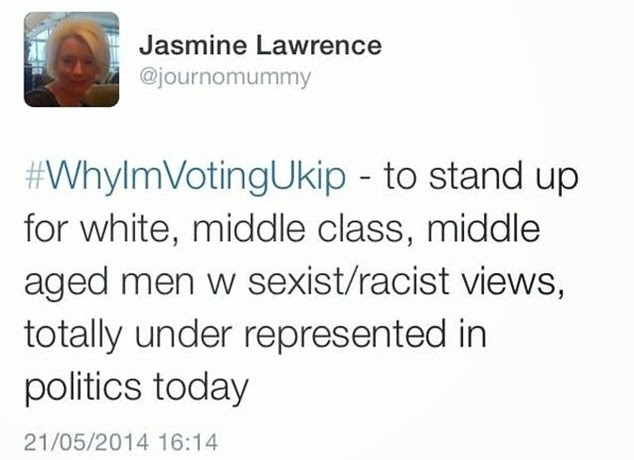
It is a sign of the times that things which used to cause outrage are becoming commonplace and shrugged off as unimportant, a fuss about nothing. And so it was that barely anyone spoke up when Jasmine Lawrence, the editor of the BBC News Channel – Britain’s most watched news channel – caused a stir by posting a virulently anti-UKIP screed on Twitter (supposedly in a personal capacity) before quietly deleting it when it began to attract negative attention.
The Guardian summarises the incident:
Lawrence, who has now shut her Twitter account, posted a tweet on Wednesday that said: “#WhyImVotingUkip – to stand up for white, middle class, middle aged men w sexist/racist views, totally under represented in politics today.”
The tweet was posted the day before the local and European elections.
Of course, the story was seized upon by the likes of blogger Guido Fawkes, but outrage and indignation at such a flagrant breach of impartiality should not be the exclusive preserve of those on the right. It does no one any good if the national broadcaster, whose one supposed redeeming feature lies in its non commercial and impartial nature, permits its employees to go rogue without consequences.
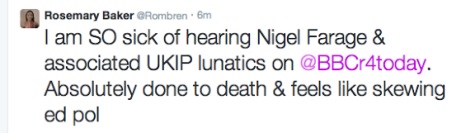
And this was far from the only example of BBC journalists publicly showing contempt for political parties outside the “big three” – a BBC Radio 4 producer had this to say:
The BBC’s mail-merged response to Semi-Partisan Sam’s complaint (yes, a complaint was justified) came today via email, and read as follows:
Jasmine Lawrence was tweeting from a personal account. She has been reminded of her responsibility to uphold BBC guidelines. She has deactivated her twitter account and will now be playing no part in the BBC’s election coverage in coming days.
Nevertheless, we acknowledge the strength of your complaint and we can assure you that we’ve registered your comments on our audience log.
Wow, the audience log. That will definitely stop anything like this from happening again.
What the BBC fail to address in their response is the fact that the remainder of the BBC’s election coverage is not the problem. The problem is the fact that Jasmine Lawrence will remain the editor of the BBC News Channel, presumably resuming full duties as soon as the election coverage is completed on Sunday.
Yes, it is certainly likely that she caused editorial harm and biased coverage in the weeks leading up to the election before her ill-advised tweet saw her stripped of her duties, but how much more damage can she now do in the coming year leading up to the general election?
We all have political preferences, and that’s fine. But the Jasmine Lawrence tweet doesn’t just reveal a tendency to lean one way or the other along the political spectrum. The editor of the BBC News Channel clearly has a deeply ingrained, long held antipathy toward UKIP and the people who support that party or agree with its policies.
Are we really supposed to believe that when she walks into the BBC offices in the morning, Jasmine Lawrence takes off her scornful, UKIP-denigrating hat and puts on her cap of unblemished impartiality, and that the decisions she makes regarding story selection, focusing of time and resources, determining which guests to interview, lines of questioning and other matters will not be influenced by the same sentiments that prompted her to call UKIP supporters white, middle aged sexists and racists?
From the muted BBC response so far, it appears that the corporation remains wholly ignorant or disdainful of the outrage that continued examples of personal bias create among its audience and the British population at large.
Rod Liddle captures and distils this outrage in the Spectator today:
‘I’ve fucking had it with these people. They are so smug; they think they know everything and they know nothing. They want a good kick in the face.’
So said a close friend of mine, more usually a Labour voter, before she went out to vote for Ukip earlier today. I think it was the Jasmine Lawrence thing which tipped her over the edge. Jasmine is, improbably enough, the boss of the BBC’s News Channel. She had ‘tweeted’ that Ukip was a sexist and racist party – yesterday.
Of course, she should be sacked. Right now. The BBC’s News Channel is supposedly impartial – that’s what we pay for, an impartial service. Either that or the BBC should accept that all of its employees possess political views and there is no problem in having them aired. But it will not sign up to that more enlightened position because it knows that 90 per cent of them are as smug, and stupid, and bien pensant as Jasmine.
The latest update from Guido Fawkes reports that a memo has been sent to BBC journalists drawing their attention to pre-existing policies on impartiality. The memo reads, in part:
But the guidance is clear when it comes to personal activity: “As a BBC member of staff – and especially as someone who works in News – there are particular considerations to bear in mind. They can all be summarised as: ‘Don’t do anything stupid’.”
I’d also specifically draw your attention to the following section: “You shouldn’t state your political preferences or say anything that compromises your impartiality. Don’t sound off about things in an openly partisan way. Don’t be seduced by the informality of social media into bringing the BBC into disrepute.”
Don’t do anything stupid – a warning issued rather too late, given the fact that the polls have now closed. But the real damage could lie ahead of Lawrence resumes her duties at the BBC News Channel after the election. If she is reinstated, everything you watch and everything you hear on the BBC’s 24-hour news channel will be filtered through the perspective of someone who thinks that the ~30% of voters sympathetic to UKIP are nothing more than Oswald Mosley blackshirt-style fascists in disguise.
If you believe that actions should have consequences, and that the BBC should have as editor of its news channel someone who is at least able to maintain the illusion of impartiality, you can quickly and easily submit an online complaint here.


 Semi-Partisan Politics