The Last Word On Bain

Mitt Romney - Bain Capital

Between them, I think that Andrew Sullivan (writing at The Daily Beast) and Joe Klein (at Time) sum up perfectly the way that Romney’s tenure at Bain Capital can be reasonably and fairly framed in the forthcoming election debate.

First Sullivan:

The point is that a president cannot just maximize profts for shareholders. Being a CEO is not the same as being a president. Moreover, even if you think that Romney’s highly profitable adventures in private equity helped the economy more than hurt it, the rigged system in which he paid lower taxes, exploited other loopholes and made money regardless of the outcome in any specific case is not a pretty picture of real market capitalism.

And then Klein:

It seems to me that Obama’s immediate point is wrong: Romney wasn’t primarily about job destruction and corporate plundering. His larger point–that Romney was not so much about job-creation as he was about profit-creation–is correct, though. But the largest point of all is this: private equity capitalism was all about short-term profits–maximizing shareholder value–rather than long-term growth. It ushered in an era of massive executive compensation and bonuses. It prospered because of tax rules that made debt more profitable than equity, and a “carried interest” tax dodge that enabled Mitt Romney to pay a lower percentage in taxes than your average construction worker. It can be a useful tool in restructuring companies and steering them toward profitability, but it is not the sort of model you’d want to apply to the entire American economy.

A President has to be about long-term growth, not short-term profits–and to the extent that Barack Obama is using the Bain ads to make this larger argument, he is not “stumbling” or attacking “free enterprise,” but he is steering the conversation toward the most important topic this year: what sort of economy do we want to have and how do we get there?

There’s nothing in these arguments that sounds stridently anti-capitalist or envious of wealth creation. The point is simply one of short term vs. long term focus, and whether successful stewardship of a large nation requires additional skills over and above those required to succeed in business.

If – if – Obama can stick to this narrower line of attack, as he did at the recent NATO summit press conference, he will be much less vulnerable to the inevitable, tired charges of socialism and class warfare that are already being warmed up by some on the Right.

Booker, Bain And Private Equity

Cory Booker - Newark - Bain Capital

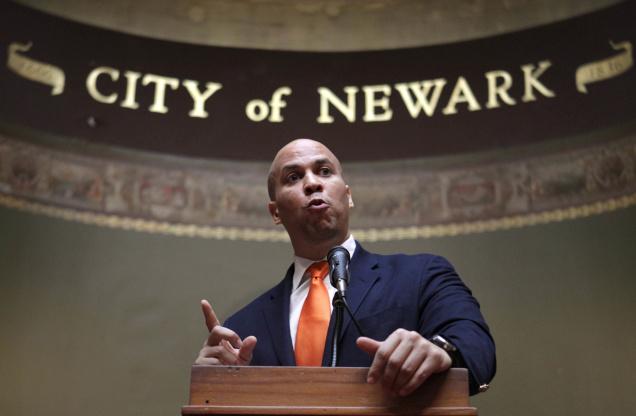
Today’s post is on the furore generated by Newark Mayor Cory Booker’s recent comments on last weeks’ NBC Meet The Press show, in which he appeared as a surrogate for the Obama reelection campaign.

When asked about attacks originating from the Obama campaign and aligned PACs, attacking Mitt Romney’s record at Bain Capital, Mayor Booker essentially said that those attacks were an unfair and unnecessary distraction from the real issues of the election:

“To me, it’s just this — we’re getting to a ridiculous point in America, especially that I know. I live in a state where pension funds, unions and other people are investing in companies like Bain Capital. If you look at the totality of Bain Capital’s record, it ain’t — they’ve done a lot to support businesses, to grow businesses.”

For those unfamiliar with the maelstrom of ridiculousness, accusation, counter-accusation, retraction and non-retraction that these innocuous comments generated, the consequences are related in amusing style by Kathleen Parker at The Washington Post.

Though really if you have taken in any American political news over the past week or so, you can hardly have failed to have heard about this story from one source or another. And in terms of the “press coverage to newsworthiness ratio” mismatch, this story scores quite highly.

As far as I can tell, despite all of the noise and column inches that this “story” has generated, most reasonable people could agree with the following sentiment: that there is nothing wrong with private equity – well, no more than what is right or wrong with any other industry – and the Obama reelection campaign has not publicly suggested otherwise.

No for-profit business is run for the sake of creating jobs – that just happens to be a fortunate side effect of growth and success, and private equity plays an important role in ensuring that capital is allocated most quickly and efficiently to those enterprises that can generate the best return on it. I don’t recall Mayor Cory Booker attacking private equity, capitalism and the American dream when he went on Meet The Press last week, nor Obama himself (though the Obama campaign and associated PACs and campaign surrogates have certainly crossed this line on occasions).

So what exactly is wrong with saying that attacks on private equity are nauseating? It may be a rather strong choice of words, but attacks on private equity are certainly irrelevant. And saying so does not blow apart Obama’s central campaign issue, as many conservative commentators seem eager to believe.

If we leave out the words of the Super-PAC political ads (and really we have to – on both sides, be they Republican and Democrat aligned – because they are loose cannons, unconnected with the campaigns and able to say anything they please regardless of the views of either candidate), what the Obama campaign is trying to point out is that a successful career in private equity is not of itself either a qualification for, nor indication of success at the presidency. Incidentally, one could (and many have) made the same argument about a career in community organising and constitutional law teaching.

Quite a few people work in private equity. And many more people – including ‘normal’ people, through their savings and investments and pensions – benefit from the work that these people do. Having a successful career in private equity does not of itself qualify someone to be President of the United States – it is a hard job, and probably nothing short of a previous stint as Head of State of another powerful nation really qualifies you for it.

And so if the Obama campaign wants to try to draw a contrast between the president’s four years of on-the-job experience and Mitt Romney’s lack thereof, that seems fair enough (though the old “don’t change horses midstream” argument is rather old and worn at this point, especially after George W. Bush’s reelection campaign), and as long as he avoids straying into “the corporations are raping the world” territory he should be allowed to make that point without being jumped on and labelled an anti-capitalist reactionary.

This seems to me like a big fuss about nothing – after eight days, let’s finally move on from this one now.