UKIP Are Not The Ones Playing Politics With The Armed Forces

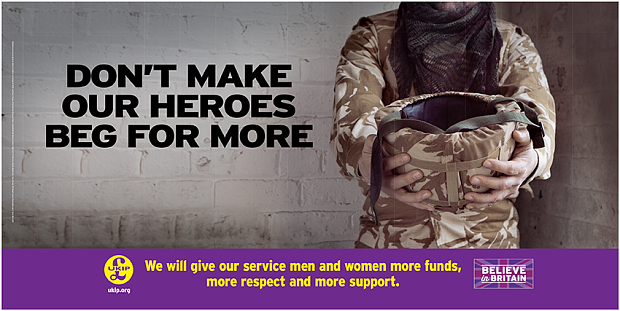
UKIP General Election 2015 Poster - Armed Forces - Dont Make Our Heroes Beg For More


UKIP’s latest election campaign poster is quite striking, and not just because it has none of the bland, derivative unoriginality that marks out Labour’s feeble effort to capitalise on public fears about ‘our NHS’.

The body shot of a soldier in camouflage gear, holding out his helmet as though asking for a donation, with the words “Don’t Make Our Heroes Beg For More” should prick the consciousness of the nation – in Britain we do far too little to fund our national defence, honour those who currently serve in uniform and support those who have borne the burden of keeping us safe.

The BBC summarises the UKIP announcement on defence:

UKIP has set out its defence policy, including a new independent veterans’ minister and a national defence medal for all members of the armed forces.

It would also cut foreign aid in order to spend 2% of GDP on defence.

The party said there was “not a cigarette paper” between the defence policies of the Conservatives, Labour and the Lib Dems.

Sadly, not everyone sees UKIP’s announcement as a good thing. The Conservative Party, perhaps having finally rediscovered their sense of shame at the way they have squandered their traditional position as natural party of the armed forces, has gone firmly on the attack, accusing UKIP of “playing politics” with the topic of defence.

From the Daily Mail:

A Conservative Party spokesman said Mr Farage was ‘playing politics with the military in a calculated and completely irresponsible way’.

He added: ‘We’ve balanced the defence budget after inheriting a truly enormous black hole from Labour. We have the second largest defence budget in Nato after the United States and will spend over £160 billion in the next decade on new military equipment.

‘It comes down to this: you can only have strong armed forces if you have a strong economy first. That’s exactly what this Government is delivering. Ukip would put that at risk – making it up as they go along and letting Ed Miliband into Downing Street by the back door.’

In truth, UKIP are not so much “playing politics” with defence as they are being the only party bothering to talk about what should be a central issue in 2015. Can UKIP really be blamed for daring to bring up the British government’s shameful neglect of our armed forces and military capability when the other major political parties are determined to bury their heads in the sand? Can Nigel Farage really be accused of political opportunism for bringing up an important topic for public debate when David Cameron and Ed Miliband would rather pretend that the issue did not exist?

Continue reading

A New Argument Against Defence Cuts

troopingthecolour
Maybe they can fill out the ranks with some extra CGI characters.


When even this Conservative-led government is willing to degrade the military capacity of our nation, it has been understandable to despair of anyone in British politics other than Defence Secretary Philip Hammond continuing the argument for a strong, fully-capable armed forces.

Arguments against making experienced veteran soldiers redundant while flashy recruitment drives for new recruits clog the airwaves have fallen on deaf ears, as did the arguments against leaving Britain without full aircraft carrier capability until the new Queen Elizabeth class ships are commissioned. But now a new argument against further cuts to the military may succeed – and it is, of course, the least important or relevant of them all.

The Telegraph reports that additional cuts to the armed forces could impair their ability to carry out ceremonial functions such as Trooping the Colour or participating in state funerals:

Cuts to the armed forces are threatening to undermine the pageantry and pomp of Britain’s biggest ceremonial events, one of the Army’s most senior officers has warned.

Garrison Sergeant Bill Mott, who oversees all major ceremonial events, says he is now struggling to produce the “same spectacle” as the armed forces have shrunk.

His comments are likely to prove especially sensitive as Prince Harry is now a staff officer in the same district as Mr Mott, with a responsibility for helping to organise ceremonial events.

The Telegraph’s source is highly experienced and not prone to hyperbole:

Over the past 12 years Garrison Sergeant Major Bill Mott has overseen every major ceremonial event in London including the royal wedding, Baroness Thatcher’s funeral and the tradition of Trooping the Colour.

However, Mr Mott told Defence Focus, an internal Ministry of defence magazine, that soldiers are “gritting their teeth and getting on with it” in the face of the cuts.

I wonder if this approach might actually work. Since the memory of the Falklands conflict seems to have evaporated from the minds of most people, and a large segment of the population equates maintaining a strong national defence with a desire to embark upon new neo-conservative inspired nation-building jaunts abroad (when in fact there is no reason for the two to be linked), there has been no real attention-grabbing or compelling argument to make in favour of ring-fencing defence spending. Until now.

If this is what it takes to wrestle back the momentum and initiative in favour of protecting military spending, then I’ll take it. But it will not speak highly of the British people if we prove to be more concerned about our future ability to stage a Princess Diana-style funeral than we are our ability to protect ourselves and defend our interests.

A Disservice To Our Military

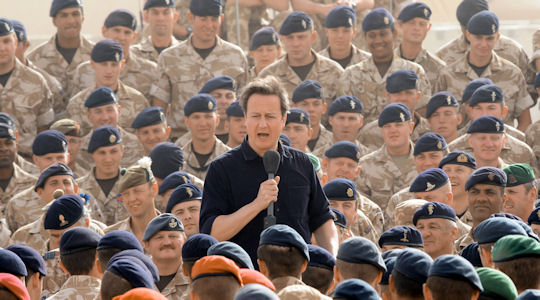
British Prime Minister David Cameron (C)

The Daily Telegraph’s Con Coughlin writes today about the terrible incident in Afghanistan where a US soldier went on the rampage in an Afghan village, killing sixteen civilians, including a number of children.

I read the piece with interest, but the author makes a couple of throwaway comments that I found quite disrespectful. At one point Coughlin writes:

“We all know that soldiers, without the proper training and discipline, can easily degenerate into a murderous rabble that terrorises the local population. We have seen this happen hundreds of times in Africa where armies are no different from the militias who rape, murder and loot at will.”

This is unnecessarily harsh language to use with respect to the armed forces. Are there countless cases where this has happened in various conflicts around the world, yes. But to suggest that the only thing separating the British or American armies from being a ruthless militia with no morals is essentially a PowerPoint presentation on coping under stress is rather glib. He then follows this up with the following:

“After six British soldiers were murdered last week in southern Afghanistan when they were blown up by one of the Taliban’s roadside bombs, it is easy to imagine the murderous thoughts of revenge their fellow soldiers are today feeling towards the Taliban. But the reason they don’t pick up their guns and walk into the neighbouring village and massacre every Afghan they can find is the strict training they receive before they are deployed.”

Excuse me? I’m sure that the fellow soldiers mentioned here are full of many feelings of sadness and anger following the deaths of their colleagues, but I would submit to Con Coughlin that as well as the fact that they received strict training before they were deployed, another reason that they don’t “pick up their guns and walk into the neighbouring village and massacre every Afghan they can find” is because they are decent human beings with the intelligence to understand not only that the general civilian population was not responsible for the deaths of their comrades, but that to do so would make them no better than the forces that they are fighting. To say otherwise, and to suggest that there is little to separate the vast majority of soldiers who are decent and brave individuals from the deranged Staff Sergeant who perpetrated this massacre is not only wrong, but frankly offensive too.

I also don’t think I am imagining things when I detect undertones of class-based superiority from the author, that maybe he views the British soldiers as slightly dim and uneducated, less capable of reason than the average, middle-class Telegraph reader, and therefore in need of this strict training to ensure that their baser, more violent instincts do not come to the fore under stressful circumstances.

It amazes me to observe the difference in tone in terms of how the armed forces are talked about in Britain compared to the United States. Such an article would never have been written by a commentator in the United States, where even President Obama’s apology to the Afghan people for the accidental burning of the Koran by US forces was met with strong criticism, so above reproach is the US military to some on the right.

Honestly, I don’t believe that either country has it quite right. In the United States, I admire how serving soldiers and veterans are acknowledged and given respect in public places such as airports (where they are allowed to stay in USO club lounges while they wait to board their flights) and sports games, where they are frequently applauded before the game. However, sometimes I feel that the almost-worship of the armed forces goes too far, with all returning soldiers being labelled “heroes” whether or not they have seen active combat.

In Britain, on the other hand, I don’t think that we do nearly enough to acknowledge the contribution that our military servicemen and women make for our country, projecting our nation’s force to implement our foreign policy objectives. Hence we see serving soliders being refused permission to stay at an hotel because of an unbelievable “no military” policy, and London’s most sacred war memorial being desecrated by the spoiled, self-entitled son of a rock musician.

But while both of our countries may have some way to go in terms of striking the correct balance in terms of how we view, treat and discuss these topics, I would hope we can all agree that there is a lot more preventing the good men and women of our nations armed forces from becoming mass murdering militias than the training that they receive, important though that may be.