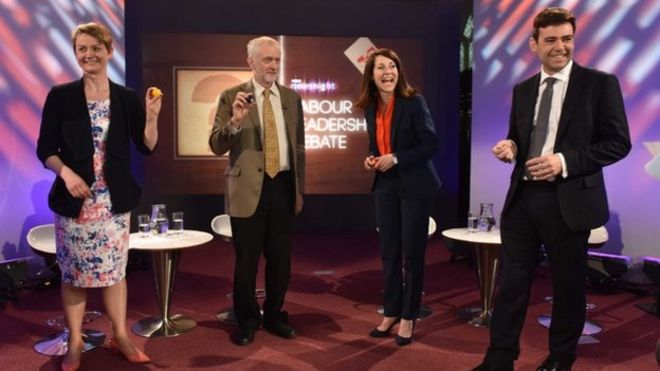
Anyone hoping that Labour Party’s haemorrhaging of northern votes to UKIP or the EU’s sacrifice of Greece to preserve the Euro might lead to a reconsideration of Labour’s reflexive, metropolitan pro-Europeanism must be sorely disappointed with the four candidates jostling for the honour of leading the party to defeat in 2020.
Although there is a groundswell of euroscepticism building across the country – and even though many prominent left-wingers are now calling for “Lexit”, including the ubiquitous Owen Jones – those who aspire to lead the Labour Party remain wedded to their desperate belief that the EU is somehow good for Britain.
Even as the contrary evidence mounts and public pressure for a left-wing eurosceptic political outlet grows, the Labour Leadership candidates prefer to stick to their increasingly hollow-sounding scripts, proclaiming the dubious virtues of political union and the supposed horrors that would befall Britain if we were to regain our independence.
This much became clear during the LBC radio Labour Leadership hustings, when a certain “Nigel from Kent” (yes, that one) phoned in with a question, asking the candidates whether there were any scenarios in which they could envisage campaigning for Britain to leave the EU and voting “no” in the Brexit referendum.
TRIGGER WARNING: This article is a polemic. If you are a Labour supporter who likes accusing the Tories of cruelty and moral deficiency but can’t take criticism in return; if you ostentatiously signal your own virtue by policing the public discourse for “unacceptable” words and ideas while turning a blind eye to appalling real-world actions; if you think that welfare reform is “divisive” but railing against “the bankers” (meaning anyone who works to earn a good salary) is A-OK; if you think Ed Miliband was a visionary leader, ahead of his time and ultimately just too good for this unworthy country – then read on at your own risk.
PRINCIPAL TRIGGERS: Unapologetic conservatism; belief in a higher power other than the state; schadenfreude; gloating; mockery; sarcasm; deliberate overstatement; forceful language; general failure to provide a safe and non-judgmental space for processing the 2015 general election result and the scale of Labour’s defeat.
Fair warning.
And so, not with a bang but a self-righteous whimper, Labour is collapsing from within, the party of Kier Hardie and Ramsay MacDonald publicly reducing itself to a smouldering heap of dark recrimination, bitter contempt for the electorate and tiresome more-compassionate-than-thou moral posturing.
This slow-motion, socialist car crash is utterly transfixing, especially because the man who led Labour to ruin, Ed Miliband – and many others – seriously believed he would now be prime minister of the United Kingdom, right up to the moment the exit polls dealt a deadly dose of reality. Now, it is not even certain that the party will survive to fight the 2020 election without having first splintered into warring People’s Front of Judea / Judean People’s Front factions.
Hot off the press, we have the Labour Party’s next proposal to make Britain a happier, fairer, more green and pleasant land. Operating under the twin delusions that fastidiously tweaking laws will affect the behaviour of people who hold the law in zero regard in the first place and that there is no bad thing in the world that cannot be quickly put right through national legislation, Labour have decided that their path back to power lies in demonising adults who smoke in cars when minors are present, and vowing to include a pledge to Save The Children in their general election 2015 manifesto unless the coalition government takes action first.
The shadow health secretary, Andy Burnham, said Britain should follow the example set by Australia, Canada and a number of American states.
He told Sky News, “When it comes to improving the health of children, we are duty bound to consider any measure that might make a difference.
“Adults are free to make their own choices but that often does not apply to children and that’s why society has an obligation to protect them from preventable harm.
“Evidence from other countries shows that stopping smoking in the confined space of a car carrying children can prevent damage to their health and has strong public support.”
I have no doubt that there may often be strong public support for not smoking in cars carrying children as Andy Burnham says, but he cleverly does not say whether or not there is equally strong support for actually legislating on the matter. Besides, if you are going to ban something it is generally best to have the means of monitoring compliance and enforcing the ban, significant details which are not mentioned in the amendment. Will a new branch of the British Transport Police be established to watch out for the tell-tale glow of a lit cigarette end in the presence of a child? And is the threat of a £60 penalty really going to change public behaviour?
If someone is so foolish as to smoke their child like a side of bacon in the car on the morning school run, the sad reality is that the unfortunate child is likely to come a cropper at the hands of their inept parents one way or another regardless of any heroic feats enacted on their behalf by a future Labour government. The dangers of second hand smoke have acquired such apocryphal universality that they are known by people who outwardly seem to know very little about anything – people who know nothing about nutrition, for example, can crack a “this counts as one of my five-a-day” joke when helping themselves to a strawberry jam doughnut or (in my case) a roll of Rowntree’s Fruit Gums.
People who subject their children to second hand smoke in the claustrophobic confines of a car know exactly what they are doing, and if they aren’t actively encouraging their children to poke metal objects into the electrical outlets at home then they almost certainly come close to that level of dereliction of parental duty in other areas as well.
Andy Burnham and Luciana Berger are clearly intent on proving themselves the “true guardians” of child safety, unlike the callous, horrible old Tory government. But there is only so much that members of Parliament, the police and the judiciary can do in their taxing role as parents-of-last-resort to a nation that is happy to keep breeding but less sure of how best to deal with the results and that awkward business of raising children.
Some acts are so evil, heinous or injurious to the public good that criminalising them is right and proper, and one of the correct functions of the legislature is to make sure that criminal law keeps up with these activities. And some other things are just plain stupid, and common sense tells any person in their right mind that to do those things would be ridiculous. Hermetically sealing your child in a vehicle and exposing them to tar and nicotine is just such a thing. The social disapprobation and public shunning of people who make their children passively smoke in cars is more of a deterrent than a £60 fine.
But while I have dwelled on the detail, Andrew Brown, writing in The Telegraph, gives the bigger picture reason why banning smoking in cars is not as noble or clever as its proponents make out:
There is a vital principle at stake: do we really want to live in a country where the state interferes to this degree in the minutiae of people’s daily lives and in private spaces like cars? The claim about protecting children is really just a Trojan horse to disarm opposition, as passive smoking was. Once people were persuaded that there was a risk of “passive smoking” (even though the risk is minimal or non-existent) then it was far easier to justify the smoking ban. If a law banning smoking in cars were to be passed, and the principle of “protecting third parties” conceded, where would it end? There would be no logical reason why the government couldn’t prohibit smoking in people’s houses where children are present. The public may tell pollsters that they support this kind of law, because it might sound plausible, but politicians have a responsibility to hold back the creeping tentacles of the meddling nanny state, not think up new ways to persecute private citizens.
Precisely. And if we really do need a Labour government to tell us that it might not be wise to give our children lung cancer and threaten us with slap-on-the-wrist penalties for doing so, then they have already achieved the kind of docile, unthinking, collectively dim and dependent society for which they sometimes – as they have done again today – so clearly and loudly agitate.



 Semi-Partisan Politics