UKIP Panic Sets In

Nigel Farage UKIP voting


Yesterday I wrote about the rise of the UK Independence Party (UKIP), and the way in which they have transformed themselves over just a few years from being an upstart fringe party full of “fruitcakes and closet racists” (thanks, David Cameron) into a populist, compelling electoral force to be reckoned with.

I set out the reasons why I think that UKIP offer a compelling manifesto, and how they may well escape the usual fate suffered by smaller parties in general elections, i.e. falling back into obscurity, single-digit vote shares and zero parliamentary representation.

Evidently other people see the writing on the wall for the traditional Labour/Conservative/LibDem trifecta too, and none do so with more trepidation than loyal-but-ideologically-compromised traditional Conservative supporters, who rather than re-examining and changing their own faulty policies would rather destroy the newcomers who make them look bad by comparison.

Cue this hit piece from Mary Riddell, writing in The Telegraph. She thunders:

So consider, this morning, what a Ukip Britain would look like. it would be a locked-down land, armed to the hilt, where good foreigners were repelled and bad ones expelled, no questions asked. It would be a country concreted over for extra jails (though never for high speed rail lines). It would be a quaint place – an old curiosity shop of matrons and smoking rooms.

It would be a nation of wild spending, of derisory taxes for the rich and – not least because all talk of climate change would be abandoned – a country programmed for ruin. Welcome to Mr Farage’s Britain.

That future should not only alarm Ed Miliband. It should horrify us all.

More insidiously, she continues the old-guard Tory attempt to paint UKIP as the British National Party in a pin-stripe suit disguise, warning:

Moreover, today’s results are the first sign that Britain is far from immune to the lurch towards extremism that has shadowed other European countries and been exacerbated by recession. For sure, Ukip is no Golden Dawn and Mr Farage no dangerous rabble-rouser. Even so, his party’s performance invites comparison with the progress made by Marine Le Pen’s Front National in France.

If UKIP is no dangerous party and it’s leader no Jean-Marie or Marine Le Pen, why is Liddell then inviting comparison with those very same people and entities? Such a heinous accusation, so innocuously put. And of course the answer is as obvious as the motive of her rhetoric is tawdry – you can put two groups together in the same sentence and protest loudly that you are not comparing one with the other, but all that people will take away and remember is that UKIP and the far right are somehow associated.

Note also the total lack of any evidence to back up her words. Is Mary Riddell being serious? From where is she conjuring this nightmarish dystopia of a UKIP-ruled Britain? Certainly not from their own manifesto, which reads like a broadly libertarian (though a touch too socially authoritarian) set of policies that many Tories and centrists could get behind.

If she is choosing to smear UKIP based on some of their whackier supporters or representatives, she should remember that less mature parties have a harder time screening their candidates as they work to develop a national presence, and that there are plenty of thoroughly cringeworthy people in the Conservative, Labour and Liberal Democrat ranks, too.

I was a UKIP doubter once, but now I’m not so sure. Their advocacy of smaller government, more competition and less regulation in both private and state sectors, and a flat tax are all very appealing to me. If the Conservative Party and their allies in the right wing media want to keep my loyalty and win my vote at the 2015 general election, the surefire way to fail in that task is to tell me that I am an ignorant reactionary being seduced by a borderline nationalist outfit favoured only by curtain-twitchers, closet racists and little-Englanders.

Mary Liddell and her ilk would do well to remember that.


UPDATE (16.25PM) – I took a closer look at the article byline and realised that Mary Riddell is actually a Labour supporting journalist, so my mistake. Of course, she has her own reasons for wishing to bash UKIP. What actually makes my misunderstanding funnier, and even more pertinent, is that her words could be so easily confused with those of any right-leaning journalist or commentator wringing their hands at the rise of UKIP.

Why Politicians Are Hated, Ctd.

OLYMPUS DIGITAL CAMERA


I wrote yesterday about the scourge of the newly-minted career politician, and the damage that this particular breed of “public servant” is doing to the perception of politics in the United States and the United Kingdom.

I received a rather surprising amount of feedback on this piece, both in support and in dissent, so I thought it worth my while to clarify and expand upon my position.

My point was not that all young politicians or wannabe politicians are bad people, or that they are bad for our politics on an individual basis. There are many examples of young MPs or congressmen who do fine work on behalf of their constituencies or districts, and who go above and beyond the call of duty to champion important issues and causes. For evidence we need look only at the work of Labour MP Stella Creasy in her campaign to crack down on illegal loan shark activities in Britain, or Patrick Murphy, US congressman from Florida, who was so incensed by some of the extremist rhetoric coming from the mouth of his then-incumbent representative, Tea Party favourite Allen West, that he switched party affiliation from Republican to Democrat to run against him.

The point is not that being young and untested in the world makes one automatically unfit for public service. The point is that because the overwhelmingly predominant route into political office now favours people such as this – especially those who find themselves in the fast track to even higher office and power – we end up with a type of uniformity of temperament and experience in our legislatures and executives that can be quite damaging.

Many people remarked, after the death of Margaret Thatcher, that the age of the conviction politician is now over. And this is largely true. Those who remain tend to be the old dinosaurs from the past, and even they are dying out or retiring. Ted Kennedy, the “liberal lion” senator from Massachusetts, is dead. Glenda Jackson, my local constituency MP for Hampstead & Kilburn in London, is retiring at the end of this parliament.

There is, at least in the United States, a countervailing force against the move away from conviction politics in the form of the Tea Party. I happen to find their particular convictions rather false and opportunistic (ObamaCare is socialism but MediCare is great, government spending is terrible, but we only just realised this in the Age of Obama…), but there is nonetheless that sense of ideological purpose underlying what those politicians say and the way in which they vote. A better example might be the more principled small government libertarianism of former Texas congressman Ron Paul, and his son, Kentucky senator Rand Paul.

And in the United Kingdom, the UK Independence Party sent shockwaves through the British political establishment after their recent successes in the local council elections in England, largely because they campaigned as the Conservative Party But With Principles, rather than on a continually-triangulating, consensus-seeking David Cameron Tory platform.

I also received feedback from other readers telling me that “hated” is a rather strong word, and that people tend to be indifferent to politics rather than truly hating it. This is a fair point, to a degree – many people are so zoned out and entranced by the world of reality TV and other inane distractions that they just don’t know or care about politics, and are unable to connect the dots and understand how political decisions impact their lives.

But having stood on the main street in my town, campaigning with my hometown MP in the run-up to the 2010 general election, I can also say with absolute certainty that there is a deep contempt, and yes, hatred, that goes well beyond mere indifference to what goes on in Westminster or Washington. As I spoke to members of the public on the street and handed out campaign literature, there were many people who expressed their revulsion against politicians of all parties, and were happy to back up their arguments with a litany of (sometimes rather irrefutable) reasons why.

When I first started work I sat next to a stridently anti-political man at my office, and had terrible trouble convincing him that some politicians were really motivated by the desire to do good, and in fact were not engaged in the devil’s own work. When our argument spread to the wider office, I found myself firmly in the minority.

The fact remains that in both the United Kingdom and the United States, we have gravitated toward a system where the path of least resistance toward high political office favours the young career politician who has no real prior experience in the world, and little intention of ever doing anything else (aside, perhaps from a lucrative lobbying position should they be unlucky enough to lose their seat).

These people are not necessarily worse than the various other breeds of politician in the Westminster/Washington zoo. But too much of any one species tends to upset the ecosystem, and that is exactly where we find ourselves today – with too many carp in the fish pond.

Music For The Day

A beautiful arrangement of the spiritual “Deep River”, which forms the finale of the cantata / secular oratorio “A Child Of Our Time” by British composer Michael Tippett. Performed here in my favourite recording of this piece, given by the London Symphony Orchestra, conducted by Richard Hickox:


And from the same work, Tippett’s arrangement of “Steal Away”:


More about Tippett’s “A Child Of Our Time” can be read here.

Best Thing Of The Day

The satirical newspaper and website The Onion can be somewhat hit-and-miss these days, but the other day they posted one of their best articles in years. In terms of sheer whimsy and surrealism, I don’t think it can be beaten, at least not since the hilarious George W. Bush pieces that they posted in the waxing days of his presidency.

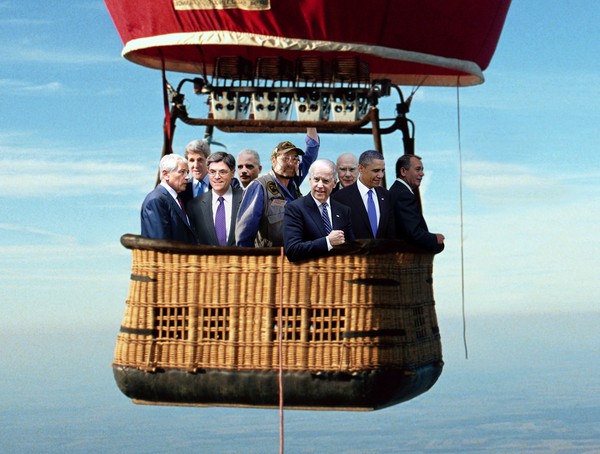
In their latest piece, The Onion report that Secretary of the Interior, Sally Jewell, has been sworn in as the nation’s first female, and 45th president of the United States, after President Obama, Joe Biden and the next six in line to the presidency were killed in a tragic hot air balloon disaster.

I quote at length:

WASHINGTON—Secretary of the Interior Sally Jewell was sworn in today as the 45th president of the United States, reciting the oath of office in a brief ceremony at the White House and expressing her continued disbelief that the president, vice president, House speaker, president pro tempore of the Senate, Secretary of State, Secretary of the Treasury, Secretary of Defense, and attorney general were all in that hot-air balloon together.

Speaking to citizens in a short inaugural address, Jewell, a 57-year-old Seattle businesswoman who was confirmed as Interior Secretary less than three weeks ago, acknowledged the challenges ahead for the nation and noted how “really quite strange” it was that Barack Obama, Joe Biden, John Boehner, Patrick Leahy, John Kerry, Jacob Lew, Chuck Hagel, and Eric Holder mutually agreed to take the day off and rent a hot-air balloon for the afternoon.

“It is with both humility and gratitude that I assume this office, while extending my deepest condolences to the families of Barack Obama and the seven government officials directly before me in the presidential line of succession, who, for reasons that still aren’t entirely clear, decided to drive together to a fairground outside Washington and take a two-hour hot-air balloon tour of the Virginia countryside,” Jewell said in her speech, delivered less than a day after the country’s top politicians reportedly agreed on a whim that a communal balloon ride would be “a lot of fun.” “I never expected to be in this position, especially not under circumstances in which our nation’s highest leaders died on the same day in an accident involving a hot-air balloon, which, for some reason, all eight of them willingly piled into even though it was clearly posted that the maximum occupancy was four. You have to admit, it’s very bizarre.”

The Onion's Fictitious Hot Air Balloon Disaster
The Onion’s Fictitious Hot Air Balloon Disaster

And what a great feat of photoshopping too. The article continues:

According to Jewell, adding to her bewilderment was the fact that the men were neither barred from the outing nor even moderately discouraged by aides or Secret Service agents. Rather, reports indicate that members of the officials’ security details simply smiled and happily waved to the two highest officeholders of the executive branch, the two leading figures in Congress, and four top cabinet members as they crowded into the balloon’s basket and began to ascend.

“What’s particularly odd is that these officials weren’t even ordered into the balloon by President Obama; it was Chuck Hagel’s idea, and everyone else readily went along with it of their own will,” said President Jewell in front of framed portraits of the deceased men. “And given that the president and vice president aren’t even allowed to fly in the same plane for safety reasons, it’s truly shocking that, instead of reconsidering their actions when John Kerry had a brief moment of trepidation before stepping aboard, they all just said, ‘It’s fine! You’re going to love it!’”

“And the next thing you know, there they are, rising to 500 feet in that cramped, bulging basket, smiling and laughing without a concern in the world,” Jewell added. “Looking at it now, it all seems incredibly foolhardy, if not almost entirely improbable.”

This stuff is just priceless. The Onion and The Daily Mash continue to be two of the best, most amusing websites in existence today.

Why Politicians Are Hated

On Tuesday, voters in South Carolina’s first congressional district will go to the polls to choose whether they want to elect Elizabeth Colbert Busch, a Democrat, or Mark Sanford, a Republican.

Mark Sanford was formerly the governor of that same state, a career politician, who was forced to leave office in June 2009 after explosive details of an extra-marital affair gave him too many of the wrong kind of newspaper headlines. However, after a short time in the political wilderness, he felt the need to return to the world of political power, and won the Republican nomination to run in the election.

The voters of the first congressional district did not look kindly on Sanford’s early attempt at redemption, and he is almost certainly likely to lose what was otherwise an eminently winnable seat for the Republicans on polling day.

Two things stand out here – first, the stupidity of the state Republican Party that they would nominate such a flawed candidate. But second, and most important, is what Mark Sanford represents. He is the epitomy of a career politician, whose whole life was about gaining political power, and who is totally unable to contemplate a career doing anything else. Oh, he may waffle about “devoting himself to public service” and suchlike, but it is self-serving nonsense. His career was, and is, about power, the pursuit of political power, and nothing else.

And it is precisely this phenomenon of the ubiquitous career politician which explains why people are so thoroughly disenchanted with politics and politicians today. Here in Britain, and evidently in the United States too.

Ask a typical voter (or non-voter, as these often make up more than half of our potential electorate) what is their idea of a typical politician, and you won’t hear a rapturous description about some incredibly well-credentialed person, someone who has a proven track record of success in their life, someone who has been a part of their community, who understands and knows and talks with people from all walks of life, and who was called to politics to try to accomplish something for the good of their fellow people and their nation, and who intends to do their part and then go back to living their life.

No.

The typical voter, once they swallow the bile that rose into their throat upon hearing your question, is more likely to paint a picture of an oily, self-entitled oik who got into politics for the power and trappings associated with it, who is intent more on climbing the greasy pole of power rather than serving their constituents, and who intends to cling to their position for as many elections and terms as they can possibly get away with, health and lack of scandal permitting.

In other words, there is no concept of the citizen-politician any more. Perhaps in Britain there never was, at least not in the modern age, but throughout American history one can see many examples. Look no further than the father of the nation, George Washington, who not only rejected entreaties for him to become a king-like figure to be addressed as “Your Majesty”, but finished serving his presidential term before retiring to his home and his farm.

You don’t get that with today’s class of professional politicians. Sadly, the well-trodden route taken by today’s slick young political wannabees is almost unvarying from candidate to candidate.

In Britain it looks like this:

1. Ingratiate yourself with your chosen political party’s university society, and start climbing the ranks. On day one of your first term. Get on committees. Make friends with the influential people.

2. Outside of your political society and party political affiliations, be as dull as possible. For heaven’s sake, don’t entertain any foolish notions of doing anything controversial, or exciting, or distinguishing, or any of the things that students should do. You can have no black marks on your resume when the time comes.

3. Graduate and move into a boring job. The law will do nicely, as you won’t be short of opportunities to make powerful new connections.

4. Join the local party association wherever you live, and get involved. Very involved. Attend all the meetings, all of the garden parties, all of the school fairs and church bake sales (if you do church – no longer required or admired). Try to become a school governor if you can, or get onto the board of a local charity. You are now Involved In The Community.

5. Schmooze. Schmooze, schmooze, schmooze. Climb the ladder. Think about trying to become a parliamentary researcher or assistant for an existing MP if you have the connections, or join a  “think tank”. Write lots of articles for anyone who will publish them. It doesn’t matter if they are any good or not.

6. Get selected as the party’s candidate. It doesn’t matter if it’s an unwinnable seat the first time, you are still building your profile. Campaign hard, and ultimately win at all costs.

7. Congratulations, you’ve been elected to parliament. Now you can choose whether to climb the ladder within your parliamentary party and try to get a cabinet position, or just relax and be a constituency MP. But why would you want to do that? Your whole life has been a continuous glide toward the Palace of Westminster, and you sure aren’t about to take your foot off the accelerator now.

And so we have a whole generation of MPs from all parties – people like Chukka Umunna – who are basically airbrushed, well-groomed and telegenic candidates who never really lived in the real world before entering politics and who have no idea what they would do with their lives if they ever had to leave it. Umunna likes to style himself as “the British Barack Obama”. He is not. Like or dislike Obama, he does possess significant leadership and rhetorical skills, and did his fair share of work in the community before his rapid ascent through the political ranks.

An important point here – we should not look to deify private sector experience above all else as Mitt Romney tried to do in the 2012 US elections. Running a government is not the same as running a private enterprise, and different skills and experiences are needed. Success in the private sector does not automatically lead to success in the public sector, and vice versa. So it is not my contention that we should be looking exclusively at corporate C-suites or the ranks of entrepreneurs for our future political leaders. There are people who have served the community deeply in many ways, who are capable of becoming excellent legislators and political leaders.

But neither should we be looking for the next bland, cookie-cutter candidate who has gone through the 7-step “become an MP by the age of 35” programme. If a candidate’s life up until that point has been all about gaining political power, what chance is there that they will ever want to relinquish it and do anything else after their first term? Their second? Their third? Their fourth? Until retirement beckons?

Thus, without term limits we end up with the same boring old faces hanging around forever, and with them a dearth of new ideas.

In South Carolina, voters are about to reject Mark Sanford’s attempt at early political redemption because they do not recognise that he has a divine right to be a politician forever and ever, until he dies, simply because that is what he wants to do with his life.

In a democracy, we get the politicians and leaders that we deserve. Let’s stop deserving bad ones.