The Only Thing Paul Mason Hates More Than The EU Is Democratically Chosen Conservative Government

Paul Mason - 2

Paul Mason, enemy of democracy

“Postcapitalism” author and former Channel 4 economics editor Paul Mason is a truly nasty piece of work. For proof, one need only look at his latest sickening column in the Guardian, in which he diligently catalogues all of the European Union’s faults and inherent anti-democratic tendencies before going on to say that he can’t possibly support Brexit when the Tories are in charge, because doing so might mean that some awful right-wing people get to implement policies democratically chosen by the British electorate.

Mason begins well enough, albeit with a predictably left-wing slant:

The leftwing case for Brexit is strategic and clear. The EU is not – and cannot become – a democracy. Instead, it provides the most hospitable ecosystem in the developed world for rentier monopoly corporations, tax-dodging elites and organised crime. It has an executive so powerful it could crush the leftwing government of Greece; a legislature so weak that it cannot effectively determine laws or control its own civil service. A judiciary that, in the Laval and Viking judgments, subordinated workers’ right to strike to an employer’s right do business freely.

Its central bank is committed, by treaty, to favour deflation and stagnation over growth. State aid to stricken industries is prohibited. The austerity we deride in Britain as a political choice is, in fact, written into the EU treaty as a non-negotiable obligation. So are the economic principles of the Thatcher era. A Corbyn-led Labour government would have to implement its manifesto in defiance of EU law.

And the situation is getting worse. Europe’s leaders still do not know whether they will let Greece go bankrupt in June; they still have no workable plan to distribute the refugees Germany accepted last summer, and having signed a morally bankrupt deal with Turkey to return the refugees, there is now the prospect of that deal’s collapse. That means, if the reported demand by an unnamed Belgian minister to “push back or sink” migrant boats in the Aegean is activated, the hands of every citizen of the EU will be metaphorically on the tiller of the ship that does it. You may argue that Britain treats migrants just as badly. The difference is that in Britain I can replace the government, whereas in the EU, I cannot.

This is fair and accurate criticism of the EU. Mason rightly senses the unaccountable nature of the supranational government in Brussels, and hones in on the key point – that the EU is antidemocratic because we have absolutely no way of removing its leaders if we wish to do so.

Unfortunately, it then quickly begins to go off the rails, as Mason’s snarling anti-democratic authoritarian streak surges to the foreground:

Now here’s the practical reason to ignore it. In two words: Boris Johnson. The conservative right could have conducted the leave campaign on the issues of democracy, rule of law and UK sovereignty, leaving the economics to the outcome of a subsequent election. Instead, Johnson and the Tory right are seeking a mandate via the referendum for a return to full-blown Thatcherism: less employment regulation, lower wages, fewer constraints on business. If Britain votes Brexit, then Johnson and Gove stand ready to seize control of the Tory party and turn Britain into a neoliberal fantasy island.

They will have two years in which to shape the post-Brexit economy. Worse, the Tories will be free to use the sudden disappearance of our rights as EU citizens to reshape the UK’s de facto constitution. The man who destroyed state control of education and the man who shovelled acres of free land into the hands of London developers will get to determine the new balance of power between the citizen and the state. So even for those who support the leftwing case for Brexit, it is sensible to argue: not now. The time to confront Europe over a leftwing agenda is when you have a Labour government, and the EU is resisting it.

Waah, waah, waah. In other words, Paul Mason fully appreciates that the European Union is hopelessly undemocratic and utterly unreformable, but he refuses to either campaign or vote for Brexit because reclaiming democracy for Britain might mean that we then go on to do the “wrong” thing with our new-found freedom.

Britain’s parliamentary system of government is not a shocking new reality. Our present system of mini “elected dictatorships” spanning the length of a parliamentary term is how Britain has always been governed in living memory. And unfortunately for Paul Mason, our electoral system produced a Conservative majority government one year ago. You can argue that most people did not vote for the Conservative Party. True. But if we don’t like the system by which our governments are chosen, it is within our power to change it. Indeed we had just such an opportunity back in 2011, and decided to stick with the status quo.

So when Paul Mason frets that a Brexit under the Tories might lead to two years of “neoliberal fantasy” government, what he actually means is that Britain might be led by the government which we only recently elected together. He is fretting that an anti-democratic impediment to Conservative rule in the form of Brussels might be removed, and that the government might then seek to fulfil its manifesto outside the constraint of the EU’s political union. He is effectively presenting democracy as the scary thing to be avoided, and the European Union as the “least worst option”, one step better than democratically chosen conservative government.

Mason then goes on to make it worse:

All this suggests that those of us who want Brexit in order to reimpose democracy, promote social justice and subordinate companies to the rule of law should bide our time.

And there’s the problem, right there. Paul Mason doesn’t support an eventual Brexit because he believes in democracy or the importance of British sovereignty. He wants Brexit only as a means to imposing his own radical left-wing policies and “social justice” values on the country. When the people look likely to support these concepts at the ballot box, he chafes at the democratic impediments thrown up by the European Union barring their implementation. But when the people spurn his left wing fantasyland and choose a conservative government, suddenly Brussels becomes his best friend, his bulwark against the people he views as “closet Nazis”.

Behold the face of the Mason/Corbynite Left. This is a movement which, to their credit, has no natural love for the European Union, often seeing it for what it is, but who have shamefully taught themselves to accept Britain’s EU membership as the price which must be paid in order to successfully “lock out” conservative viewpoints and policies.

This is a movement chock full of people who love nothing more than to prance around screeching about how wonderfully tolerant and accepting they are, right up until the moment they encounter somebody with a different political philosophy, at which point any previous lip service paid to the importance of democracy or even free speech goes straight out the window.

It’s hard to say  which is worse – the fact that Paul Mason harbours these seething anti-democratic sentiments in the first place, or the fact that he is so shameless that he openly admits his desire to thwart the general election result by forming a temporary alliance with the hated European Union, swinging around to support Brexit only when the prospect of giving democracy back to Britain seems likely to deliver the kind of government he wants.

One thing is for certain, though – Paul Mason is no man of the people, and no friend at all of democracy.

 

European Union - United Kingdom - Britain - Flags

Top Image: Guardian

Support Semi-Partisan Politics with a one-time or recurring donation:

Agree with this article? Violently disagree? Scroll down to leave a comment.

Follow Semi-Partisan Politics on TwitterFacebook and Medium.

Brexit For Grown Ups

Eurosceptic but tempted to vote Remain because of the Boris Johnson / Faragist circus that is the official Leave campaign? There is a better Brexit campaign out there, and they have a comprehensive plan for safely leaving the European Union which does not rely on trumped up statistics or school playground insults

Are you a eurosceptic or undecided voter who is instinctively sceptical of the European Union, but put off by the bombast and rank amateurism of the official Leave campaign?

Perhaps you sense that there must be a better campaign out there somewhere, that the well worn record of Nigel Farage and the ranting of Boris Johnson – a man who had not even decided which side he was on until a couple of months ago – cannot possibly make then the best ambassadors for Brexit.

Perhaps you appreciate that most of us already know and understand the reasons why the EU is bad, and that what matters now is convincing a majority of our fellow citizens that there is a safe and non-disruptive way to leave the political construct of the EU while maintaining, even enhancing, our status as a global trading nation.

If this describes you, then you may get value out of this excellent TED-style talk by Dr. Richard North of the eureferendum.com blog. The video comes from a recent meeting of The Leave Alliance at the Royal Overseas League in London, and is a great visual exposition of the comprehensive plan for leaving the European Union known as Flexcit or the Market Solution.

Read The Market Solution pamphlet here.

Read Flexcit (the full-length plan) here.

It is vital for people to understand that the coming EU referendum is not like a general election, or even a by-election. We are not voting to elect the Vote Leave Party – thank heavens. That means that although Vote Leave often say some fantastical and frustrating things, and continue to spout statistics which don’t withstand the slightest scrutiny and end up helping the other side, fortunately it doesn’t matter because Vote Leave will not be in charge of the secession negotiations with the EU.

The idiots in Vote Leave do not speak for the whole Brexit movement, and their half baked plans for leaving (such as they exist) do not represent the political realities. In reality – when you take into account the inherent caution of the civil service and the composition of the Westminster parliament which would have to deal with a Brexit vote (more than 50% Remainers) – Britain would inevitably take the path of least resistance and exit to an off-the-shelf EFTA/EEA model (or a shadow version of the same) as a stepping stone, maintaining single market access but giving Britain the right of reservation, an emergency brake on immigration (like the one David Cameron failed to win) and a full seat on all world bodies once again.

This is why Remainers are desperate to falsely discount the EFTA/EEA model as something that Brexiteers either do not want or which would mysteriously be denied us – for it annihilates at a stroke every last one of their doom-laden warnings about economic apocalypse in the event of Brexit, while freeing us from the explicitly political union which they seem to love but dare not publicly say so. Adopting Flexcit (the Market Solution) leaves the Remain campaign with literally nothing besides their fear of change and love of having a supranational government increasingly do the hard work of governing.

For in truth, there is no cooperation between European countries which cannot flourish just as well – and often much better – outside the EU’s explicitly political, integrationist structure. Be it defence, international aid or the environment, inter-governmental cooperation can be far more effective than running everything through a set of institutions in Brussels which were designed not to foster effective governance, but to gradually sideline and undermine the various member states, creating immense resistance and resentment along the way.

If one reads the history of the EU, one quickly realises that the founding fathers never troubled to hide their intent, or the fact that two world wars made them see the nation state as the root of all evil, and the EU’s supranational government as the “cure”. This is not a conspiracy theory – you can read it in their own words. To think that Britain can stay in the club and not be swept along to the final destination is denialist fantasy.

As for staying “globally relevant”, this blog and my fellow writers in arms ceaselessly point out that most EU trade rules are actually set by global bodies like UNECE, Codex Alimentarius, the IMO and other organisations. The EU often does not come up with these rules and regulations, but merely passes them along to the member states, sometimes with unwelcome EU gold plating and tweaks which actually act as an impediment to global trade. The EU is certainly no longer the “top table,” as Remainers love to claim.

That is the future of trade and globalisation – global regulation. Being in the EU means that Britain surrenders our seat or vote on these bodies, must fight to be just one of 28 countries contributing to a common EU position, and has no right of reservation to say no to those regulations which could harm key industries or our national interest. Perversely, sometimes the EU, claiming competency and controlling the British vote, wields that vote against us in these global bodies. Brexit means we can rejoin the global regulatory environment as a full and active player, while remaining in the EU is quite literally giving up and conceding that Britain no longer has the ability or the will to govern ourselves.

But worst of all, voting to Remain because of understandable disillusionment with the mainstream Vote Leave campaign will doom us – quite unnecessarily – to a dismal future lived cowering behind the EU’s skirts while the opportunity to build a genuinely global trading and regulatory framework passes us by.

And for what? Nothing more than the pointless pursuit of a dusty, mid 20th century blueprint for a united Europe, dreamed up by old men scarred by the memory of two world wars and already out of date, long before it is fully realised.

Europe has moved on since VE day. And euroscepticism has moved on since the 1990s. Wanting Britain to leave the EU does not mean throwing your lot in with Nigel Farage, UKIP, Boris Johnson or anyone else, if you do not wish to do so. There is another way. There is a better Brexit campaign out there.

Take 30 minutes of your time to be an engaged citizen, and watch the video.

Then come join us.


The Leave Alliance - Flexcit

Support Semi-Partisan Politics with a one-time or recurring donation:

Agree with this article? Violently disagree? Scroll down to leave a comment.

Follow Semi-Partisan Politics on TwitterFacebook and Medium.

Stik’s Street Art, Like His Life Story, Is Moving. But This Worship Of The NHS Is Dangerous

NHS worship - Stik - National Religion

In secular Britain, the only things left to worship are ourselves, government and the NHS. And boy, do we do it well

Here is an interesting variant on the usual deification of the NHS we are used to seeing and hearing from the organisation’s cult-like defenders.

From the Hackney Citizen:

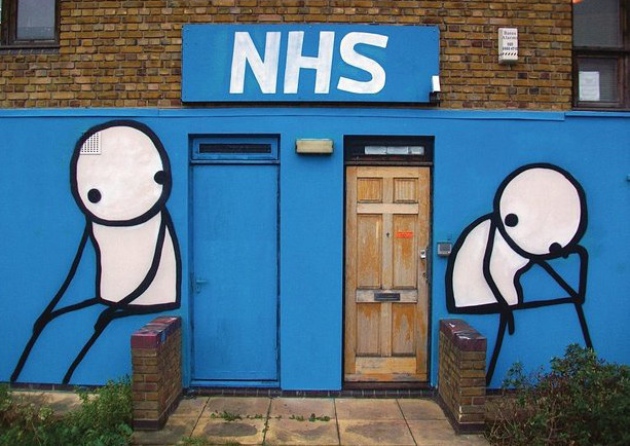
Stik, the once-homeless graffiti artist, whose stick-like figures adorn the streets of East London and beyond, has announced that a full set of his NHS Sleeping Baby print is to be auctioned at Christie’s later this month.

The prints, expected to sell for £2,000 to £3,000 as a set of four, will raise money for the Homerton University Hospital NHS Foundation Trust Art Charitable Fund.

This is not the first time Stik has used his art to help the hospital. The original ‘Sleeping Baby’ mural can be seen in the garden of Homerton Hospital itself, and last year Stik sold £50,000 worth of prints of the image with all the proceeds going to the Homerton Hospital’s art room.

The iconic image of a sleeping baby, painted in Stik’s usual style of block colour and thick-black lines, has since been adopted as a symbol by NHS workers. “It represents the vulnerability of the NHS and the feeling of fondness we have for it. The NHS is our baby and we have to protect it,” Stik says.

During the recent junior doctors strikes, the image was printed on placards with slogans such as ‘Hands off our NHS’ and ‘The NHS is our baby’.

To be clear: doing anything to raise money for hospitals is a selfless and noble act, to be applauded. That much is great. What is troubling are the sentiments expressed which accompany the philanthropic act – in this case, an almost slavelike devotion not to the idea of healthcare, hospitals or the work of medical professionals, but rather to one specific organisation, government department and method of healthcare delivery.

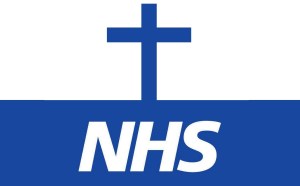
Speaking about the NHS as a vulnerable infant, almost like the Christ child, is not healthy behaviour. Nor is placing ourselves in the position of loving parents to this baby, charged with protecting it from all harm (though it does make a refreshing change from portraying ourselves as the children, being tended to by the watchful parent of big government).

Equally offensive is the way that NHS cultists presume to speak for everyone in the country, and routinely pontificate about things like “the feeling of fondness we have for it”. Oh do we, now? I’m fairly certain that NHS-loving drones are indeed in the majority, but I would also wager that there is a not insignificant number of people who fully support the idea of universal healthcare and are very grateful to doctors and nurses, but who have very little attachment to Britain’s unique model of centralised, government-owned delivery.

And yet the NHS cultists, much like the Princess Diana cultists nearly two decades ago, have the nerve to speak on behalf of us all. They declare on our behalf just how much we love the NHS and will fight to protect it from change, just as the Diana cultists wept into every passing television camera, sang along to Elton John and declared the entire nation to be in mourning.

Stik is a gifted artist, and many people find his murals poignant and beautiful. But we should not allow our respect for an artist and sympathy with his powerful life story to cause us to unquestioningly swallow NHS propaganda, hook, line and sinker. Other countries, without an NHS of their own, manage to build and operate hospitals too. Many of them provide their citizens with healthcare free at the point of use. Many also help the homeless, or indeed anyone in urgent need of medical care. Believe it or not, generosity, compassion and public spiritedness are not uniquely British values.

Whether we are allowing Stik to lead us in worship of the fifth biggest employer in the world, childishly painting the NHS logo on our faces, wearing it on our clothes or propelling a schmaltzy NHS Choir ballad to the Christmas No. 1 slot in the charts, in each cases we are disengaging our brains and allowing ourselves to be swept up in a cult rather than thinking rationally. Maybe the NHS was just what Britain needed back when we were struggling to pick ourselves up from the rubble of the second world war. But 68 years later, even in this age of globalisation, no other country has chosen to copy our approach. Not one. Shouldn’t that tell us something?

Faith is important*, but it is generally best applied to the spiritual realm. In the temporal realm here on Earth, we are able to look at evidence, test hypotheses and innovate new solutions when old ideas and ways of working become obsolete. Nowhere is this more true than the field of medicine. If we or a loved one were gravely ill, few of us would put our trust in a faith healer or wait for a divine miracle alone to provide a cure. Indeed, we tend to scorn and even prosecute those who do so.

And yet when it comes to the system of healthcare delivery we choose for our country, we proudly spurn new information and cling desperately to the familiar, seizing on any news story which confirms our present pro-NHS biases while simply ignoring heretical contrary evidence. In other words, we act entirely through (misplaced) faith, not reason.

Of course we should all hope that Stik’s Sleeping Baby prints raise much money for the Homerton University Hospital NHS Trust when they are auctioned – nobody disputes the worthiness of the cause. But in post-religious, increasingly secular Britain, we should be very wary of what we choose to fill the void once occupied by the Church. The human urge to worship has clearly not been vanquished, and venerating the NHS as we currently do is terrible for us, and calamitous for our flailing healthcare system.


* Long-time readers will recall that I am a Roman Catholic


NHS Logo - Cross - National Religion - Worship - Idolatry

Top Image: London24

Agree with this article? Violently disagree? Scroll down to leave a comment.

Follow Semi-Partisan Politics on TwitterFacebook and Medium.

Universities UK And Scientists For EU, Selling Out Democracy And Academic Freedom In The Grubby Pursuit Of Cash

Universities for Europe

Pro-EU academic umbrella organisations like Scientists for EU and Universities for Europe are actively peddling myths and propaganda rather than dealing in ideas, in a heinous betrayal of their supposed professional ethics

The LSE’s BrexitVote blog is carrying a great rebuttal to the endless, whining, selfish demands from Scientists for EU and others that the British people should reject Brexit because leaving the EU might hinder some money from flowing unimpeded into the pockets of various grubby special interests.

Christopher Bickerton and Lee Jones, both university lecturers, write:

When scientists wail that their ‘lab would fall apart’ outside the EU, they reflect the lamentable, Not-In-My-Back-Yard attitude of many academics to the forthcoming referendum. Any critical argument about the EU, and indeed any political argument whatsoever, seems to fall by the wayside, deemed irrelevant by those thinking only of their present research activities. The referendum is not about anyone’s lab; it is about democracy. The consequences of EU membership or exit are so vast and wide-ranging that this is the most significant political decision that will occur in our lifetimes. It is too important to reduce to pounds and pence. We all have our own interests, but sometimes we should aim to look a bit further than that.

If you don’t like the immigration regime as it applies to students and academic staff, then campaign to change it. If you think that UK science is under-funded, making us overly reliant on EU money, then demand that government funds universities properly. If this idea that popular demands should translate into government policy seems unrealistic, it simply signifies how degraded our democracy has become after decades of EU membership.

If you want to stay in the EU, then campaign for it – honestly. Don’t hide behind dodgy statistics and present what is really a cultural and political preference as a matter of economic and scientific necessity.

Read the whole thing.

How refreshing – and how long overdue – it is to see this fightback occurring within academia. Too often, the people in our country who are supposed to be the most adept at thinking, the best equipped to understand abstract concepts and possessed of the best knowledge of history have in practice spurned all of these gifts and sung uncritical hymns of praise to the European Union, and looked at the most fundamental question to face our country in decades as a parsimonious question about how much money will flow into their coffers in the event of a Leave or Remain vote.

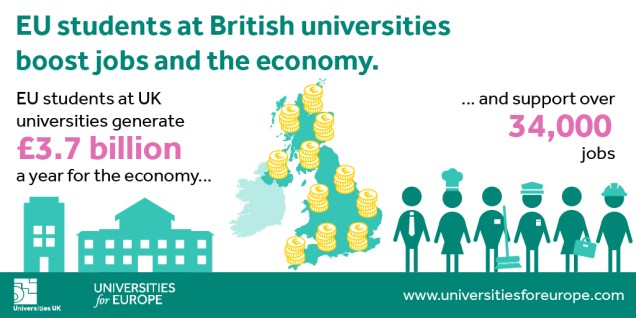
The dismal lack of vision or serious thought behind Scientists for EU and Universities for Europe is laid bare in the campaign poster shown at the top of this article, which trumpets the benefits to the British economy of European students studying here. Great. But are they seriously suggesting that these students would no longer come to Britain if we were to leave the political construct of the EU? Would all European students currently here be summarily deported, dragged from their halls of residence in the middle of the night by Home Office SWAT teams? Of course not. But those who claim to speak for scientists and universities are not above falsely implying that European students would automatically disappear from our shores in the event of Brexit.

We can rule out the idea that Universities for Europe are misinformed, and labouring under the misapprehension that something so apocalyptic might really occur – these are supposedly bright people, after all. So that leaves us with the rather distasteful truth – that they are actively lying and seeking to scare and deceive the British people, in order to defend what they see as a lucrative revenue stream of EU funding. In other words, not only have British universities abandoned the pursuit of truth, they are now enthusiastically peddling misinformation and propaganda. I hope they can sleep at night.

Of course, it is not only the academic establishment at fault for slavishly joining in the EU praise chorus – the same can be said of the entire Remain campaign from David Cameron and the government on downward. Neither feel comfortable talking about the big issues of democracy, accountability and national self-determination, which is why they constantly bring the focus back to tedious and unprovable economic arguments about pounds saved or GDP growth at risk.

Neither academia nor government can talk about Britain’s gradual absorption into a European political union in warm and enthusiastic terms, because to do so would be too immediately repellent to voters. And so unable to make the real positive case for the EU and for European federal union, instead we see this endless parade of risibly apocalyptic warnings about Brexit.

Which is a shame, because it would actually be quite nice to know whether our political and intellectual leaders believe that the top-down supra-national government of Europe is a good objective, or whether they are merely going along with it because of perceived short term social and financial advantage.

And if nothing else comes from this abysmally fought EU referendum, it would be nice to know whether our pro-European betters in Westminster and the academy are more stupid or greedy. Right now it seems quite finely balanced.


European Union - United Kingdom - Britain - Flags

Agree with this article? Violently disagree? Scroll down to leave a comment.

Follow Semi-Partisan Politics on TwitterFacebook and Medium.

Notes: The Moral Rot Behind The ‘Fight For 15’ Campaign

Fight for 15 - Care Workers

Notes – a new feature I’m trialling on the blog, in an attempt to publish the occasional random thoughts which never coalesce into a concise argument with a proper beginning, middle and an end. These will be sporadic, and if I haven’t contradicted myself at least once by the end of the year then I’m probably not doing it right.


My favourite fast food restaurant in the United States without a doubt is Chick-Fil-A. If they franchised internationally and I had the spare cash, I would open one here in London and it would easily do as well as recent US arrivals Five Guys and Shake Shack.

The reason that Chick-Fil-A is so good – besides the great tasting food – is the service, which (at least in the locations I have visited) goes above and beyond what one might expect in any fast food restaurant in Britain. As you arrive, a team member is always on hand to open the door for you and give you a warm greeting. That’s nice. Then, somebody with a smiling countenance and a decent command of English takes your order, usually getting it right the first time. And while you are sitting at the table eating, another team member circulates the restaurant offering to top up patron’s drinks from the soda fountain. Not only is there bottomless soda, you don’t even have to stand up and wipe the grease from your fingers to get your own refill.

When I go to my local McDonald’s on Kilburn High Road, I don’t expect any of this. I know that the restaurant will be in a state of perpetual chaos whether it is rammed at lunchtime or if tumbleweeds are blowing through in the dead hours. I know that asking for an extra barbecue sauce is like asking the server if they will donate a kidney. I know that the person taking my order will be unfriendly verging on hostile at least half the time, and I learned the hard way the necessity of carefully examining the contents of the bag to catch the frequent mistakes in the order before leaving the store.

What has recently made my local McDonald’s much better is the fact that they have just installed the new automatic order terminals. And now, I never have to have another human interaction there again, because the computer does it for me. I never went to McDonald’s for the stellar service or pleasant dining experience, and so I am happy to interact with a machine instead of a human being.

This is what Fight for 15 campaigners and other proponents of a higher minimum wage don’t get. If the labour is not worth $15 an hour and people do not want to pay the prices required to sustain profit margins with artificially higher labour costs, employers will look to replace human labour with technology as soon as it becomes practicable to do so. Somewhere like Chick-fil-A, a more traditional values-oriented chain with a premium on customer service, can perhaps withstand the tide. But McDonald’s and most other fast food retailers can not. The price of virtue-signalling middle class campaigners taking time off from their college classes or creative industry jobs to campaign for higher wages for fast food workers is that many of the latter will be thrown onto the unemployment scrapheap. Perfectly good entry-level jobs will be lost, and the ladders to better employment which they provide destroyed, just so that Guardian readers can feel better about themselves.

From Breitbart:

Wendy’s fast food restaurant chain says it will begin offering self-serve kiosks at its 6,000-plus locations across America, making them available to costumers by the end of 2016.

The fast food giant’s decision to move toward automation comes just as “Fight for $15”–a progressive protest movement, pushing minimum wage hikes–is applying pressure on state governments to raise wages for low-skilled fast food workers.

Last August, Wendy’s CFO Todd Penegor told investors that mandated wage hikes will cause his company to pursue other innovative avenues that could lead to fewer jobs for low-skill workers.

“We continue to look at initiatives and how we work to offset any impacts of future wage inflation through technology initiatives, whether that’s customer self-order kiosks, whether that’s automating more in the back of the house in the restaurant,” Penegor said, adding that “you’ll see a lot more coming on that front later this year from us.”

On the same conference call, Wendy’s CEO Emil Brolick said that individual Wendy’s franchises “will likely look at the opportunity to reduce overall staff, look at the opportunity to certainly reduce hours and any other cost reduction opportunities, not just price.”

But let’s look at another job staffed largely by people on minimum wage – the caring industry. This is a hard job, one whose financial rewards in no way meet the stresses and challenges of the work, looking after the health and sometimes social needs of elderly people. Some people in this line of work go above and beyond the call of duty, adding infinitely more value to the lives of the people in their care than will ever be reflected in their pay packets. Why? Because we don’t care about our aged relatives, particularly here in the West.

Well, maybe that’s unfair – we do care about them sentimentally speaking. But when it comes to putting our money where our mouth is, the indifference curve between purchasing a marginal improvement in quality of life for an elderly relative and buying the new iPhone is skewed horribly against grandpa. And if we can store our ageing relatives away in warehouses staffed by well-meaning but overwhelmed eighteen year olds, eye-rollingly disinterested others with hopefully one or two saints thrown in to ensure some minimum quality of life, that’s fine by us.

We could end the sorry drip-drip of nursing home abuse scandals tomorrow if we wanted to – by giving the profession the respect that it deserves, requiring some kind of training or qualification before employees are entrusted with vulnerable human beings, and ensuring that an attractive career path is in place for carers. That we fail to do so is a reflection not on government, not on the employers, but on ourselves. We permit this to happen, each one of us.

I’ve never understood why the Fight for 15 and minimum wage campaigners chose to go to the wall fighting for the rights of burger flippers to be paid in some cases significantly more than their labour is worth, while all the time there is a population of living saints among us – the carers, people who clean up the blood (and worse) in our care homes, and provide a vital measure of compassion and comfort to people in the sunset of their lives – being paid equally poorly. I am no advocate of wage controls, but the person who goes above and beyond to provide just a moment of personalised attention to a neglected older person despite having been on their feet for 12 hours straight seems to be an infinitely better figurehead for the movement than the person who operates the deep fat fryer at KFC.

If anything, Fight for 15 is a giant abdication of personal responsibility, declaring to the world that we are too lazy or selfish to stop eating manufactured food that costs almost nothing to produce or pay care workers a pittance while still expecting them to be Florence Nightingale, and that we would much rather the government step in to artificially hike the wages of those we are unwilling to pay better ourselves. The average Fight for 15 campaigner is quite happy to continue eating cheap fast food – they just want government to assuage their guilty consciences by topping up the wages of those whose labour does not command the minimum price.

Maybe this just speaks to the sickness at the heart of our decadent, self-absorbed late-stage imperial decline-ravaged Western society – our hearts brim over with compassion for the person who remembers not to put the pickle in our 99p cheeseburger, while we utterly neglect our ageing relatives and those who care for them on McDonald’s money.


Semi Partisan Notes - semipartisansam

Agree with this article? Violently disagree? Scroll down to leave a comment.

Follow Semi-Partisan Politics on TwitterFacebook and Medium.