Booker, Bain And Private Equity

Cory Booker - Newark - Bain Capital

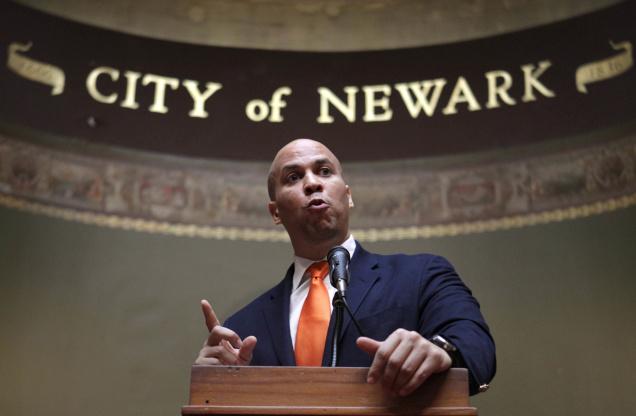
Today’s post is on the furore generated by Newark Mayor Cory Booker’s recent comments on last weeks’ NBC Meet The Press show, in which he appeared as a surrogate for the Obama reelection campaign.

When asked about attacks originating from the Obama campaign and aligned PACs, attacking Mitt Romney’s record at Bain Capital, Mayor Booker essentially said that those attacks were an unfair and unnecessary distraction from the real issues of the election:

“To me, it’s just this — we’re getting to a ridiculous point in America, especially that I know. I live in a state where pension funds, unions and other people are investing in companies like Bain Capital. If you look at the totality of Bain Capital’s record, it ain’t — they’ve done a lot to support businesses, to grow businesses.”

For those unfamiliar with the maelstrom of ridiculousness, accusation, counter-accusation, retraction and non-retraction that these innocuous comments generated, the consequences are related in amusing style by Kathleen Parker at The Washington Post.

Though really if you have taken in any American political news over the past week or so, you can hardly have failed to have heard about this story from one source or another. And in terms of the “press coverage to newsworthiness ratio” mismatch, this story scores quite highly.

As far as I can tell, despite all of the noise and column inches that this “story” has generated, most reasonable people could agree with the following sentiment: that there is nothing wrong with private equity – well, no more than what is right or wrong with any other industry – and the Obama reelection campaign has not publicly suggested otherwise.

No for-profit business is run for the sake of creating jobs – that just happens to be a fortunate side effect of growth and success, and private equity plays an important role in ensuring that capital is allocated most quickly and efficiently to those enterprises that can generate the best return on it. I don’t recall Mayor Cory Booker attacking private equity, capitalism and the American dream when he went on Meet The Press last week, nor Obama himself (though the Obama campaign and associated PACs and campaign surrogates have certainly crossed this line on occasions).

So what exactly is wrong with saying that attacks on private equity are nauseating? It may be a rather strong choice of words, but attacks on private equity are certainly irrelevant. And saying so does not blow apart Obama’s central campaign issue, as many conservative commentators seem eager to believe.

If we leave out the words of the Super-PAC political ads (and really we have to – on both sides, be they Republican and Democrat aligned – because they are loose cannons, unconnected with the campaigns and able to say anything they please regardless of the views of either candidate), what the Obama campaign is trying to point out is that a successful career in private equity is not of itself either a qualification for, nor indication of success at the presidency. Incidentally, one could (and many have) made the same argument about a career in community organising and constitutional law teaching.

Quite a few people work in private equity. And many more people – including ‘normal’ people, through their savings and investments and pensions – benefit from the work that these people do. Having a successful career in private equity does not of itself qualify someone to be President of the United States – it is a hard job, and probably nothing short of a previous stint as Head of State of another powerful nation really qualifies you for it.

And so if the Obama campaign wants to try to draw a contrast between the president’s four years of on-the-job experience and Mitt Romney’s lack thereof, that seems fair enough (though the old “don’t change horses midstream” argument is rather old and worn at this point, especially after George W. Bush’s reelection campaign), and as long as he avoids straying into “the corporations are raping the world” territory he should be allowed to make that point without being jumped on and labelled an anti-capitalist reactionary.

This seems to me like a big fuss about nothing – after eight days, let’s finally move on from this one now.

Obama The Inevitable – Continued

Just as I was starting to think that everyone had bought into the myth that the upcoming US presidential election is going to be anything other than a landslide for Barack Obama, Jamelle Bouie from The American Prospect brings a healthy dose of perspective to the matter:

I don’t mean to single out partisans; actual Beltway pundits are also too concerned with gaffes and faux controversies. Mike Allen and Jim VandeHei’s assessment of the last month—which has the top spot at POLITICO—describes the Obama campaign as “stumbling out of the gate” and “struggling” with message discipline. It’s everything you would expect from a micro-focus on the election

How much of this is remarkable, and how much of this is the usual sturm und drang of a presidential election? Campaigns always see blowback on their messaging, on account of the fact that political parties aren’t monolithic entities. Obama may have had a huge fundraising advantage in 2008, but in a polarized country where Democrats have taken steps to regulate Wall Street and raise taxes on rich people, it’s no surprise that Republicans have suddenly emerged with a fundraising advantage, and the support of interested billionaires. It would be unusual if that weren’t the case.

Hear, hear. Finally, some level-headedness on the start of Obama’s campaign.

The Republicans chose Mitt Romney as their nominee. Mitt Romney. And so unless Barack Obama is caught on camera having an extramarital affair, sneaking gold ingots from Fort Knox or peeing on the American flag while whistling jaunty showtunes, he is going to be re-elected president in November. And no-drama Obama ain’t going to be doing any of those things.

Obama The Inevitable

Well, stop blogging for a month or so and when you come back, the world has turned a little bit. The ratcheting up of the Euro crisis, the effective end to the Republican presidential nomination process, the sudden and complete inability of David Cameron’s Conservative Party to do anything right, in terms of either action or image… Guess I learned something there. Anyway, picking up where I left off in April…

So much handwringing in the media at the moment about President Obama’s political fortunes and reelection prospects!

From Politico:

Nothing inspires Democrats like the Barack Obama swagger – the supreme self-confidence on stage, the self-certainty in private.

So nothing inspires more angst than when that same Obama stumbles, as he has leaving the gate in 2012.

That’s the unmistakable reality for Democrats since Obama officially launched his reelection campaign three weeks ago. Obama, not Mitt Romney, is the one with the muddled message — and the one who often comes across as baldly political. Obama, not Romney, is the one facing blowback from his own party on the central issue of the campaign so far — Romney’s history with Bain Capital. And most remarkably, Obama, not Romney, is the one falling behind in fundraising.

National polls, which had shown Obama with a slight but steady lead over Romney through April, moved into a virtual tie this month — despite Romney’s clumsy conclusion to the GOP race.

And from The Daily Beast:

The dirty little secret of campaigns is that there are usually just two messages. Either: Stay the Course or It’s Time for a Change. When Barack Obama won 53 percent of the popular vote and carried 28 states, just 14 percent of Americans thought we were moving in the right direction. So it was obviously a Time for a Change election. When Ronald Reagan and Bill Clinton coasted to easy reelections, the country’s mood was undeniably Stay the Course. The election coming up in November is stuck in between. Americans don’t know whether to forge ahead or swing back.

And watching from across the pond, The Daily Telegraph:

There are storm clouds on the horizon for Barack Obama’s re-election.

Democrats indulged in over-confidence during the Republican primaries. It was an understandable reaction to the chaos that came with all the pandering to the far-Right and the rise of frankly laughable candidates like Michele Bachmann and Herman Cain in the search for an alternative to Mitt Romney.

After that debacle, the Romney campaign manager’s promise of an “etch-a-sketch” moment to re-shake and re-shape public perception about their candidate seemed a dose too hopeful.

But only a month after the Republican primaries all but officially ended, we have a real horserace on our hands.

According to a new Washington Post/ABC poll, 30 percent of Americans say they are worse off than when President Obama took office in the depths of the fiscal crisis. This is comparable to the numbers President George HW Bush faced when he lost re-election to Bill Clinton in 1992.

And right now Obama and Romney are essentially tied when registered voters are asked who would be better at creating jobs and handling the economy.

Why do we do this to ourselves?  Why spend so much time speculating about an event the outcome of which is almost a foregone conclusion?

I understand the motives of the professional media. People will not tune in to The Situation Room with Wolf Blitzer or Hardball with Chris Matthews in significant numbers to get their daily dose of the campaign ups and downs if they think that the result is already assured. That would mean less advertising revenues for the networks, and a huge army of unemployed cable news talking heads who would suddenly flood the market and push unemployment back up above 9%. So the word must continue to go out that the uninspirational, unpersonable technocrat who is unable to motivate his base and who campaigns like an electioneering android with a gaffe bug actually poses a serious threat to Obama’s reelection chances.

With regard to the professional media, I think there is also the bias factor. And by that I don’t mean the fact that all news outlets are biased in one direction or another, but actually the fact that all of the television and most print sources (even Fox News to some extent) strive to appear “balanced” when reporting the news, to tell both sides of the story (even if, in Fox’s case, the tone of voice, facial expressions and screen captions help to “guide” the viewer as to which side is correct).

At some point – and not being a student of journalism and media I don’t know when – good television reporting stopped meaning uncovering and reporting the truth, but rather reporting and giving equal weight to both sides of a story. So if Sam says the world is round but Bob says that it is a perfect cube, today’s headline will read “Sam and Bob spar in congress over shape of the world” rather than “Bob effectively ends his career with insane statement”.

But why do we ordinary people do it to ourselves? Are we just led by the media, or is there something else at work too?

I suppose that I will be doing the blogging walk of shame come November this year if the unthinkable occurs and Romney does become president-elect. But seriously. Are we all really so bored and in need of intrigue that we are going to kid ourselves that this one is even going to be close?

Wait A Second.

Politico reports that Republicans are protesting that the Democrats are refusing to help them undo automatic cuts to the defense budget agreed as part of the previous debt ceiling deal. Apparently, allowing these automatic cuts to government spending to take effect would risk plunging the US economy back into recession:

http://www.politico.com/news/stories/0512/76749.html

Sen. Harry Reid’s refusal to “back off” looming cuts to the Pentagon won’t just harm the nation’s security, Republicans say. It could plunge the fragile U.S. economy back into a recession next year.

GOP defense hawks struck back at the Senate majority leader Thursday for insisting he won’t stave off or delay $600 billion in automatic defense cuts unless Republicans budge on new revenues.

President Barack Obama’s top military advisers, including Defense Secretary Leon Panetta, have warned that the so-called defense sequestration would weaken national security, Republicans said. And a report from the nonpartisan Congressional Budget Office this week handed the GOP more ammunition: It concluded that spending cuts and tax hikes set to take effect in January would stall the economic recovery — at least in the short term.
Yes. Republicans, who have been busy blaming Obama’s stimulus package and increased government spending in general for the current slow rate of economic growth in the US, now say that cutting government spending would put the recovery in jeopardy. Hmm.


Okay, so what do we learn from this snazzy little pirouette by congressional Republicans? Wait, “learn” is the wrong word, let me rephrase. What tired, depressing old certainty is reinforced upon our weary souls by this latest spat?

1. When Democrats expand or maintain government spending for their pet projects (infrastructure, public services, welfare), it increases the deficit, adds to the national debt and is a grave mistake, but when Republicans expand or maintain government spending for their pet projects (like defense), they are taking vital steps to prevent a double-dip recession.

2. People will invoke the Congressional Budget Office to win an argument whenever the CBO pronouncement supports what they want to do, and they will ignore it or trash it if the CBO pronouncement suggests that what they want to do may be unwise.

Neither party exactly makes a serious play for the fiscal responsibility trophy here, but for sheer, barefaced hypocrisy on the matter, it is definitely the Republicans who flunk this round.

On Young Voters And The GOP

Republicans - GOP - Young Voters

At least some people in the Republican Party seem to have woken up to the demographic timebomb ticking away under their feet, and have started to lament, if not yet analyse, the fact that the vast majority of young people in America today would sooner give up their loud music and Pac-Man video games (or whatever it is that young people do for fun these days) than vote for a GOP candidate in a presidential election.

There is an article worth reading on this topic by Jeff Jacoby in today’s Boston Globe, entitled “As Dems rack up debt, youth should flock to GOP”.

Mitt Romney is apparently the latest Republican to develop a sense of outrage that no one outside of the grey haired brigade would be seen dead voting for him:

‘I don’t mean to be flip with this,’’ said Mitt Romney during a Q&A with students at the University of Chicago last week. “But I don’t see how a young American can vote for a Democrat.’’ He cheerfully apologized to anyone who might find such a comment “offensive,’’ but went on to explain why he was in earnest.

The Democratic Party “is focused on providing more and more benefits to my generation, mounting trillion-dollar annual deficits my generation will never pay for,’’ Romney said. While Democrats are perpetrating “the greatest inter-generational transfer of wealth in the history of humankind,’’ Republicans are “consumed with the idea of getting federal spending down and creating economic growth and opportunity so we can balance our budget and stop putting these debts on you.’’

At which point the needle on my “Are You For Real?” machine jolted as far toward the “You Must Be Kidding” end of the spectrum as it could go before the whole machine exploded in a shower of sparks.

The author himself does a good job of pouring cold water on any Republican claims to the mantle of fiscal restraint:

But that debt wasn’t piled up without plenty of Republican help. During George W. Bush’s presidency, annual federal spending skyrocketed from $1.8 trillion to $3.4 trillion, and $4.9 trillion was added to the national debt. Bush left the White House, in fact, as the biggest spender since LBJ . Granted, the profligacy of Barack Obama has outstripped even Bush’s bacchanal: CBS reports that Obama has added more to the national debt in just three years and two months than Bush did in his entire eight years. Still, younger voters can hardly be blamed if they haven’t noticed that Republicans are “consumed with the idea of getting federal spending down.’’

Therefore I do not intend to say anything more about the glaring, shameless hypocrisy of the Republicans – the party that gifted America two unfunded wars, large tax breaks not balanced by spending cuts and the joke that is Medicare Part D – laying any claim whatsoever to competency in handling the nation’s finances. Except that I will say that much of the “profligacy of Barack Obama” mentioned by the author was the result of a fiscal stimulus implemented (despite its imperfections) at a time when the US economy was in freefall, and without which the tepid recovery currently being experienced would likely be nothing but a sweet dream.

Mitt Romney and those others in the Republican Party who scratch their heads wondering why young people don’t like them miss the point entirely when they sulk that young people should embrace their economic policies. Though their fiscal policies may perhaps benefit young people in certain ways (and even this is arguable), there is no evidence based on past behaviour that they will actually have the political courage to implement them if voted into office. Old people (the beneficiaries of the “wealth transfers” that Romney claims to lament) actually vote in large numbers. Younger people don’t. The policy priorities of our political candidates duly reflect this fact.

Besides, it is not the GOP’s economic policies that are the main problem. The problem is the fact that in a bad economy, the opposition party is spending more time talking about abortion, contraception, mass deportations of illegal immigrants, repealing ObamaCare, questioning the president’s eligibility to hold office, and reinstating “Don’t Ask, Don’t Tell” and a host of other socially regressive policy positions which are anathema to a majority of young people today than they are about how to reduce unemployment and help a population ill-equipped to perform the more highly-skilled, non-manufacturing jobs of tomorrow.

Rick Santorum in particular often complains that the media focuses on his socially conservative policy positions and not his economic plan, but he can hardly expect young voters to thrust him into office on the back of his inspired ideas on the economy (spoiler – they are not that great) when they are more worried that he will cut off their unemployment insurance, or close down the Planned Parenthood centre where they go for medical care, or start a war with Iran.

It is no coincidence that the one Republican presidential candidate who actually walks the fiscal conservatism walk and who doesn’t continually bleat on about social issues and the culture wars – Ron Paul – vastly outperforms his rivals with young voters, in primary after primary.

Newsflash to Mitt Romney, Rick Santorum and Newt Gingrich:

Even if you had a cogent economic policy (which, by the way, none of you do) you will never appeal to young people by just tweaking your fiscal message a little bit. You had a choice when you started your presidential campaigns, and in your desperation to secure the party base you chose to fearmonger and rant about “taking back America”, and fret about turning into a socialist state, and speak about the importance of individal freedom in one breath while promising to impose your religious values on the whole country in the next.

Many young people would like an alternative to President Barack Obama, but you offer them nothing by way of a contrasting, conservative vision for the country that they could ever find acceptable. You offer them nothing. You offer racial minorities nothing. You offer women nothing. You offer the working poor and the unemployed nothing. And all of these constituencies will dutifully line up to vote for Barack Obama, and you will lose the presidential election on November 6th.

It could be otherwise, if only you offered the American people a genuine acceptable choice when they cast their votes.