The BBC reports that French president Francois Hollande has been accused by a French magazine of having an affair with a 41-year-old actress, Julie Gayet. The article reveals:
The magazine’s print edition came out on Friday and shows pictures it claims support the rumours that the 59-year-old president routinely spends the night with Ms Gayet at a flat not far from the Elysee Palace.
The pictures show the pair arriving separately. Mr Hollande, wearing a helmet, is on a motorbike driven by a chauffeur.
The magazine claims the president’s bodyguard arrives the following morning to deliver croissants.
I like the detail of the morning croissants. Even if one is sneaking out of the Elysee Palace late at night to get some action, one still needs a decent continental breakfast so as to appear statesmanlike again the next morning.
Just as with the fictional American President Grant in the US drama “Scandal”, skulking around the capital city in the dark with limited protection, exposing oneself (and the secure, uninterupted governance of one’s nation) to any risk of kidnapping, physical harm, blackmailing or worse in the pursuit of a booty call, is probably not behaviour that voters would wish to see in a serving head of state. Transgressions which take place before taking office, honestly explained, atoned for and forgiven by the electorate, are one thing. Actively committing further such acts whilst in office is another matter entirely.
The BBC article reports that though Hollande is making noises about potential legal action against the magazine Closer, he does not deny the specific allegations of the affair.
Although, if ever proven true, this would represent a severe lapse in acceptable personal standards of behaviour, and of presidential decorum on the part of Hollande, the solitary refreshing fact (if that term may be used) in the sordid allegation is that Francois Hollande does not continually preach to his people about the sanctity of traditional marriage in the way that some politicians in the UK, but particularly America, insist on doing.
In contrast to the likes of Newt Gingrich or Rudy Giuliani, both adulterers with serial failed marriages to their names, the French president does not devote his every waking hour to fretting about the potential impact of allowing gay people to wed on the institution of holy matrimony.
And for not adding his voice to the hypocritical cacophony of self-righteous moral preaching, we still owe Francois Hollande our thanks.
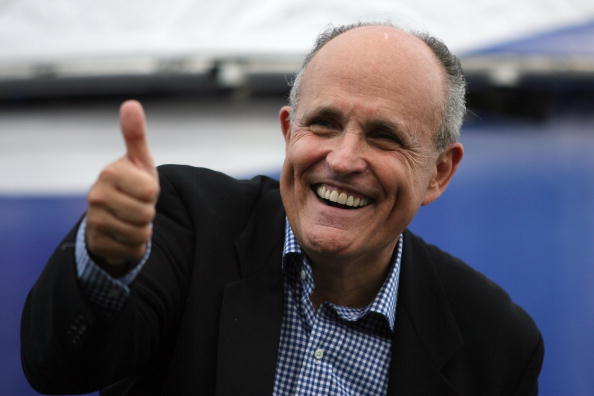
You don’t want to know why Rudy Giuliani is smiling.
Jonathan Turley writes an excellent expose and analysis of the terrible forced confession and public shaming of Charles Xue, an American businessman and influential blogger. These public shaming rituals are so difficult to watch, not only because of the tremendous pity one feels for the person involved, but because it makes ones blood boil to think of the abuse of state power taking place. Tea Partiers and others who see tyranny and despotism behind every move that President Obama makes would do well to look at this case and remind themselves what true tyranny and absence of the rule of law looks like. If our occasional polemics on blogs, radio and television were directed against the Chinese leadership rather than the American or British political class, many of us would also be sitting in a prison cell. Though it may not help Xue at all, we can at least take some small measure of comfort from the fact that China’s rising middle class, with their ever greater accustomisation to a high standard of living and their increasing exposure to other cultures, will not tolerate the government’s paranoid meddling in their lives indefinitely.
China appears to be returning to the Cultural Revolution with public confessions of dissidents as a warning to all those who would challenge the ruling party. Chinese viewers were exposed to a truly sad and transparent confession of American businessman and leading Chinese blogger, Charles Xue. The Chinese recognize the Internet as the greatest threat to the totalitarian regime. Xue was therefore rolled out to degrade himself before the Chinese people — begging forgiveness for forgetting his place in objecting to such things as contaminated water. He admits to feeling like the “emperor of the Internet” and apologizes for spreading rumors against the ruling party leaders.
A word of advice for all of the American pundits and commentators who puffed up their chests in wounded outrage when the president of Russia dared to suggest in a New York Times op-ed that it was dangerous for a country or a people to consider themselves exceptional: look at the image below.
Not very encouraging.
There are really only two possible ways to explain the fact that the US cover of Time Magazine diverged from all of the global editions on this occasion. The first is that the publishers of Time believe their American readership to be so shallow, insular or dumb that a story about important geopolitical developments would deter them from reading the magazine, and that featuring a story about college sports would be less intimidating and off-putting. And the second possibility is that the Bad Man, Vladimir Putin, said some nasty things about America a few days ago and hurt our feelings, so now we have to pretend that he doesn’t exist so that we can get back to our happy place as quickly as possible.
Neither scenario is really screaming “exceptional” at me.
This isn’t a post to denigrate America – clearly, any regular reader of this blog will soon sense my deep admiration of the United States and the belief that it remains, in some very important ways, exceptional in the world. And neither do I think it necessary to list (again) the many flaws of Russia, as they are manifold and frequently in the news, as a counterweight to what I have written here. Most people, given the choice of where to live, would choose the United States over Russia; it doesn’t need to be shouted from the mountaintops.
But I will say this to those “patriotic” Americans who feel slighted when every visiting foreign head of state doesn’t issue a statement declaring America to be superior to their own country, and who get upset when President Obama doesn’t take time out to lecture other nations about how the United States is the role model to be emulated in all matters (because we all know that would be such a successful diplomatic stance):
You sound like a spoiled, coddled toddler, always needing reassurance that you are special and perfect. Frankly, it must be quite embarrassing for your less insecure compatriots to be associated with you. Instead of stomping around the world, hammering out angry op-eds about how the USA is A-OK and super, super exceptional, how about you go out and actually do something exceptional to contribute to that exceptionalism? And if you can’t do that, how about just sitting at home and enjoying the exceptionalism in silence without bothering anyone else? Actions speak louder than words.
Ronald Reagan used the term “a shining city on a hill” to describe his aspiration for America, a really quite moving and wonderful phrase. It evokes a beacon of light, guiding people to America’s example through her very existence and perseverance; her deeds and not just her words.
By contrast, today’s neo-conservatives and others who wrap themselves in the cloak of exaggerated “patriotism” resemble not so much a shining light in the distance, leading others to prosperity, but rather a shrill, incessant car alarm, parked outside the house of every foreign nation, its loud, unceasing warble continually scolding them for not living up to America’s own ideals.
I will let comedian Lewis Black have the last word on this subject:
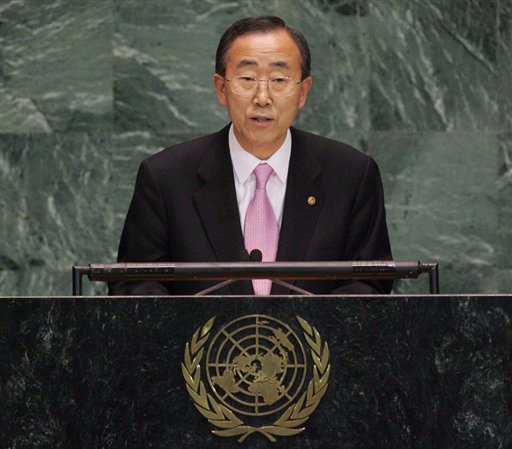
To much internal fanfare, the United Nations is trailing the release their super official, totally comprehensive report into the alleged use of chemical weapons in Syria. Though the report is (amazingly, still) not to be published until next week, the Telegraph reports that this did not stop Secretary-General Ban Ki-Moon from hinting at its contents:
Mr Ban did not say that Syrian government forces had carried out the suspected chemical arms attack near Damascus last month that was investigated by UN experts, but chose to point out that the Syrian leader had “committed many crimes against humanity”.
“Therefore, I’m sure that there will be surely the process of accountability when everything is over,” he said on Friday, in remarks that will increase the pressure on the Syrian regime and could even hamper high-level negotiations.
A UN team is expected to send its report on the Aug 21 attack to Mr Ban on Monday. He stressed that he still did not have the report, but predicted: “I believe the report will be an overwhelming report that the chemical weapons were used.”
While it is nice to see that the official machinery and bureaucracy of the UN is finally about to acknowledge the fact that chemical weapons were used, the glacial speed at which they reached even this laggardly point bodes very ill for the usefulness of the United Nations in any future conflict, or indeed any global event that moves faster than cold molasses on a winter day.
Three weeks after the fact, he begins to suspect that something naughty may have taken place in Syria.
This is a problem, because everyone else in the world – from Russia to the Pope to anyone who saw the videos of victims writhing on the ground and thought to themselves “hmm, those don’t look like gunshot wounds” – has already acknowledged the use of these weapons of mass destruction, and moved onto the question of culpability (which is also nearly resolved, save for Russia who have chosen to disguise their flagrant opportunism and self interest as principled skepticism).
So what do we do when the United Nation takes three weeks longer to determine something that is already a glaring and acknowledged fact in the real world? Clearly, this situation cannot be allowed to continue, when so many of the future problems that are likely to beset the world – military grade cyber attacks, border skirmishes, internal separatist rebellions and pan national natural disasters – will require a rapid response in order to prevent massive and unnecessary escalation of the conflict at hand, or the deaths of more innocent civilians.
This is not to impugn the work of the UN chemical weapons inspectors, who I am sure did an entirely professional and competent job collecting and analysing the evidence taken from the chemical attack sites. And if a comprehensive suite of laboratory tests takes a couple of weeks to complete, then there is little that can be done to hurry it along.
But we should be clear that the problem faced by the United Nations is not to do with technology or resources, but entirely to do with the workings of the institution itself. The truth is that the United Nations, despite the good that it has done in some areas, faces a massive challenge to its credibility, from skeptical people in all nations.
From fact that the five key victors from the Second World War enjoy exalted status as permanent, veto-wielding members of the security council (as a Brit, I wouldn’t want to give that up; who would?) to the fact that countries with truly odious records frequently hold rotating membership of important committees on human rights or climate change, to the fact that many UN apparatchiks seem more keen on jetting around the world lecturing sovereign governments and trying to impose their preferred left-wing policies on a bemused population, the UN has lost any claim it ever really had to a democratic mandate or moral legitimacy.
Despite these manifold institutional failings, we cannot simply brand the UN “unfit for purpose” and leave the organisation – we still need some system in place, a forum where the countries of the world can meet to resolve conflicts and tackle pan-national issues. But the United Nations either needs to start moving faster in response to developing global crises, or we all (individuals, politicians and governments) need to stop holding aloft the will or approval of the UN as the official moral or legal stamp on any action that is taken around the world.
Given recent and not-so-recent events, that rosy image of the UN is tarnished beyond repair.
In an unusual development, Vladimir Putin and the Russians have taken over the drivers seat when it comes to the international response to the use of chemical weapons in Syria. This shift has been met either by gushing praise over President Obama’s deft handling of a fluid situation, or condescending scorn that Obama allowed the United States to be upstaged and outplayed in the diplomatic arena by an old arch-enemy.
This should be interesting.
Regardless of where the truth really lies between these two extremes, two things are certain:
1. The ball is in Russia’s court. They have seized the initiative, they have the ear of Syria, and they are now in the best position to force Bashar al-Assad to comply with demands to turn over his chemical weapons to the international community.
2. Russia is already flunking the test, and their first shot at global responsibility.
Rather than getting to work immediately to establish an architecture and process for the international community to verify the safe removal and decommissioning of Syria’s chemical weapons, President Putin is spending his time writing op-ed pieces in the New York Times, arguing the lonely and discredited position that the Syrian rebels were responsible for the chemical attack on themselves, and urging the American people (not that much urging is required) to speak out against any future military strikes against the regime. Furthering Russia’s own interests rather than trying to solve a global problem.
From the outset, Russia has advocated peaceful dialogue enabling Syrians to develop a compromise plan for their own future. We are not protecting the Syrian government, but international law. We need to use the United Nations Security Council and believe that preserving law and order in today’s complex and turbulent world is one of the few ways to keep international relations from sliding into chaos. The law is still the law, and we must follow it whether we like it or not. Under current international law, force is permitted only in self-defense or by the decision of the Security Council. Anything else is unacceptable under the United Nations Charter and would constitute an act of aggression.
Ah yes, Russia – tireless, stalwart defenders of the rule of law, at home and abroad. And then we get this:
No one doubts that poison gas was used in Syria. But there is every reason to believe it was used not by the Syrian Army, but by opposition forces, to provoke intervention by their powerful foreign patrons, who would be siding with the fundamentalists.
It makes a change to see Vladimir Putin peddling a “false-flag” conspiracy theory rather than being the subject of one.
Newsflash, Vladimir – the military option is off the table for the time being. You helped to do that (though certainly not out of high-minded, altruistic pacifism). Tempting as it must surely be to rub the Obama administration’s face in your steaming pile of diplomatic cunning, it would be far more helpful to keep military action off the table, not by performing a valedictory lap in the media, but by buckling down and taking action on the new commitment that you have just made for your country. Your time is not well spent testing the patience of the United States and her allies by stalling and prevaricating, especially when Obama has made clear (just like all other US presidents in recent history) that constitution be damned, he seeks neither congressional approval or public support to attack another sovereign nation.
And to those who side with President Putin and crow that there was a diplomatic solution at hand the whole time if only the warmongers had been looking for one, it should be remembered that without the credible threat of force emanating from the United States, the present reset of diplomatic efforts would not have been possible. You don’t need to have supported military strikes to understand this – I was against military strikes without the rest of the international community joining us on the moral and financial hook, but I still appreciate that it was only the determination to proceed with strikes on the part of the Obama administration that ultimately led Damascus to seize so gratefully on the Russian proposal.
So, the responsibility for achieving a meaningful disarmament now lies with the Russians. As Putin concludes his op-ed:
A new opportunity to avoid military action has emerged in the past few days. The United States, Russia and all members of the international community must take advantage of the Syrian government’s willingness to place its chemical arsenal under international control for subsequent destruction. Judging by the statements of President Obama, the United States sees this as an alternative to military action.
I welcome the president’s interest in continuing the dialogue with Russia on Syria. We must work together to keep this hope alive, as we agreed to at the Group of 8 meeting in Lough Erne in Northern Ireland in June, and steer the discussion back toward negotiations.
If we can avoid force against Syria, this will improve the atmosphere in international affairs and strengthen mutual trust. It will be our shared success and open the door to cooperation on other critical issues.
I have grave doubts that Russia is serious about this. But if they are, then we must wish them every success. Whether motivated purely by self interest or not, Lord knows we need more mature actors on the world stage.




 Semi-Partisan Politics