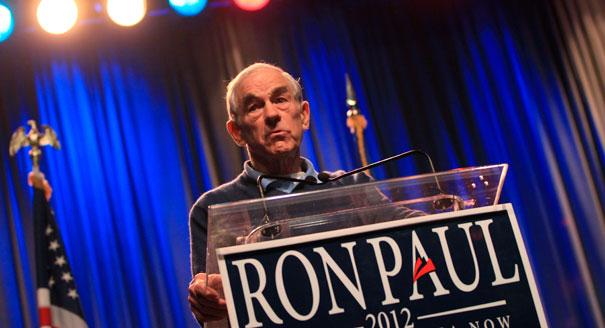
Ron Paul, The New Russian Apologist

RonPaul


Former US congressman Ron Paul (R-TX) is nothing if not consistent – an admirable and all too rare quality in a politician. But just sometimes, the unflinching adherence to a particular principle or policy can be a bad thing – witness the Tea Party’s stance on taxation, the National Security Cheerleader Caucus’ enthusiasm for government surveillance, or the legislate-by-Bible-verse preference of the religious right.

Ron Paul has now sadly joined this group of ideologues, not because many of the points that he makes have suddenly stopped being timely, persuasive and correct, but because he now makes them in such a way that they no longer inform or educate, but merely generate material to be used by enemies of the United States and the West as ready-made propaganda pieces.

Indeed, some of Paul’s recent pronouncements on the Ukraine crisis and the Russian usurpation of Crimea are so one-sided and so determined to examine only the faults of the West while negating or ignoring the faults of Russia, that one wonders what his motivation could possibly be. Paul seems to be adopting a one-man Fox News Strategy, whereby he single-handedly attempts to redress what he sees as an inherent bias or gross imbalance by coming down incredibly hard on one side of an argument – whilst proclaiming all the while to be fair and balanced.

The latest fodder for Kremlin-apologists came on Sunday, when Paul penned an op-ed for his own Ron Paul Institute website, the subtitle of which could easily have been ‘I told you so.’ In this piece, he lashes out at the monetary and other forms of assistance given to Ukraine over the past ten years by US-funded non-governmental organisations (NGOs):

But what do the US taxpayers get, who were forced to pay for this interventionism? Nothing good. Ukraine is a bankrupt country that will need tens of billions of dollars to survive the year. Already the US-selected prime minister has made a trip to Washington to ask for more money.

And what will the Ukrainians get? Their democracy has been undermined by the US-backed coup in Kiev. In democracies, power is transferred peacefully through elections, not seized by rebels in the streets. At least it used to be.

As with most effective attempts to mislead, there is just enough truth contained in this statement to suggest respectability and provide a stepping stone to reality, but not too much that it might get in the way of the misinformation being delivered.

It is certainly the case that the National Endowment of Democracy, a private and non-profit organisation, is active in Ukraine. But the NED is not secretive about this fact. Indeed, they detail all of their activities and funded initiatives across all of the countries where they work on their own website. Details of their funded work in Ukraine can be read here.

It is certainly possible that organisations such as the Human Rights Training Center or the Ukrainian Catholic University are nothing but shadowy US puppet organisations, greedily taking in American taxpayer money and using it to subvert the will of the Ukrainian people, just as it is possible that Barack Obama became president of the United States for the sole purpose of gathering material to aid in his upcoming romantic comedy about living and working in the White House. Possible, in other words, but eyebrow-raisingly unlikely.

But the narrative sounds very good to anyone predisposed to view any American or Western activity with suspicion, and so by floating unsubstantiated assertions that western-funded NGOs are doing anything other than trying to promote and build the strong institutions required for democracy to flourish, Paul is playing into a harmful narrative which misconstrues the intentions of his own country and those of the West.

In a separate intervention last week, Paul rhetorically asked:

Why does the US care which flag will be hoisted on a small piece of land thousands of miles away?”

The thought does not seem to occur to Paul that perhaps the United States does not care about the flag – that perhaps it is not the small piece of land that is at stake, but rather the way that it changed hands so rapidly under threat of force that is the problem. And, regrettably, he seems all too willing to recall previous bad actions and mistakes made by the United States to excuse current crimes committed by Russia:

“Where were these people when an election held in an Iraq occupied by US troops was called a ‘triumph of democracy’?

Iraq was certainly very recent, but to make a blasé statement such as this without giving a thought to the many differences between the invasion of Iraq (non-permanent and not for acquisition of land) – however terrible and wrong it may have been – and the Russian invasion and annexation of Crimea, is propagandist point-scoring at its worst.

No strangers to propagandist point-scoring themselves, the Kremlin-funded Russia Today network predictably seized on Ron Paul’s latest op-ed, and folded it into their continuing efforts to spin the Russian invasion and annexation of Ukraine’s sovereign territory as something entirely consistent with international law, recent precedent and human decency.

RT.com wasted no time putting their own helpful gloss on Ron Paul’s words:

According to Paul, high-funded intervention doesn’t equate to spreading democracy. Instead, he wrote, the US has invested in a country where power has been passed along not by the way of a democratic election, but rather the ousting of the country’s presidents by his opponents.

Of course, the regime of Viktor Yanukovych ousted by the supposedly undemocratic popular uprising in Kiev was itself busily trying to subvert the Ukrainian democracy by cracking down on freedom of speech, silencing dissent and dramatically increasing the powers of the president, which rather muddies the waters and exposing the Ron Paul / Russia Today line as the one-sided propaganda that it is.

Ron Paul accuses President Obama of doing many of the things in America that Viktor Yanukovych did in Ukraine, albeit on a slightly smaller scale – certainly, Obama’s war on whistleblowers and the surveillance state that he has tolerated and expanded can be said to chip away at the foundation of democracy. And yet this outrage at the illiberal policies being enacted in America is nowhere to be found when he looks at the former Yanukovych government, who, for all Paul seems to know or care, were benign arbiters of justice and democracy, unjustly pushed from office by a baying mob of anti-democracy fanatics.

If the recent Edward Snowden / NSA / surveillance debate have taught us nothing else, we have at least been reminded that democracy and its institutions are fragile and never more than one generation away from serious damage, subversion or destruction. When countries such as Britain and America – who have traditionally held aloft the flame of liberty and democracy – now suffer under governments that think nothing of secret surveillance of their own citizens, detain people or subject them to indefinite curtailments on their freedom without trial or allow those who permitted torture to take place to avoid justice, how much more fragile and in need of support must be those nations with a much shorter history of democratic government?

And in this context, is NGO money spent to strengthen democratic institutions in countries around the world not one of the best investments that the West could make?

The suggestion is not that Ron Paul has no right to speak out against past US failings – he has a longstanding and admirable track record of doing so. But the problem comes when his zeal to remind people of past US and Western failings leads him not to condemn those same actions by other countries, but rather almost to praise them as a perverse means of restoring parity within the global order.

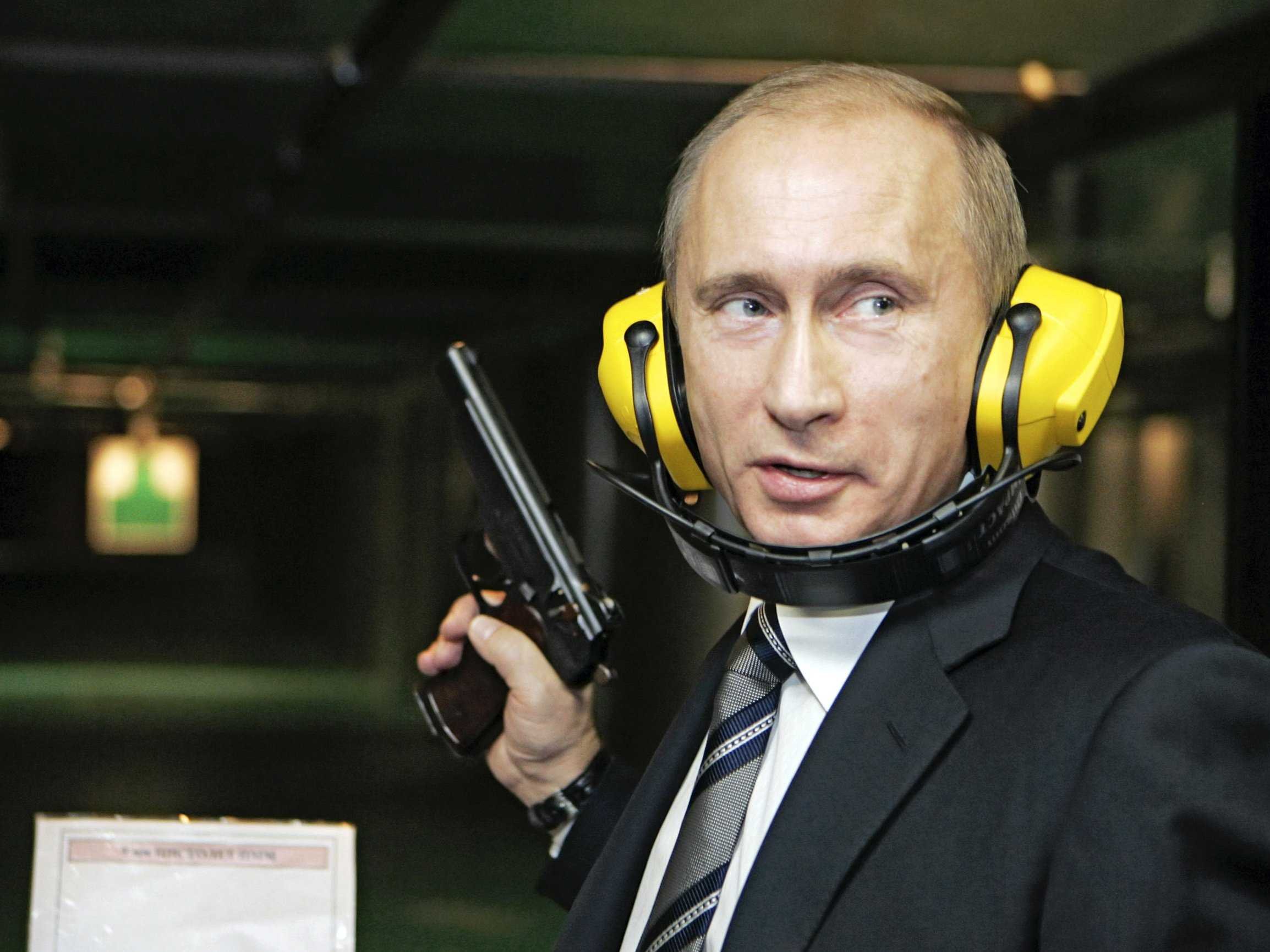
In his recent speech to the Russian parliament, Vladimir Putin ranted, raved and gave the world a stark insight into his paranoia, his sense of inadequacy and the huge chip on his shoulder concerning how his country is perceived by the rest of the world. Railing against the West, he said:

Our Western partners, led by the United States of America, prefer not to be guided by international law in their practical policies, but by the rule of the gun. They have come to believe in their exclusivity and exceptionalism, that they can decide the destinies of the world, that only they can ever be right. They act as they please: here and there, they use force against sovereign states, building coalitions based on the principle, “If you are not with us, you are against us.” To make this aggression look legitimate, they force the necessary resolutions from international organisations, and if for some reason this does not work, they simply ignore the UN Security Council and the UN overall.

They did it before, so now we can do it, too.

Ron Paul is in many ways a visionary, and is certainly a real American patriot. Which is why it is concerning that he and the dictator from Russia find themselves singing from the same hymn sheet.

The death throes of free speech in Russia


As the world’s attention remains fixed on Ukraine, less attention is paid to the final nails being hammered into the coffin containing the corpse of Russia’s free and independent press. And while the annexation of Crimea and the west’s shamefully half-hearted response (slapping sanctions on a mere handful of Russian officials and exempting Vladimir Putin and his closest confidantes) certainly deserve their column inches, journalistic independence and free speech finally died in Russia, without a shot being fired. It is only right that we acknowledge this backward step, too.

A couple of excellent columns published over the past weekend aimed to do exactly that – Julia Ioffe writing at the New Republic and David Remick at The New Yorker. Both articles come highly recommended and paint a compelling, sad story.

In his piece, Remnick mourns the backwards steps under Putin which have now erased each and every gain made for freedom of expression under the Gorbachev glasnost era, with particular reference to the Russian government’s recent interference with popular news site Lenta.ru:

In recent years, when Russian liberals have tried to sound optimistic, they have invariably said, Well, at least they haven’t cracked down on the Internet the way the Chinese have. Lenta.ru is one Web site, not the entire Russian-language Web, to be sure, but today’s firing is still an important and ominous step. Lenta.ru was getting more than thirteen million unique visitors a month, and was far more direct and critically minded than anything on state television or in most print publications. Some staff writers and editors have said that they will leave rather than work with [new editor] Goreslavsky. They have no doubt that responsibility for today’s firing lay with Putin and his circle.

Seventy-nine staffers at Lenta.ru issued a statement of angry protest, reading, “Over the past couple of years, the space of free journalism in Russia has dramatically decreased. Some publications are directly controlled by the Kremlin, others through curators, and others by editors who fear losing their jobs. Some media outlets have been closed and others will be closed in the coming months. The problem is not that we have nowhere to run. The problem is that you have nothing more to read.”

Remnick notes that in today’s world and with modern technology, the domestic Russian media can be bought, manipulated and coerced very easily by Putin, with no need for recourse to any of the Soviet-era’s more heavy-handed techniques:

In each individual case, the degree of censorship and pressure is hardly Stalinist in degree. Putin’s media strategy is more sophisticated than that. (The book-publishing industry has remained quite free and unchanged in recent years.) The sophistication of it is that Putin exerts just enough control (blacklisting certain known dissident voices from state television, for example), and punishes just enough of his opponents, to set markers—boundaries of the permissible. Sometimes those boundaries are crossed, but a general tone has been set.

This is precisely the problem, and perhaps the reason why the assault on the Russian free press is getting much less attention than it deserves. In the modern age, the sheer number of cable television channels, newspapers and online news sites can easily give the impression of a vibrant, raucous and effective media, easily reflecting the views of the entire population and holding the leadership to account. However, because of concentration of ownership and endemic corruption, the appearance diversity or independence is merely an illusion – everyone toes the party line.

Julia Ioffe’s New Republic piece sees even more danger, with Russia’s authoritarian attempts to control speech and thought now reaching the internet:

Yesterday, the Kremlin went full-China on the Internet, the holy of holies of the Russian opposition. Using some flimsy legal pretexts, it banned access to various oppositional news sites, to the website of Moscow’s biggest radio station, and to the blog of Alexey Navalny, who is currently under house arrest. Last week, the owner of Dozhd announced that, due to the clampdown, the channel is going to close in a couple months.

Within the span of a couple months, the Kremlin, by hook and by crook, has cleared all the media underbrush. There’s suddenly not much left of the independent media, even of what little of it there was left after Putin’s first two terms at the wheel.

Some of the personal anecdotes recounted by Julia Ioffe are even more disturbing:

Then came the day a Moscow acquaintance announced on Facebook that her daughter, a first-grader, came home from school in a panic because the teacher had told the class that America was about to invade Russia. But then television host and attack dog Dmitry Kiselev went after the “radicals” in Kiev in a special broadcast dedicated to Ukraine, saying that the transfer of Crimea to the Ukrainian Soviet Republic in 1954 was “a historical crime” and blaming the dissolution of Yugoslavia on the West. “What is Yugoslavia now? A pimple on the body of Europe.”

The Russian Writer’s Union then felt the need to write an open letter to the Kremlin throwing their wholehearted support behind Russia’s annexation of Crimea:

… the Russian Writers’ Union, which is as Soviet as it sounds, declared that, “in these worrying times, when the fate not only of Russia and Ukraine, but of all European civilization, is being decided, we want to express our support of your firm and responsible position.” They also blamed “the destructive forces of the West.”

Whatever one might think of the press in the United Kingdom or United States, one cannot imagine them banding together like this to explicitly praise the leader. It is certainly true that President George W. Bush received ridiculous levels of hagiography and unquestioningly supportive coverage from the western press in the run-up to the second Iraq war, the profession as a whole did not feel the need to pledge their fealty with one voice. And though they were largely banished from the main networks, there was strong and vocal opposition. Not so in Russia today.

If there is any glimmer of hope to be had in this sorry situation, it is the fact that a sizeable number of Russians – despite their almost total erasing from the domestic news – have grown heartily sick of their country’s backward slide, and are making their views known as best they can.

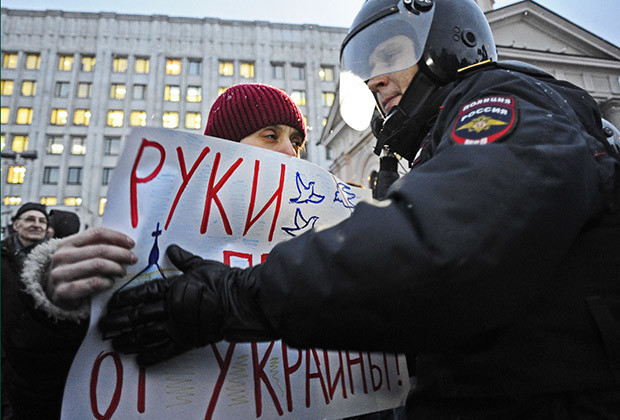
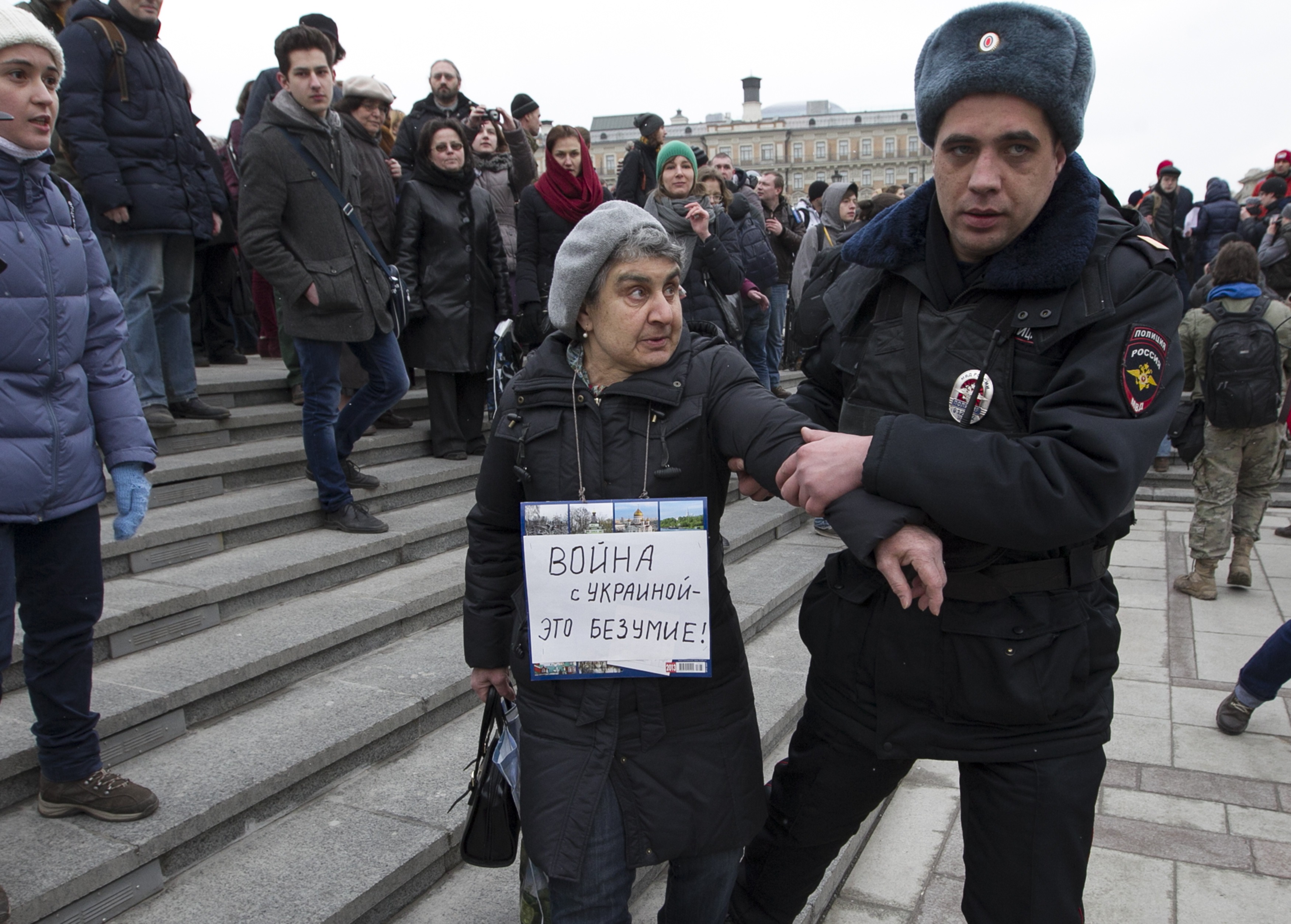
The BBC reports that up to 50,000 people attended a pro-Democracy “Hands Off Ukraine” rally in central Moscow. And apparently caught off guard, Putin’s regime did not thwart the march, and mustered only 15,000 of their own supporters in a counter-demonstration:

Earlier in Moscow, tens of thousands rallied against Russia’s actions in Ukraine, the biggest such protest in two years. As many as 50,000 attended the rally, with protesters shouting: “Hands off Ukraine.”

One man told the BBC he felt Russia was turning back to the days of Soviet dictator Joseph Stalin.

Nearby, some 15,000 supporters of President Vladimir Putin came out to support the Crimean referendum. Many of them wore identical red outfits and carried Russian and Soviet flags.

But displays such as this are likely to become far fewer as the number of truly – or even partially – independent news outlets willing to provide a non-Kremlin perspective on the world dwindles to nothing.

Regrettably, the paranoid propagandists at the Kremlin are now also being encouraged to a degree by some in the west. The usually-admirable Ron Paul, for example, clearly shows the limitations of applying libertarian philosophy to its ultimate limits, and of citing moral equivalency between Russian meddling in Ukraine and unauthorised Western invasions to argue that the West has no legitimate basis to condemn Russia’s actions. Because the United States and Britain did wrong in the past, goes this argument, Russia must be allowed to do wrong now:

Paul said Crimeans should be allowed to break away from Kiev.

“I think everyone should have right to express themselves,” he said. “It is messy, that is for sure, because two big governments are very much involved in trying to tell the Ukranians what to do.”

However he said Russia had a more justifiable basis for being involved in Crimea than the US, and no government should prevent locals on the peninsula from determining their future.

This deference toward Russia maintaining a geopolitical sphere of influence whereby it is allowed to meddle and assert special interests in the politics of its neighbours would be slightly more defensible coming from Ron Paul if he did not castigate the United States for doing the same thing when it comes to influencing America’s Latin American neighbours:

PAUL: Well, I think free trade is the answer. Free trade is an answer to a lot of conflicts around the world, so I’m always promoting free trade. And you might add Cuba, too. I think we would be a lot better off trading with Cuba.

But as far as us having an obligation, a military or a financial obligation to go down and dictate to them what government they should have, I don’t like that idea. I would try to set a standard here where countries would want to emulate us. Unfortunately, sometimes we slip up on our standards and we go around the world and we try to force ourselves on others.

If free trade and an absence of foreign meddling is truly the stance favoured by Ron Paul he should be vigorously denouncing the aggressive actions taken by Russia, not seeking to justify them by finding tenuous comparisons in recent US and western foreign policy. Ukraine had a clear choice – closer engagement with the European Union or re-embracing Russia. Until Vladimir Putin began interfering in Ukraine’s internal politics and encouraging President Yanukovych to abandon the EU deal in exchange for sweeteners from Russia, Ukraine leant towards Europe. The EU may have its imperfections, but it represents a much more liberal option than anything Putin’s Russia represents, and if anyone has subverted the will of the Ukrainian people and deserves Ron Paul’s disapproval today it is Vladimir Putin.

And while Ron Paul has led from the front in the important public debate about the nature and extent of the US surveillance state, and any curtailments on free speech in America, there is no acknowledgement from him of the grave and far more routine impositions on free speech that take place in Russia. That’s not to say that every criticism of America needs to be counterbalanced with a corresponding flaw in the rest of the world, but it is certainly the case that jumping into the debate on Ukraine without acknowledging this elephant in the room significantly detracts from his argument.

When it comes to counterarguments and balance in media coverage, Russia makes America and Britain’s own tribulations look like nothing by comparison. And while it is unfortunate that some people – particular those from the left/libertarian part of the spectrum – have felt the need to use the Ukrainian crisis as an “I told you so” moment or to burnish their own non-interventionist credentials, this is nothing more than posturing for a domestic audience. It does nothing to help the people of Ukraine or Russia.

While it is Ukraine that is currently being deprived of its territory in Crimea, the usurping Russians are also being robbed. Their loss, taking place with far less comment, is that of their independent press and free speech. And without a free domestic press to even go through the motions of scrutinising Vladimir Putin’s leadership, today’s Russia – in full paranoid, expansionist, Soviet-nostalgic mode – is not going to stop at Ukraine.

On Dissent In The Mainstream Media

Not in Abby Martin's name
Not in Abby Martin’s name


Glenn Greenwald, now writing for The Intercept, makes a very good point about journalistic integrity in the context of the ongoing Russian invasion and occupation of Crimea.

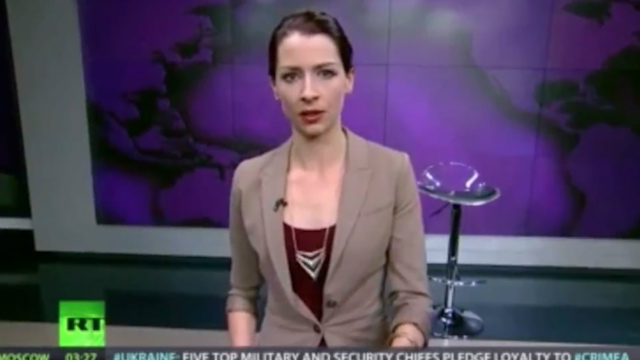
In the midst of this developing story, one of the anchors at Russia Today, the Kremlin-funded English-language news channel presenting a Russian perspective on the world, made news of her own by denouncing Russia’s actions at the end of her segment. The clip is available to view here:


The money quote is this:

I can’t stress enough how strongly I am against any state intervention in a sovereign nation’s affairs. What Russia did is wrong. I admittedly don’t know as much as I should about Ukraine’s history or the cultural dynamics of the region, but what I do know is that military intervention is never the answer. And I will not sit here and apologise or defend military aggression.

Greenwald wonders aloud how so many of those voices condemning Russia for invading a sovereign country can do so with a straight face when they themselves agitated for, or were apologists for the US-led war in Iraq:

Enthusiastic supporters of a wide range of other U.S. interventions in sovereign states, both past and present and in and out of government, are equally righteous in their newfound contempt for invasions – when done by Russia. Secretary of State John Kerry – who stood on the Senate floor in 2002 and voted to authorize the invasion of Iraq because “Saddam Hussein [is] sitting in Baghdad with an arsenal of weapons of mass destruction” and there is “little doubt that Saddam Hussein wants to retain his arsenal of weapons of mass destruction” – told Face the Nation on Sunday: “You just don’t in the 21st Century behave in 19th Century fashion by invading another country on completely trumped-up pretext.” The supremely sycophantic Face the Nation host Bob Schieffer – as he demanded to know how Russia would be punished – never once bothered Kerry (or his other Iraq-war-advocating guests, including Defense Secretary Chuck Hagel and Washington Post columnist David Ignatius) by asking about any of that unpleasantness (is it hard at all for you to sermonize against invasions of sovereign countries given, you know, how often you yourself support them?)

This is just as true for the press as it is for television talking heads or armchair generals. As Greenwald shows by quoting the example of CBS’s Bob Schieffer, the implicit assumption in many questions asked by television news hosts in America (and indeed in Britain) is that the invasion is unprecedented, wrong and contrary to international law. And while the invasion is indeed all of these things, this same level of proper journalistic scepticism was mysteriously missing when we were the aggressor.

Indeed, those few brave American media personalities who did speak out against the impending invasion of Iraq, and who dared to question the legitimacy of the Bush Administration’s every unconstitutional action, soon found themselves banished to the western journalistic equivalent of Siberia. Well known journalists or personalities such as MSNBC’s Phil Donohue and Ashleigh Banfield certainly felt the consequences, as Greenwald points out in an addendum to his piece:

Both Donahue and Arnett were fired because of their opposition to the U.S. war. Arnett was fired instantly by NBC after he made critical comments about the war effort on Iraqi television, while a memo from MSNBC executives made clear they were firing Donahue despite his show being the network’s highest-rated program because he would be “a difficult public face for NBC in a time of war”.

During that same time, MSNBC’s rising star Ashleigh Banfield was demoted and then fired after she delivered a stinging rebuke of misleading pro-war TV coverage by U.S. outlets, while Jessica Yellin, at MSNBC during the time of the war, admitted in 2008 that “the press corps was under enormous pressure from corporate executives, frankly, to make sure that this was a war that was presented in a way that was consistent with the patriotic fever in the nation and the president’s high approval ratings” and that executives would change stories to make them more pro-war.

While it is too soon to determine the medium-longer term impact of Abby Martin’s words on her career at RT, the contrast between this act of journalistic independence on a news channel so close to the Kremlin and the recent history of the American (and British) news media is sobering and discomforting. Though the post-PATRIOT Act consensus is finally starting to fray given the recent NSA scandals and revelations, at a crucial period in American history significant dissent or journalistic scepticism was almost entirely absent from the domestic press.

That is not to say that press freedom in America/Britain and Russia are in any way comparable – despite a worrying background noise of increasing official encroachments, regulation and intimidation, the press is far more free in America than in Russia, and any sane journalist would wish to operate in the former climate rather than the latter.

But while infinitely preferable to homogenised Russian state propaganda, western media has shown itself capable of being bullied into self-censorship on occasions, be it the panicked urge to appear ‘acceptably’ pro-war and support the policies of George W. Bush in 2003 or the far more recent insidious suggestion by David Gregory in 2013 that journalists who report on leaked classified information should consider themselves co-conspirators.

As always, before climbing atop the highest parapet and waving the Stars and Stripes or the Union Jack, we would do well to re-examine our own recent, tarnished history – be it our history of military intervention abroad or journalistic coverage of those adventures.

Doing so will not make Russia’s egregious actions in Crimea any more palatable or legitimate, but it will at least allow us to look Russia in the eye as we denounce them.

On Responding To Russian Aggression


Not necessarily something to be proud of, but this blog may have finally found common ground with Senator Lindsey Graham.

Politico reports that Graham has told President Obama to stop the idle threats about “costs” and “consequences”, and to regain some credibility by taking real, tangible action in the face of Russia’s invasion of Ukraine:

Sen. Lindsey Graham said on Sunday that President Barack Obama needs to “stop going on television and trying to threaten thugs and dictators.”

“It is not your strong suit. Every time the president goes on national television and threatens [Russian leader Vladimir] Putin or anyone like Putin, everyone’s eyes roll, including mine,” the South Carolina Republican said on CNN’s “State of the Union.”

Graham’s own starter for ten:

“President Obama needs to do something,” Graham said. “How about this: Suspend Russian membership in the G-8 and the G-20 at least for a year, starting right now and every day they stay in Crimea after the suspension. Do something.”

This intervention is just a condensed version of the critique and suggestions made earlier by Florida Senator Marco Rubio, who also places the emphasis on concrete actions rather than new ways to scold from the sidelines:

This is a critical moment in world history. The credibility of the alliances and security assurances that have preserved the international order is at stake. If Putin’s illegal actions are allowed to stand unpunished, it will usher in a dark and dangerous era in world affairs.

To his credit, President Obama has taken some of this advice – John Kerry is being dispatched to Kiev as an initial show of solidarity. William Hague is heading there too. That’s a good start. But it is the more tangible displays of disapproval that are now required most, from Britain, America and everyone else.

That means boycotting the Paralympic Games, freezing the overseas assets of Russian regime officials, and booting the country out of all international organisations such as the WTO and the G8. Revoking some visas and cancelling all intergovernmental cooperation on everything would also go some way to showing that Russia cannot behave in this way and expect to remain a respected part of the international community.

And if Putin retaliates by turning off the gas supply? Well, maybe the governments of Britain and Europe should have paid more attention to their energy security.

How Should The West Respond?

Predictably, Andrew Sullivan has some of the best coverage of the unfolding situation in Ukraine, with a longer post detailing his fuller thoughts due tomorrow. Worth reading and following.

Andrew Sullivan's avatarThe Dish

Russian Anti-War Protesters Detained In Moscow

I’m still absorbing all the information I can, and hope to post something at length tomorrow. But this much seems clear to me: Putin has panicked. To initiate a full-scale war with Ukraine, after effectively losing it because of the over-reach and corruption of Yanukovych, opens up scenario after scenario that  no prudent Russian statesman would want to even consider, let alone embrace. That doesn’t mean he won’t continue to over-reach or that we should be irresolute in confronting this aggression; just that we should be clear that the consequences of further escalation will be deeply damaging for his regime – and certainly far graver for him than for the West.

Obama and Putin spoke on the phone last night. Here’s what Leon Aron wishes Obama had said:

Ideally, the conversation would have been one in which the American president was speaking not only for the U.S., but also for…

View original post 674 more words