Labour’s NHS Party Election Broadcast: Jo Brand Is A Big Fat Liar


“A decent society looks after its people” is the moralising title of Labour’s latest celebrity election broadcast about the NHS, starring comedian Jo Brand.

That Jo Brand is a loyal supporter of the Labour Party hardly comes as a shock – the comedian was a supporter of the People’s Assembly anti-austerity coalition, and performed at the Stand Up Against Reality Austerity gig organised by that group last year. And credit where credit is due: she puts her time and money where her mouth is, supporting a cause she believes in. But unfortunately, in the case of Labour Party scaremongering about the NHS, that cause is a blatant falsehood.

Brand opens Labour’s latest celebrity ad with one of those “oh! fancy seeing you here” introductions, as though we were the last people she expected to encounter as she exercised on a lone cross-trainer slap bang in the middle of a brightly lit TV studio:

“There’s an election coming up. You might know that. And we all have our own personal axes to grind. Mine is what’s gonna happen to the NHS. Not because of my undeniable status as a national fitness icon, but because once upon a time I used to be a nurse.”

Establish credibility? Check.

When debating healthcare reform in Britain, nothing sweeps away logical debate and replaces it with hushed reverence more effectively than uttering the words “I’m a nurse”, or “I’m an NHS doctor”. Suddenly the speaker becomes an oracle, imbued with deep and mystical wisdom about national healthcare policy thanks to their selfless occupation on the front lines of clinical care.

If you are employed by the NHS, that huge organisation, the largest employer in Britain and fifth largest in the world (just behind McDonald’s), is there not the slightest possibility that working for such a vast branch of government – with a bureaucratic life of its own and a very strong survival instinct – and relying on it for your pay cheque just might skew your judgement when it comes to changing structures and working practices? Apparently not.

Regardless, Jo Brand then whips out the first of her many personal axes to grind:

Continue reading

Cameron / Miliband’s Bland And Inoffensive Path To Not-Quite-Victory


Today saw the launch of the Conservative Party’s latest election broadcast, emailed to their supporters and promoted on YouTube. And from a strictly artistic and technical perspective, it’s not bad.

The video was distributed along with this blurb:

Samuel,​ <– thanks, mail merge personalisation

Have you seen our new Election Broadcast?

It shows how our plan is securing the things we all want for our children and grandchildren: a good education, a decent job, great public services and the chance to make the most out of their lives.

It’s really important that everyone knows the choice at this election: a better, more secure future with the Conservatives or putting all the progress we’ve made at risk with Ed Miliband propped up by the SNP.

Cue lots of video footage of babies and small children, and voiceovers in which the parents express their hopes that little Johnny will emerge from the British educational system reasonably literate and numerate, never have to “worry about paying the bills each month” as an adult, and to come of age in “a Britain with opportunities” (duh). All of this is accompanied by the gentle strumming of guitars familiar to any fan of the TV show Gilmore Girls, and the same amiable whistling that TSB currently uses in advertisements to trick people into thinking that they are a friendly local bank.

But despite the focus on youth, in reality the Tories (and Labour too) are much more concerned with “securing the things we all want” not for our children and grandchildren, but for our parents and grandparents. The welfare state certainly needed reforming in 2010, and Iain Duncan Smith’s rollout of Universal Credit could yet go a long way toward eliminating the benefit trap, but it cannot escape anyone’s attention that the younger generations have borne the brunt of the necessary corrections to excessive government spending.

Meanwhile, Britain’s pensioners – who are much more likely to be homeowners and free of the cost of young raising families – have not been asked to contribute a penny, even as we were told that we are “all in it together”. Instead, the older generation are showered with non-means tested benefits such as free television licences and bus passes, while their pensions are protected with a “triple lock” which ensures that they will always get richer in real terms.

Continue reading

Why Did The BBC Silence John Darvall?


John Darvall BBC bias General Election 2015 WordPress Blog 2


The personal WordPress blog of John Darvall, the BBC Radio Bristol presenter removed from his regularly scheduled programme because of his relationship with a Conservative MP, offers further clues as to why the DJ was silenced ahead of the 2015 general election.

In an article dated 9 November 2014, Darvall struck a decidedly cynical tone in response to the posturing of all the main political parties:

There is an election coming. You may have noticed. All the parties are squaring up to each other while trying to convince you that they ‘have a plan’. They all want to ‘help’ you and yours have a better life, they all say other parties offer you nothing and scare you about why you should be afraid of them if they get in.

We are, of course, being ravaged by ‘crisis’ in all our public services, there is failure on every front and it is all everyone elses fault, but not yours. You are the victim. This was the same in 1979, 1983, 1987, 1992, 1997 and so on. You didn’t ask to [borrow] the money, you didn’t use the services and you said yes when you should have said no. So now, as we hope for actual leaders to actually lead and real ideas to inspire us, it’s time to test and debate what they are offering. Exciting isn’t it? Well maybe it just might be in a world of four or even five party politics.

Does this sound like the ranting of an ethically compromised journalist eager to spin the news in favour of his fiancée’s political party?

On the contrary, it is the type of indiscriminate “plague on all your houses” lament that could be uttered by any but the most stridently partisan British voter. Rather than indicating a desire to talk up Conservative Party policies and accomplishments, this blog post suggests a weariness with all of the political parties, and impatience with the voters who keep falling for the same promises time after time.

Later in the piece, Darvall goes on to outline his semi-serious “manifesto” for Britain:

We all pay a flat income tax at 20% of our income, after that income exceeds £15,000 per annum. National Insurance is abolished, along with VAT. Once you earn over £100,000 you then pay 30% income tax and 40% over £200,000.*

You pay a further 2% of you income to you [sic] local council.*

Fuel Duty and Vehicle Tax is abolished and you pay 2p for every 1 mile you drive.

Both national and local councils must send you an annual receipt of what you paid and what they spent it on.

A visit to the Doctor will cost you £18.50, like a basic visit to the dentist, which is currently £18.50. The same exceptions will apply as in dental treatment and if you are undergoing treatment for a chronic illness you do not pay.

Flat taxes, a pay-per-use approach to Britain’s sacred public services and full transparency of how local and national government spend taxpayer money? Quelle horreur!

Not to mention Darvall’s heretical idea that the British people may themselves be partly to blame for the stale political consensus that currently entraps the main political parties.

It is starting to look as though the BBC torpedoed John Darvall’s career not because of any potential pro-Conservative bias he may have shown, but simply because he was no longer willing to pretend that this election (and the major parties competing in it) offers the British people anything like real democratic choice.

And shattering that particular illusion would be just terrible for ratings.

John Darvall And The BBC’s Warped Approach To Editorial Impartiality

John Darvall BBC bias General Election 2015


It can’t be easy for the BBC’s news division, required by law to produce strictly non-partisan coverage while being assailed by both left and right for failing to sing their respective praises loudly enough. And while much of this criticism may be deserved, the fact remains that most BBC journalists perform a difficult and valuable job to a good standard, much of the time.

But the BBC would make life much easier for itself by taking a more consistent approach to its handling of editorial, investigative and disciplinary matters. At present there is no consistency at all, leading to the strong (and correct) perception that there is one rule for some people (and political parties), and another rule for others less favoured.

Take the case of John Darvall, a local radio presenter for BBC Bristol who was removed from his regular presenting slot because he happens to be engaged to a Conservative MP:

John Darvall, of BBC Radio Bristol’s Mid-morning programme, is being moved before the general election but says that he has had no guarantee he will be able to return.

Darvall, 48, and Charlotte Leslie, the MP for Bristol North West, met four years ago on his programme. They began dating in October and the twice-married father of four proposed on Christmas Day.

He is being moved to an afternoon show with less emphasis on news due to “heightened sensitivities” and to avoid accusations of a conflict of interest. BBC bosses said that he will be back after May. During a phone-in on the sacking of Jeremy Clarkson, Darvall suggested that he might not be back even after the election. A caller suggested that he should apply for a job on Top Gear, to which the host replied: “Trust me, I have a lot of reasons myself to be angry with the BBC at the moment. I am coming off this programme tomorrow, so I might consider something of a career departure.”

Questioned by another caller, he added: “It’s to do with the election and protecting BBC impartiality. It’s not my decision. I’m honouring what the BBC have asked me to do and I sincerely hope to be back after the general election, and the BBC have sort of said that I might possibly be, barring any unforeseen circumstances.”

In short, John Darvall was removed from his position not for something he did, something he said or even something that he thought, but rather because of who his future spouse happens to be. This harsh and career-damaging reaction by the BBC –  as taking a journalist off the political beat at election time surely is – was meted out not even for thought-crime, but in Darvall’s case for existence-crime.

Continue reading

Labour’s NHS Attack Ad Exemplifies Our Rotten, Uninspiring Politics

General Election 2015 Labour Party Campaign Attack Ad NHS Public Spending


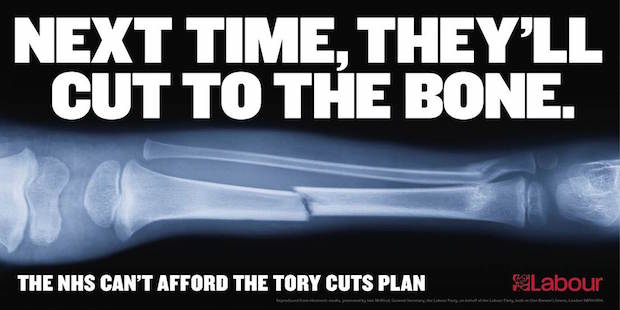
Today we saw the publication of the Labour Party’s first election poster of the 2015 campaign, and it is a nasty, negative little piece of work.

Designed to appear like an X-ray image, the poster shows a broken arm, and the warning “Next Time, They’ll Cut To The Bone. The NHS Can’t Afford The Tory Cuts Plan”.

There’s no point wasting space pointing out that this is not a very promising start from a party that promised to wage a relentlessly upbeat, positive election campaign – that point has already been well made. And it’s a fair point, but perhaps not the most important one.

What is really depressing about this Labour attack ad – and all of the negative campaigning we will soon see from the Conservatives, Liberal Democrats and UKIP too – is the lack of vision, of imagination, of anything resembling a positive outlook for Britain’s future.

Ed Miliband is fervently hoping that he can squeak across the finish line and into Number 10 Downing Street on the back of the British public’s fear that our precious public services will be cut back or degraded under five more years of Tory rule. Nick Clegg and the Liberal Democrats hope to stave off electoral annihilation by likewise preying on the fear of a Tory majority, and by promising that returning a sufficient number of LibDem MPs to Westminster will help to soften the edges of a future coalition as they did in 2010.

Meanwhile, UKIP, for all their anti-establishment fervour and sometime happy warrior image, will be busy preying on fears and resentments about immigration and injustices inflicted upon helpless Britain from Brussels. And David Cameron and the Conservative Party will desperately hope that their own negative campaign ads, designed to make the British public fear the uncertainty and economic chaos that a profligate Labour administration would bring about, will convince us to allow them another term in government.

The common thread? All of the campaigning between now and May 7 will be negative.

Continue reading