Nepotism Alert – Emily Benn

emily benn tony benn


“People might ask how I can know anything about ‘the real world’ given who my family are and the fact I am the granddaughter of Tony Benn” – Emily Benn


First it was Stephen of House Kinnock. Then came Will of House Straw. Euan of mighty House Blair waits in the wings. And now it is official – Emily Benn, fifth generation of her line, has been selected as Labour’s parliamentary candidate for Croydon South.

At one time, this depressing nepotistic spectacle was mostly a Tory party phenomenon – the Conservatives still boast a grandson of Sir Winston Churchill, Nicholas Soames, among their MPs. But as the ideological gap between the main parties has narrowed and the background of one party’s parliamentary intake has gradually become indistinguishable from another’s, we can only expect cases like this to become more frequent.

Is it necessarily bad to have someone from a political family, a woman in her early twenties, in Parliament? Of course not. Since the interests and priorities of young people are often scarcely acknowledged by Britain’s political leaders, more young faces in the halls of Westminster can only be a good thing. In particular, at a time when huge areas of government spending have been strictly constrained, virtually nothing has been asked of Britain’s pensioners or soon-to-be retirees, so great is the power of the grey vote. More young voters and a few twentysomething MPs are not the whole solution by any means, but it couldn’t hurt.

But is this really best that today’s Labour Party can do, in the age of Miliband? When every other speech from the Labour shadow cabinet (generic ranting against austerity aside) bemoans the lack of opportunities available to disadvantaged young people and the vital importance of listening to them, how will electing a privileged young woman from a dynastic family, almost completely divorced from real life, help to redress the balance?

Emily Benn, of course, is falling over herself to emphasise her humbler side and the extent to which she shares in the same trials and tribulations as the rest of us. In a piece in the Telegraph entitled “What I can offer British politics”, she insists:

“I get up and go to work every day (in the private sector). I have the same friends as everyone else and use the same buses, tubes and trains to get around town. I procrastinate on Facebook, just like the rest of our digitally savvy society, and struggle to find a house I can afford. And right now I am using the very same NHS hospitals as you would, while I accompany my mother to appointments in her cancer battle.”

But while it is true that this routine does indeed mirror the lives of many Britons, it would bring absolutely nothing new to the socioeconomic makeup of the House of Commons. Emily Benn’s career path has essentially been that of any other young(ish) Labour MP: university graduate (Oxbridge was helpful), premium graduate job (working for UBS investment bank, in Benn’s case), dabbling in lower level local politics to show a willingness to “help out”, followed by the nimble leap to national political party life. The only thing that differentiates Emily Benn from the other women in the Labour parliamentary party is the speed at which she achieved the holy grail of being selected by a constituency association – a victory which, if she were to be honest, is entirely attributable to her surname.

Contrast the embryonic career of Tony Benn’s granddaughter with the likes of Owen Jones, the young and telegenic left-wing campaigner, author and talking head. While one can disagree with his politics (this blog certainly does), it is hard to deny Jones’ very tangible accomplishments: a bestselling book that made people stop and think and which influenced the national political conversation, another book on the way, and a respectable track record of grassroots activism to back it up. Jones is often encouraged, even begged by some supporters, to stand at the next general election – though to his credit, he demures and remains non-committal. And few would doubt that Owen Jones would make an energetic, engaged, articulate and highly effective MP were he ever to run.

When has Emily Benn made people stop and think anew about a longstanding social problem? How many people turn out at events to hear her speak passionately on an issue close to her heart? How many newspaper articles does she have to her name, how many books has she published, how many times has Emily Benn’s media profile or debating ability led to invitations to appear on Question Time? In short, aside from her brief tenure as a local councillor, what has she done (aside from graduating university and getting a job like the rest of us) that in any way suggests an ability and promise so great that they earned her the right to carry the Labour Party banner into the 2015 general election?

When The People’s Assembly skulked through London in protest against austerity, this blog contended that a national movement which chooses Russell Brand rather than the likes of Owen Jones as its figurehead should not be surprised when it is generaly dismissed as irrelevant and unserious. The same criticism must now be levelled at the Labour Party, and the way in which local Labour associations are selecting their parliamentary candidates. If Labour insists on choosing famous names, and favouring style over substance, why should voters give them the time of day?

Ultimately, Emily Benn must ask herself this question – are her potential abilities as a future Member of Parliament so great and so unique that her contribution to British political life will outweigh the harm that she is doing by perpetuating yet another exclusionary British political dynasty?

But we cannot expect Ms. Benn to reach the difficult, truthful conclusion on her own. Therefore, it falls to the constituents of Croydon South to ensure that genuine promise beats hereditary entitlement in May 2015.

Going Back To Battle For Thatcherism, 40 Years On

nights watch 1


In this week’s thrilling Game of Thrones season finale, there was a moment when the great wall separating the barbarian wastelands from the civilised world seemed sure to be breached. Disheartened and battle weary, the leader of the wall’s depleted guard crossed enemy lines to negotiate the terms of their surrender to the wildling force besieging them. There was no other way out – when suddenly a saviour rode into view, a king from the south with thousands of armed men galloping behind him.

Trade the fictional land of Westeros for the realpolitik of Westminster, and David Cameron’s Conservative Party are not in quite as bad a shape as the ragtag Night’s Watch army on the wall, holding back the tide of socialism but leaderless and in desperate need of rescue by stronger and more organised forces – at least not yet. But this is largely thanks to the Liberal Democrat implosion and Ed Miliband’s pioneering work in the field of political self-immolation.

Were it not for this hugely favourable climate, the Tories would certainly be on the ropes with less than a year to go until election day. That the conservatives are under siege is evidenced by the fact that they have all the unpopularity of a losing team despite having successfully achieved almost none of their policy goals such as eliminating the budget deficit, rolling back the state or pushing back against antidemocratic EU interference from Brussels.

For British conservatives, libertarians and classical liberals, the heroes riding to the rescue were decked out in workaday business attire rather than the resplendent suits of armour seen in Game of Thrones, but they were no less welcome a sight for that when they arrived at London’s Guildhall to participate in the first annual Margaret Thatcher Conference on Liberty, organised by the think tank Thatcher founded with Sir Keith Joseph 40 years ago.

British advocates of individual liberty and a small state have endured long years in the wilderness – the fading days of the Major government, thirteen years of gradual state encroachment under the benevolent grin of Tony Blair (then the angry fist of Gordon Brown), and four years of conservative-in-name-only meandering under David Cameron’s coalition with Nick Clegg. Aside from the misty-eyed retrospectives following Margaret Thatcher’s death, talk of personal freedom, liberty and unapologetic pride and optimism in Britain have been missing in action from mainstream political discourse, presumed dead.

Before you cry ‘hyperbole!’, think on it for a moment: The main political mantras of the period 2010 to 2014 have been “The Big Society”, “We’re all in this together” and “Paying their fair share” (fairness, of course, remaining conveniently and forever undefined). All are collectivist tropes designed to soothe and placate natural Labour voters, not the principled words of liberty befitting the heirs to Thatcher.

The Big Society was meant to serve as rear-guard cover as the Conservative-led coalition sought to stem the rise in government spending and enlist volunteer groups to pick up the slack, but its architects forgot that a sudden burst of civic-mindedness and philanthropy was unlikely to come to pass if the government did not reduce its ominous presence in everything else that we do.

“We’re all in this together” was always a phrase better left to the teenage cast of Disney’s “High School Musical”, because it sounds both patronising and wooden coming from the mouths of politicians like David Cameron and his Chancellor of the Exchequer. George Osborne & co. are quite clearly not suffering the effects of austerity in the same ruinous way as families who have been deliberately led down the road to government dependence through Labour tax credits and allowances, and stranded there to suffer in the great recession. Suggesting that we are all suffering equally has opened the door to ridicule and Labour’s inevitable counterattack of ‘class warfare!’ as they seek to distract attention from their awful record in office.

And the less said about “paying your fair share” the better; suffice it to note that we now live in a country where any reduction in benefits granted to an individual by the state is not only indignantly referred to by opponents as a ‘tax increase’, phrases such as ‘the bedroom tax’ are unquestioningly adopted by the media without the slightest hint of irony.

As this blog noted yesterday, these are not auspicious times for those Britons who believe in a smaller government and more power for the individual.

But this only made the words spoken and the ideas expressed at the Margaret Thatcher Conference on Liberty all the more heartening for those beleaguered souls who think Thatcher was right, and that we need to embrace rather than repudiate her vision of a modern, capitalist Britain.

From start to finish there were powerful speeches on important topics such as re-emphasising national sovereignty, promoting free markets, tax reform, foreign policy, immigration and defence. Sometimes the ideas discussed were almost startling because they clashed so violently with the centrist orthodoxy that now predominates.

Take the panels on economics and fiscal policy. With Art Laffer in attendance there was no pulling of punches as he restated his timeless keys to success for any national economy: “A low-rate, broad-based flat tax, spending restraint, sound money, free trade and sane, limited regulation”. It cannot go unnoticed that the Conservatives have ceded some of this ground to UKIP in the past few years, but while policies such as a flat tax may be something of a pipe dream, Laffer’s contribution to the debate could be what is needed to help the Tories rediscover their footing on tax policy.

Also looming large in the discussion was growing cosiness between big business and big government, be it through lobbying at the national and EU level (more than 15,000 lobbyists and counting, noted Conservative MEP Daniel Hannan) or direct collusion on matters such as government surveillance. Perhaps surprisingly, given the circumstances, the delegates still considered big government a bigger threat than big business by a margin of 79% to 21%. Art Laffer summed up this sentiment, saying “big or small business is irrelevant – what matters is efficiency and competency”.

The discussions on national sovereignty and the need to stand firm in support of the nation state as the best guarantor of individual liberty were particularly refreshing, as they stood in such stark contrast to the pessimism and declinism which inevitably colour the attitudes of the pro-Europeans and those who have lost the ability to distinguish between patriotism and nationalist xenophobia.

Daniel Hannan argued that the EU should become “a free trade area in the model of NAFTA”, a nice idea, but given the fact that the European project has taken on a life of its own with the EU’s own interests now superseding those of its member states, there was too little discussion of how best to effect a British exit. Indeed, when the time came to vote on whether the EU can realistically be reformed, attendees voted 43% yes (wishful thinking) but a solid 57% no.

One of the most concrete areas of policy development was on tax, with the launch at the conference of the very SEO-friendly #ThePolicy. This proposed tax reform calls for the total abolition of capital gains and corporation tax for small businesses, giving them a shot in the arm to expand and create more jobs. The negative impact on the Treasury would be offset by the falling welfare bill, together with increases in PAYE and National Insurance contributions from the newly employed. While the policy needs further analysis and costing, it seems a lot more solid than Labour’s various hare-brained schemes to achieve full employment by levying yet another one-time tax on ‘the bankers’.

Underpinning all of these conversations on the economy was the imperative to rescue the reputation of capitalism, which has been tarnished partly through its own fault but mostly by left wing saboteurs, crony capitalism and poor government regulation. Charles Moore, Margaret Thatcher’s biographer, posed the question: “How can capitalism work for people who don’t have capital?”. It is certainly the prevailing view, and has too often been the case, that capitalism has not worked well for too many people as implemented by their governments. Changing this negative impression of capitalism, and the element of truth behind it, will be key if the Conservatives are to rebuild the winning coalition of working and middle classes that Thatcher forged in 1979.

This discussion naturally led to the importance of preventing distortions in the market, and the observation that “gifts through the tax code and obscure regulatory benefits” are no less than corporate welfare, and should be discouraged in order to salvage capitalism’s reputation. And in another nod to the importance of semantics, it was reinforced that “libertarians, Thatcherites and other pro-capitalism sympathisers need to speak of being ‘pro-market’, not ‘pro-business’ in order to avoid being associated with harmful crony capitalism.”

There were several interesting debates on the media, with Guido Fawkes blogger Paul Staines and the National Review’s Jonah Goldberg hosting an interesting Google Hangout on the future of news media, the opportunities presented by online journalism and the disruptive impact on existing revenue models – a topic which could have been a day conference in itself. And it was perhaps unsurprising that 70% of delegates were against continued full state subsidisation of the BBC.

On national identity and culture (or what has become known here as the #BritishValues debate), former Australian prime minister John Howard attempted to reframe the argument, describing himself as a “multiracialist, not a multiculturalist”. In doing so, Howard explained that conservatives should be welcoming to immigrants regardless of their race and ethnicity, but hold everyone to the same standards of behaviour and observance of the law – a call to assimilate which many on the left are too timid to echo.

John Howard also had timely words of warning on winning elections, a topic where David Cameron could use advice from a someone with a track record. Howard warned: “The worst way to try to win office is to pretend you’re not too different from your opponents”.

Cameron is limited in what he can do in government by his Liberal Democrat coalition partners, but when the starting gun is fired on the 2015 general election campaign, this will no longer be the case. The Conservative Party – if they are willing and courageous enough to do so – will be able to clearly articulate their policies and present a radically different blueprint for Britain than that offered by Ed Miliband’s dystopian “One Nation” vision.

The centrist status quo was challenged on almost every issue, even if some topics (such as immigration, where delegates from North America and Europe found themselves talking at cross purposes for much of the time because of their differing experiences) were not convincingly resolved.

The only question remaining now the conference is over: Is today’s Conservative Party still receptive to what the small government free-marketeers have to say? Will the Tories reach out and take the help and advice being offered?

In Game of Thrones, those who guard the wall are a motley crew of misfits, idealists and outcasts. Anyone who has ever made the mistake of expressing support for conservatism or (heresy of heresies) admiration for Lady Thatcher at a Hampstead dinner party or northern England working men’s club could immediately identify with their plight.

But despite the prevailing atmosphere of scepticism, the happy warriors at the 2014 Margaret Thatcher Conference on Liberty did something important in defence of the realm the likes of which we have not seen on such a scale since their not-so-ancient order was founded by Sir Keith Joseph and Margaret Thatcher in 1974 – they came together and boldly, unapologetically proclaimed the principles of small government and individual empowerment that saved Britain once and can do so again.

By contrast, Ed Miliband addresses crowds of the Labour faithful (nobody else listens to him now) and – with a straight face – proclaims that his disproven, tired old formula of tax hikes and renationalisation represents “the new politics” that Britain so desperately needs, if only we realised.

Consequently, the 2015 general election could end up being a battle between two recycled political ideologies. And we will have a choice to make: Shall we choose the one that inevitably leads to the four-day working week, rolling blackouts, industrial unrest, punitive taxation, the brain drain, the politics of envy and ‘managed decline’, or the one that puts its trust in the people, liberating them to make Britain great again through their own efforts?

With the Margaret Thatcher Conference on Liberty, Thatcher’s peers, friends and successors made a surprisingly forceful show of strength on the side of freedom.

Newark And Beyond: What Will It Take To Stop UKIP?

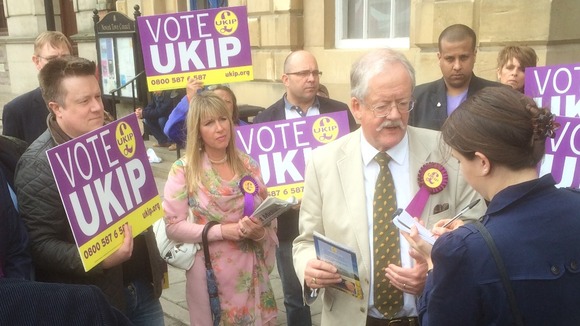
Roger Helmer Newark UKIP


If UKIP manages to defy the odds (and the polls) and win the Newark by-election, claiming their first seat in the House of Commons, the achievement will speak for itself – and the strength of the British political earthquake will be confirmed.

But what will a Conservative victory in Newark mean? What will it mean if the Tories squeak across the finish line ahead of UKIP when the votes are counted on Thursday?

The Conservatives will spin a very upbeat narrative, as would be well within their rights. For an incumbent governing party locked into an unpopular coalition and coming off the back of a double mauling in the local and European elections, managing to staunch the bleeding and retain the confidence of the voters of Newark would be just the shot in the arm that David Cameron’s team needs.

But given the extraordinary amount of effort that the Conservatives are expending to beat UKIP (in a race where Labour and the Liberal Democrats are relegated to the status of also-rans), have the Tories blundered by raising expectations so much that anything other than an emphatic Conservative victory will now be perceived as underwhelming, even worrying?

Be in no doubt, the Conservatives are desperate to hold on to Newark in the by-election. David Cameron has ordered all of the key cabinet members to go to Newark to campaign, while prospective Conservative Party candidates for 2015 and beyond have been sternly warned that they will be struck from the list of approved candidates unless they campaign vigorously enough in the town. Meanwhile, the local campaign office has an MP “roll of honour” prominently displayed on the wall, where visiting Tory MPs have to clock in and out. CCHQ takes the UKIP threat in Newark extremely seriously.

But many Tory seats are vulnerable to a UKIP surge in the general election, and no party will be able to mount the kind of desperate scorched-earth campaign against UKIP currently underway in Newark, replicated 30 or more times across the country. If this is what it takes for the Conservatives to halt the UKIP advance in just one parliamentary constituency, how will they cope when all of their incumbents are up for re-election in 2015 and all of their seats in play?

Of course, the opposite could also hold true. Some argue – quite plausibly – that it is the growing, insurgent party that fights best in a single constituency but which will struggle to marshal the resources to compete in multiple constituencies in a national general election. These people certainly have overwhelming evidence from other parties once seen as “the next force in British politics” on their side.

But what they miss – those who still blithely write off UKIP’s future prospects – is the fact that UKIP’s appeal and current performance is very little to do with their party organisation chart or their untried and untested voter mobilisation tactics. Previous insurgent parties such as the SDP were formed from schisms at the top of the establishment; the power of UKIP comes from the grass roots and lies in an idea.

The idea of UKIP is sometimes fuzzy around the edges, is articulated slightly differently by each activist the media might stop and question in the street, and is sometimes expressed forcefully and unpleasantly in a way that the party would not like; but for all that, it has the huge advantage of being small-c conservative without the long half-life toxicity of the Conservative party, unabashedly pro-British and demonstrably not of the “same old” political establishment.

Such is the British public’s current disdain for the same old Westminster political parties with their platitudes and broken promises, and such is the growing desire for a return to conviction politics where ideas and principles actually mean something and are worth arguing about, Britain could now be entering a phase where the country is unusually receptive to new ideas and bold solutions. If this is the case, even Grant Shapps, his computerised voter data models and his army of young student activists may be powerless to stop the advance of Nigel Farage.

We last saw this weariness with the status quo and desire for radical change in 1979, when Margaret Thatcher won election. Back then, the crisis facing Britain was economic and existential – would we continue to allow the trades union and the tired accommodations of the post-war consensus to continue sapping away at Britain’s vitality until there was nothing left but an impoverished, third-rate, failed socialist state.

In 2014, many Britons (save UKIP) do not see an existential threat, but there is nonetheless a crisis of ennui, disengagement, democratic illegitimacy and the return of that 1970s fatalism that says Britain can no longer prosper without pooling political sovereignty with Europe on the unfavourable terms of the vanquished.

The Newark by-election campaign is revealing exactly what the revamped Conservative Party machine and ground game is capable of when the Tories really, really want something. Thursday’s result will give the first hint as to whether this will be enough to stop UKIP in 2015.


UPDATE:  The Telegraph’s James Kirkup appears to be in agreement with this assessment. He writes:

A win in Newark would show that the Tory election machinery is in good nick – or at least that a professional party campaign apparatus can trump a band of amateurs with more conviction than organisation.

And is that the same thing as winning the argument? Have a quick glance at the national opinion polls: the Tory number is hovering around 33, with Labour a couple of points ahead. Remember 2010? Those figures were CON 36 LAB 29. And that still wasn’t enough for a Tory majority.

A win in Newark will solidify Tory optimism about the general election, but it won’t change the awkward fact of national politics: the party still has a long, long way to go to win that majority.

More Reasons For UKIP’s Popularity

Winston Churchill Texas

The commentariat class continue to scratch their heads in puzzlement as to how UKIP’s support is not melting away in the face of wall-to-wall attacks from the media and the political establishment, and this blog continues to patiently explain why this is the case.

Well, for those who obstinately refuse to learn, here is yet another reason – Labour and the Conservative Party have given a clear demonstration of their ideological muddle by both hiring former Obama campaign officials to help with their respective 2015 general election messaging efforts.

First Labour (whose rollout of former Obama senior adviser Axelrod went hilariously badly):

Ed Miliband hailed the appointment as “excellent news” and predicted the strategist would be a “huge asset to our campaign as we work to show the British people how we can change our country for the better”.

Mr Axelrod said he had been struck by the power of the Labour leader’s ideas and the “strength of his vision”.

He drew a comparison between Mr Miliband’s economic policies and the arguments articulated by Mr Obama in 2008, saying both have at their core “the experience of everyday people”.

And then the Conservatives:

The Conservatives have also recruited another former adviser to Barack Obama, his ex-campaign manager Jim Messina, to work on their 2015 election team.

As with Mr Axelrod, Mr Messina is not leading the campaign on the ground but remains in the US, reporting to the Conservatives’ senior management team.

It is common knowledge that the Britain sits well to the left of the United States on the political spectrum, so in one sense it is not surprising that an American Democrat such as Axelrod might still find common cause with Britain’s centre-right party (he wouldn’t be caught consorting with a Republican in a million years).

But in another sense, it is a terrible indictment of the British political system that both main political parties – our two ‘polar opposites’, the alpha and the omega of our choices come election day – are either so intellectually bankrupt or coldly calculating that they can both recruit from same same American political talent pool and still present themselves to the British public as though they are different as chalk and cheese.

Intellectually bankrupt or coldly calculating. In truth, there is a fair measure of both at work in the Labour and Conservative parties. Both have followed the example of ‘triangulation’ pioneered so successfully by Bill Clinton, in order to win over the undecided middle while hanging on to just enough of their restive core voters to make it over the finish line.

Tony Blair’s New Labour certainly took the triangulation strategy and moulded it into a political work of art. But make no mistake, the Conservatives are at it, too. Even when accounting for the fact that they have governed only in coalition since 2010, the fact that they have allowed harmful defence cuts and continued encroachments on civil liberties while largely tolerating Labour’s legacy of tax hikes and fiscal drag shows that they, too, see more value in playing to the woolly undecided voters in the middle than making a convincing ideological case for their core principles.

Which brings us back to Nigel Farage and UKIP.

Say whatever else you like about them, but here is a party that has a set of core beliefs and is unafraid to articulate them plainly and simply. (If you are reading this and thinking “but surely all UKIP stand for is leaving the EU, with a portion of racism on the side” then you have been indoctrinated well by the media who have slavishly served the interests of the main political parties – but UKIP do actually have a broadly libertarian policy platform that can be easily researched).

Leaving aside the coming European elections on Thursday 22 May, UKIP’s increasing (and surprisingly solid) popularity is not just a function of the British people having nowhere else to meaningfully express their euroscepticism or their dislike of politicians in general (the protest vote). It is driven also by the fact that conviction politics is all but dead in Britain, leaving many thoughtful and politically aware people with no one who speaks their language, but a host of politicians willing to patronise and double-cross them to gain votes, before discarding them once they are delivered into power.

Tony Benn and Margaret Thatcher are no longer with us, and British politics is suffering the absence of them and their kind. The few conviction politicians left in the House of Commons tend to be curmudgeonly old men and women (think Glenda Jackson or John Redwood) whose prime days are behind them and who will never be brought back in from the margins. And this leaves the political future to be shaped by the oily likes of Ed Miliband in the labour party (with young guns such as Chuka Umunna or Gloria de Piero to look forward to when he is inevitably deposed), and Cameron-Osborne for the Tories.

So forget about the European Union and the Newark by-election. Forget about the mudslinging and accusations of racism from one side and intimidation from the other. In many ways, it’s all just noise, the kind of nonsense we are left to argue about when there is so little left to distinguish the three main political parties from each other when it comes to real life policy.

When Labour and the Conservatives are so indistinguishable that they both instinctively look to buy Barack Obama’s 2008 message of “hope and change” from across the Atlantic, is it any wonder that the only party with an authentic, home-grown message is reaping the rewards in the polls?


Picture: Student drawing from an elementary school in Texas

What Do The Tories Stand For?

Interchangeable
Interchangeable


Iain Martin poses an excellent question to restive Conservative ministers and backbenchers currently jostling for position in a 2015 conservative leadership election that may very well never transpire – what would they do for the country if they actually got the job?

A very pertinent question. Watching the unseemly attempts of cabinet member after cabinet member manoeuvre for advantage and brief against perceived rivals provokes unpleasant flashbacks to the time when Gordon Brown finally had his way and muscled Tony Blair out of Number 10 Downing Street, only to become prime minister and realise that he had just fulfilled the extent of his ambition.

With more than a year to go until what will undoubtedly be a closely-fought election campaign, now is really not an appropriate time for self-interested ministers to be promoting their personal prospects at the expense of stable governance. And if they absolutely must indulge in such counterproductive, selfish shenanigans, they could at least give the public some semblance of a reason to believe that they offer a better alternative to David Cameron.

As Iain Martin points out, none of the would-be plotters have yet risen to this challenge:

Some people are positioning ahead of a potential vacancy and talking seriously in private about who the next Tory leader will be. So far it has all been very heavy on personalities and score-settling.

What we hear less of is ideas. What do those who want to succeed Cameron, if he loses, want to do with or for the country? This is, I know, a hopelessly naive question, although I never tire of asking it during a leadership race.

We already have a coalition government that stands for next to nothing. Blaming Labour for the country’s economic predicament and the state of the public finances may be correct, but it doesn’t amount to a platform for governing. And with little more than a year left in the lifetime of this parliament, we can expect precious little more in terms of radical or effective new policies. This mean that the electorate has to make up their minds based on what we can see today. So what is there?

Michael Gove’s education reforms spring to mind as something both tangible and in line with conservative principles, but aside from that, what else can the Tories point to? The period from 2010, when the United Kingdom finally escaped the Gordon Brown terror, has been characterised by retrenchment and burden-sharing and sacrifice-making and painful compromise at every turn. There has been almost nothing positive. Whether it is fiscal policy, defence policy, welfare reform (though credit to Iain Duncan Smith for at least trying), privacy or constitutional reform, it has been an exercise in damage limitation on all fronts.

If the conservatives were (heaven forfend) to elect Boris Johnson as their new leader, or Theresa May, or George Osborne or anyone else, what would they do differently? Why go through the trauma of ditching Cameron and choosing someone else who may be identical, or worse?

Iain Martin proposes a good set of questions, well worth asking, that could help distinguish one candidate from another and maybe tease out some real talent or independent thinking amidst a sea of caution and homogeneity. Making the valid point that voters will not warm to a new leader who only attained his or her position by virtue of being ‘next in line’, he issues the following challenge:

Eventually, the rest of us in the audience – taxpayers, the people who live here, Tories and non-Tories alike – might like to hear what applicants to be Conservative leader and trainee prime minister have in mind, other than stopping each other.

Here are his ten questions:

1) How can the country be more productive?

2) How can we maximise the advantages of globalisation without having to concrete over the whole of southern England to accommodate the millions more who want to be here?

3) Are our banks still too big and how do we get more competition to aid consumers and business?

4) Why is the tax system such a mess of conflicting incentives?

5) Is EU membership really compatible with being a self-governing nation state?

6) Is it even possible to be truly self-governing any longer in the age of the EU, big tech and giant corporates that operate across continents?

7) The Blair/Gove education reforms are up and running – how might they be built on?

8) What is the UK’s foreign policy?

9) What are the threats and how will we defend ourselves?

10) Can the UK be remade to give all its constituent parts, especially England, greater autonomy while still holding together the Union?

While it is absolutely right to challenge those seeking to be David Cameron’s successor to answer these questions, in reality it would be good for all politicians and party leaders to have a stab at addressing them, because these ten questions really form the basis of how we currently see ourselves as a country, and where we want to go from here.

Take the first question on productivity. This could lead to an interesting debate along any number of lines, including trade union reform, European Union membership status, working conditions for interns and apprentices, and more. Already we would see a divide between the mainstream Conservative party MPs who remain deeply eurosceptical, and the more Europhile fringe. Similarly, a contrast would be drawn between the mainstream anti-union position and those such as Robert Halfon MP who have been trying to reintroduce a trade union heritage to the party.

The tax system question is also one that urgently requires answering, not just to help search for the ideal future Tory leader but because the current tax code is such a mess. Some are quite keen to continue incentivising certain ‘good’ behaviours such as marriage through the tax code while others (one dares to hope) might argue for a radical stripping down and simplification of the system. While none of the potential candidates are likely to come out in support of a genuinely interesting idea such as a flat tax, we might see ideas about eliminating the myriad of tax credits in order to lower rates for everyone gain some traction.

Martin’s list is not perfect, and some of the questions are more philosophical than immediately useful. The brace of questions on the EU, for example, are the type of topic that one could imagine being debated at length over canapes at Davos or Bilderberg, but which are of no help in distinguishing future Tory leadership candidates. EU membership is clearly increasingly incompatible with being a self-governing nation state, and will remain that way for as long as the Treaty of Rome’s ‘ever closer union’ call continues to be advanced with no democratic mandate from the European people. And no Tory leader is ever likely to publicly surrender British policymaking to the forces of the EU, multinational business or big tech, no matter what compromises may take place in secret.

The questions on foreign policy and preparing to meet future threats are of extreme importance. While Russia’s annexation of Crimea and continued slide back toward authoritarian despotism is not about to herald a new age of big set-piece land wars in Europe, it will at least hopefully remind UK policymakers that the next unknown threat to the UK will by definition come from out of the blue. Having been chastened by that reminder, Tory leadership candidates might have some refreshing opinions on the size, strength and scope of our armed forces, perhaps with a view toward undoing some of the recent damage done.

The final question on remaking the UK to allow greater (and ideally equal) autonomy for all constituent nations of the United Kingdom, and the need to clearly set out those powers that belong at Westminster, those that belong with the home nations and those that should be devolved to local level is perhaps the most important of all. This blog has long advocated for answering this question by holding a UK constitutional convention to decide these matters once and for all. While this is an extremely unlikely prospect, it would be interesting to know the potential candidates’ thoughts on these matters.

But of course we will hear no opinions on any of these matters, because there are no Tory leadership candidates. And there are no Tory leadership candidates because there is no Tory leadership election on the cards.

The bottom line is this – there are a lot of important questions about the current state of our country and how best to move forward. Iain Martin has done a good service by listing some of these, and any politician who can disengage from the daily grind of politicking and governance for long enough to answer them would be making a valuable contribution to the debate.

But those Conservative ministers and prominent backbenchers inclined to look past the 2015 general election to burnish their leadership prospects while refusing to engage in real debate on the issues are just being opportunistic and cowardly, and do not deserve the air time or our attention.

Those who want to replace David Cameron as leader of the Conservative Party ought to try believing in and standing for something themselves – something other than their own selfish career advancement – before the jostling for position and knife-sharpening gets out of hand.