Little Englander Conspiracy Theories, Eh?

Francois Hollande - Common State - European Union - EU Referendum - Brexit

It isn’t difficult to discern the trajectory of the European Union over the next decades. Just listen to the words of the EU’s leading political figures from past and present

Leave Alliance blogger Paul Reynolds has published an excellent retort to claims by assorted Remainers and EU apologists that those of us who warn of the impending European state are somehow indulging in paranoid fantasies.

For while everyone in the Remain campaign, from the prime minister on downwards, may be shouting “move along, nothing to see here!” while the scaffolding for a single European state continues to be steadily assembled behind their outstretched arms, any objective person can clearly see what is going on.

Among the examples given by Reynolds, in a piece entitled “A Profound Choice”:

“We have sown a seed… Instead of a half-formed Europe, we have a Europe with a legal entity, with a single currency, common justice, a Europe which is about to have its own defence. ” — Valery Giscard d’Estaing, President of the EU Convention, presenting the final draft of the EU Constitution, 13th June 2003

“The proposals in the original constitutional treaty are practically unchanged. They have simply been dispersed through old treaties in the form of amendments. Why this subtle change? Above all, to head off any threat of referenda by avoiding any form of constitutional vocabulary!” — Valéry Giscard d’Estaing, 2007, referring to the the Lisbon Treaty achieving the aims of the rejected EU constitution

“The Constitution is the capstone of a European Federal State.” — Guy Verhofstadt, then Belgian Prime Minister, now an MEP

“The European Union is a state under construction.” — Elmar Brok, Chairman of the European Parliament’s Committee on Foreign Affairs

“Of course the European Commission will one day become a government, the EU council a second chamber and the European Parliament will have more powers.” — German Chancellor Angela Merkel addressing MEPs,  November 2012.

“We need a true political union … we need to build a United States of Europe with the Commission as government and two chambers – the European Parliament and a “Senate” of Member States … European Parliament elections are more important than national elections … This will be our best weapon against the Eurosceptics.” — Viviane Reding, Vice-President of the European Commission, January 2014

“For my children’s future I dream, think and work for the United States of Europe” — Matteo Renzi, Italian Prime Minister, May 2014

 “I look forward to the day when the Westminster Parliament is just a council chamber in Europe.” — Kenneth Clarke, Conservative Chancellor in International Currency Review Vol 23 No 4 1996

Reynolds then goes on to show how this was the plan all along. As it was in the beginning:

Nor should anyone believe that this is a recent development. The EU was always conceived as a vehicle for supra-national federal union, dating right back to its founding organisation, the European Coal & Steel Community (ECSC) established in 1951:

“Through the consolidation of basic production and the institution of a new High Authority, whose decisions will bind France, Germany and the other countries that join, this proposal represents the first concrete step towards a European federation ..”
 — The Schuman declaration May 1950

“By the signature of this Treaty, the participating Parties give proof of their determination to create the first supranational institution and that thus they are laying the true foundation of an organised Europe.” — Europe Declaration made on 18 April 1951, at the signing of the Treaty of Paris establishing the ECSC

Is now:

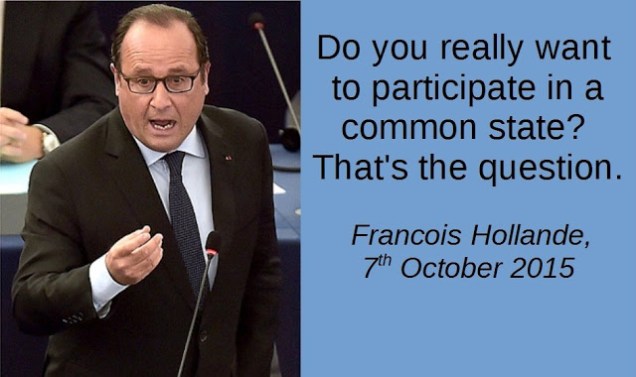
“Do you really want to participate in a common state? That’s the question.” — Francois Hollande, French President, addressing UKIP leader Nigel Farage in the European Parliament, 2015

And forever shall be:

This is reinforced by the proposals for the next EU treaty, The Fundamental Law of the European Union, published by the federalist Spinelli Group of MEPs, through the Bertelsmann house in late 2013. The preamble contains a telling paragraph:

“This proposal for a Fundamental Law of the European Union is a comprehensive revision of the Treaty of Lisbon (2007). Replacing the existing treaties, it takes a major step towards a federal union. It turns the European Commission into a democratic constitutional government, keeping to the method built by Jean Monnet in which the Commission drafts laws which are then enacted jointly by the Council, representing the states, and the European Parliament, representing the citizens. All the reforms proposed are aimed at strengthening the capacity of the EU to act.” 

European Political Union without end, Amen.

The time for childish, wistful self-deception is over. The British people need to wake up and make a decision – as Francois Hollande rightly exclaimed last year, in a moment of rare candour – about whether we want to participate in a common European state, or whether we wish to be independent, like every other major country in the world outside of Europe.

Ignorance about the intentions and trajectory of the European Union is no longer excusable. These quotes are not difficult to be defined. Neither can their existence be denied or countered in the way that the various economic claims on both sides have been subject to ridicule. These statements all exist because the real political leaders of Europe really do intend to take the European Union in this direction. Today’s EU institutions stand as testament to their vision and their determination to make it a reality.

Contrast the determined long game played by the euro federalists (the quotes selected by Paul Reynolds extend from 1951 through to 2015) with the flimsy, ethereal, cosmetic efforts of British politicians to supposedly win “concessions” from the EU. David Cameron’s renegotiation was nothing more than a grubby little fraud perpetrated on the British people, securing meaningless nods of assent from various heads of government acting in their own capacity, not the EU’s, most of whom will soon have moved on and been replaced by successors who do not feel bound to honour the various tidbits promised to Britain.

And leftists are no better. The once proud and principled tradition of left-wing euroscepticism is virtually dead, stabbed in the back by the likes of Jeremy Corbyn and Owen Jones (was the guilt and shame of this betrayal – and he knows he is betraying his true values – the reason why Owen turned in such a weak performance on Question Time last night?). And the leftists are now queueing up to talk about their utterly unachievable pipe dream of hands-across-Europe socialism, pretending to themselves and the rest of us that the EU can somehow be “changed” into a perfect socialist vessel. The EU’s founders and current leaders have been working toward a common state for nearly a century! What gives the likes of Owen Jones and Yanis Varoufakis such misplaced confidence that their little socialist tugboat can alter the course of the EU’s giant oil tanker, steaming at maximum knots toward economic and political union?

No, there are only two choices available to Britain – leave the European Union and seek to become a self-governing democracy once again (like every other major country in the world), or remain in the European Union and continue down Francois Hollande’s path toward a common European state.

There is no third way. David Cameron’s renegotiated settlement is not worth the used napkin on which it is scrawled – as far as the EU is concerned, a “Remain” vote mean that Britain is all squared away and ready to continue the march toward political union.

And those who continue to fatuously claim that the EU is simply about cooperation, trade and sharing cookies with one another are lying – to themselves, and to the British people. That benign version of “Europe” is not on offer in this referendum. We have a choice between independence and re-engagement with the world as a confident, powerful player on the one hand, and continued participation in the journey to a common European state on the other.

Do you really want to participate in a common state?

As Britons step into the polling booth on 23 June, this is the question which should ring in our ears.
 

European Union - United Kingdom - Britain - Flags

Top Image: The EU Question

Agree with this article? Violently disagree? Scroll down to leave a comment.

Follow Semi-Partisan Politics on TwitterFacebook and Medium.

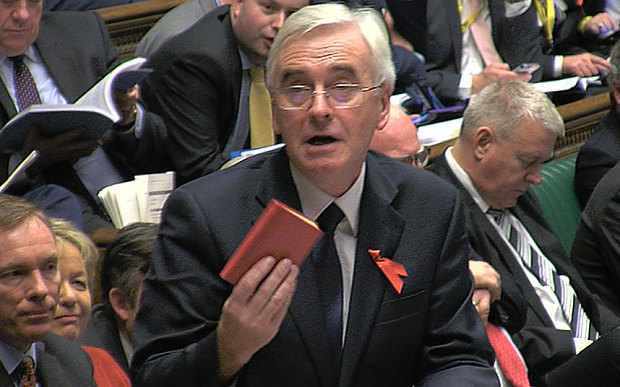
Warning Of ‘Tory Brexit’, Labour’s Unspeakable Shadow Chancellor Parades His Contempt For Democracy

John McDonnell - Little Red Book - Tory Brexit

The Labour Party doubles down on its sick, openly anti-democratic case for Britain remaining in the European Union

That slobbering, Marxist, assassination-approving, lynching-advocating IRA-supporter John McDonnell continues to show his contempt for democracy by loudly opposing Brexit on the grounds that freedom from the European Union might make it easier for a democratically elected British government to actually, y’know, govern.

Of course this would be terrible and cannot possibly be allowed to happen – when the incumbent government is a Tory one, that is.

Labour’s unspeakable shadow chancellor is now taking to the pages of the New Statesman to promote his pie-in-the-sky, fantasy land “Another Europe”, whereby an explicitly integrationist and federalist club can be magically transformed by McDonnell, Jeremy Corbyn, Yanis Varoufakis and other assorted left-wingers into some kind of Utopian, socialist paradise.

McDonnell, trialling his “Tory Brexit” catchphrase again, writes:

The undeniable truth about the referendum is that what is on offer is a Tory Brexit. On 24 June, we will still have a Tory government, because under the Fixed-Term Parliaments Act the Conservatives could change leader from David Cameron to Boris Johnson and still try to cling on until 2020.

This would be a disgraceful betrayal of democracy. But what over the past six years has suggested to you that anything would be beneath the Tories? And, regardless of who would be leader of their party, the initial trade negotiations following a Tory Brexit could resemble TTIP on steroids.

We know what they think of the Working Time Directive; can you imagine what other workplace rights they would trade away and try to blame on someone else? With global economic uncertainties combined with George Osborne’s economic incompetence, the UK is uniquely exposed to the risk of an immediate economic fallout from a Tory Brexit.

Odd, you might think, that Labour’s shadow chancellor is so happy to associate the movement to restore democracy and independence to Britain with his lifelong enemies in the Conservative Party. But then these are not ordinary times.

McDonnell continues:

I want to see a reformed EU in which we make many of its institutions more transparent and democratic. For the first time in a generation, there is a growing coalition of socialists across the EU who can help us achieve this together. By choosing Labour’s “Another Europe” agenda, our country can stand with others across Europe to make a positive case to end austerity, offer a more humane response to the migrant crisis and protect and expand workplace rights.

And the evidence that this Magical Candyland Europe spoken of so warmly by leftists from Jeremy Corbyn to Owen Jones is actually achievable? Zip. Zilch. Nada. Tumbleweeds. The very purpose of the European Union is to facilitate a process of integration towards a common European state. Don’t take my word for it – see what the EU’s own leading voices openly say about their creation. In this grand endeavour, democracy is the mortal enemy. And John McDonnell seriously thinks that he can make EU institutions deliberately designed to shut out popular opinion more democratic?

Whether or not there is indeed a growing coalition of socialists, there is absolutely nothing to suggest that they currently form – or could conceivably form in the future – a bloc powerful enough to wrest control of the key European Union institutions. Even if the parties of the far-left somehow manage to defeat the parties of the centre, centre-right and far right and become a force in the European Parliament (itself an impossibly tall order), so what? The European Parliament is a rubber stamp, the least important and least powerful of all the EU institutions. How does that alter the makeup or direction of the Commission or the ECJ? The answer, of course, is that it doesn’t.

The very best scenario that McDonnell and friends could conceivably hope for is to jam the European Parliament with a bunch more angry leftists. But any anti-establishment wave which helps the left is generally likely to help the right, too. In fact, the radical right have been running rings around the socialists for some time. McDonnell’s dream scenario, therefore, is one where parties like Podemos and Syriza scream at parties like UKIP and others much further to the right, and bring the European Parliament to a cacophonous deadlock, while the other EU institutions – the ones which actually matter – glide on, unchecked.

Here is a political party – and an approximation of a man – who have let their blind, seething, inchoate rage against the Evil Tories snuff out what little dedication they ever had to democracy or respect for the will of the people. Here is a shadow chancellor and broader left-wing movement who are so wedded to their policy of unthinking, virtue-signalling pseudo-internationalism that they would sooner doom Britain to remain trapped in an antidemocratic, dysfunctional, failing political union than admit the terminal flaws in the European Union and fight for left-wing policies in a newly independent Britain.

But more than all of that, this is a left wing movement which cares about democracy only when it advances their own particular narrow agenda. John McDonnell isn’t willing to energetically make the case for the things he claims are under threat in case of Brexit. He simply wants those things to be undemocratically imposed on the British people by a higher, supranational authority. He wants to win without trying, to impose his beliefs on others without doing the hard work of winning them over. McDonnell literally doesn’t care how his policies are implemented, or who is steamrollered in the process – just as long as those clapped-out old left-wing policies somehow see the light of day.

You can call that “passionate” and “principled” if you want, if you are still enthralled by the Corbynite glow. But the rest of us should call it what it is – narrow minded, bigoted authoritarianism.

Meet your friendly Labour Party of 2016 – happy to throw democracy and British independence under the bus in pursuit of the fevered hallucination of a united, socialist Europe.


European Union - United Kingdom - Britain - Flags

Top Image: Telegraph

Agree with this article? Violently disagree? Scroll down to leave a comment.

Follow Semi-Partisan Politics on TwitterFacebook and Medium.

More Commentators Embrace The Norway Option As Part Of A Staged Brexit Plan

Norway Option - A Good Start - Brexit - Flexcit - EU Referendum - European Union

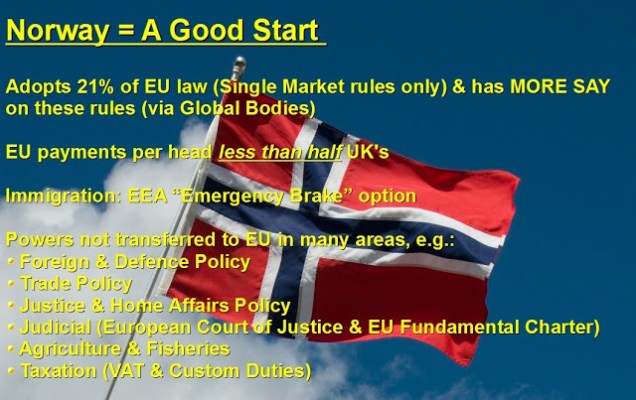
At long last the penny has started to drop among serious influencers that a Brexit to the so-called “Norway Option” as an interim staging position is the only safe, stable and plausible Brexit plan on offer – regardless of whatever Vote Leave may say

Maybe it was Vote Leave’s alarming pivot back to immigration with the rollout of their Australian style points-based scheme, or maybe it was just the slow accumulation of tactical and strategic idiocy bordering on political self-harm.

But regardless of what it was that finally caused Vote Leave to hit rock bottom in the eyes of the commentariat, we should all be eternally grateful – because finally, serious and influential minds with serious bully pulpits are starting to look past the Boris clown show and talk openly about the Norway Option being the only sane Brexit plan capable of delivering a safe, stable process of withdrawal from the European Union.

First, last week, Allister Heath came over to the light side of the Force:

The core assumption of the anti-Brexit economists is that leaving would erect damaging barriers to trade; the pro-Brexit side must take on and demolish these arguments. The good news is that it’s quite easy to do so. The Leave campaign’s long-term aim is to break away completely from the EU. But there is no doubt that, were we to vote Leave on June 23, the UK would seek to adopt, as an interim solution, a Norwegian-style relationship with the EU which ensures that we remain in the single market, giving us plenty of time to work out new arrangements with the rest of the world.

That is both the only realistic way we would quit the EU – the only model, that, plausibly, MPs would support as a cross-party compromise deal – and the best possible way for us to do it. The Norwegians would welcome us with open arms, as their own influence would be enhanced, and other EU nations would seek to join us. Such a deal would eliminate most of the costs of leaving, while delivering a hefty dose of benefits as a down payment.

As part of the European Free Trade Association, we would remain in the single market, complete with its Four Freedoms, while withdrawing from agricultural and fisheries policies, justice and home affairs and the customs union. The City wouldn’t lose access and virtually all of the anti-Brexit scare stories would be neutralised, which is presumably why that option was mysteriously absent from the Treasury’s ludicrous analysis of the short-term impact of Brexit.

And now, Heath’s Telegraph colleague and International Business Editor Ambrose Evans-Pritchard has weighed in with a forceful case for the Norway Option as the only sensible plan for extricating Britain from European political union within the constraints set out in Article 50 of the Lisbon Treaty:

The Leave campaign must choose. It cannot safeguard access to the EU single market and offer a plausible arrangement for the British economy, unless it capitulates on the free movement of EU citizens.

One or other must give. If Brexiteers wish to win over the cautious middle of British politics, they must make a better case that our trade is safe. This means accepting the Norwegian option of the European Economic Area (EEA) – a ‘soft exit’ – as a half-way house until the new order is established.

It means accepting the four freedoms of goods, services, capital, and labour that go with the EU single market. It means swallowing EU rules, and much of the EU Acquis, and it means paying into the EU budget.

We can quibble over the wording “much of the EU acquis”, as analysis puts it closer to reasonable-sounding 28 percent, but otherwise this is spot on. The article actually explicitly mentions Flexcit and the work of Dr. Richard North, as well as the recent welcome interventions from the Adam Smith Institute courtesy of ASI fellow Roland Smith. In fact, the Telegraph is becoming quite the incubator of serious liberal Brexit thinking of late.

In his latest Telegraph column, Allister Heath goes further and points out that the onus is in fact now on Remainers to explain what the European Union will look like in twenty years’ time given the various crises besetting it (and the EU’s instinctive ratchet towards ever more centralisation), and how voting to Remain could possibly be considered the “safe” option:

The EU was always intended by its founders to be a process – a mechanism by which formerly independent European countries gradually bind themselves together into an ever-closer union. Crises were seen as useful flashpoints that would trigger a further push to integration, and its central institutions were deliberately designed to seek and accrue power.

When I was growing up in France, it was made consistently clear that the EU was a political project that used economics as a tool of state-building; the single market was created because all countries have a free internal market, not because the EU’s founding fathers believed in international free trade. We used to be taught all of this openly and explicitly at school: the EU was the obvious, rational future, the only way war could be avoided and the best way to protect our social models from the ravages of “Anglo-Saxon” markets.

There are therefore two possibilities if we vote to stay: eventual abrupt disintegration, or further EU integration. If the latter, how many more powers will we give up when the next treaty comes along, and how much “progress” will be made in critical areas like a European army, tax harmonisation, and the centralisation of justice and home affairs? Why haven’t voters been told ahead of June 23?

The biggest, costliest and most immediate change after a Remain vote would be psychological. Forget about all the caveats: an In victory would be hailed as proof that Britain has finally ceased fighting its supposed European destiny. Our bluff would have been called in the most spectacular of fashions: after decades of dragging our feet, of being ungrateful Europeans, of extracting concessions, rebates and opt-outs, of trying to stand up for our interests, we would finally have hoisted the white flag. The idea that we would hold another referendum on the next treaty would simply be laughed out of town. Voting to Remain would thus be a geopolitical disaster for the UK, a historic failure.

Comfortable, middle-class voters who are considering sticking with the devil they believe they know need to think again. Voting to remain is a far greater leap into the unknown than voting to leave. It’s self-evidently normal to be independent and prosperous: just look at America, Australia, Canada or Singapore. But there are no known examples of a previously independent democracy being subsumed into a dysfunctional, economically troubled technocracy and doing well as a result. As mad gambles go, it is hard to think of anything worse.

And in a final coup, Toby Young has blessed the Norway Option on Twitter:

https://twitter.com/toadmeister/status/738097722692149251

To which one can only say: Alleluia. Good. It’s about time.

Hopefully we are now witnessing the beginnings of a slowly building stampede away from the car crash of an official Leave campaign masterminded by Dominic Cummings and toward something better. Hopefully this is the result of serious people with pro-Brexit sympathies starting to realise that surely there must be something better than Vote Leave’s sixth-form level campaign about voting leave to Save Our NHS, doing some research of their own and finding that the solution was there all along in the form of the Norway Option.

There certainly now exists a wealth of independent research and writing advocating for the Norway Option as an interim staging post on the journey out of the European Union, and for the general principles enshrined in Flexcit. The tireless indie bloggers of The Leave Alliance can surely claim some much-deserved credit for this turn of events.

But will the eureka moments experienced by Allister Heath, Ambrose Evans-Pritchard and Toby Young be enough to make a material difference to the trajectory of the campaign? It’s a tall order – unless they do really represent just the beginning of a much larger landslide of Brexit-sympathising commentariat opinion away from the clown show.

A few columns are a good start, but they are nothing compared to the incessant Vote Leave campaign commercials now playing on YouTube, exhorting British voters to leave the European Union so that well-known NHS fanatics like Boris Johnson and Michael Gove can build a brand new, state-of-the-art NHS hospital on every street corner with the money that we supposedly save.

While we should be encouraged by this positive development and seek to exploit these endorsements, it does feel rather like establishment Brexiteers, in freefall and with the ground rushing up to meet them, have finally remembered to pull their parachute cord a mere hundred feet from the surface.

Action at this late stage is unlikely to significantly slow our descent, and our slim hopes of survival rest either in having our fall arrested by the branches of a major anti-establishment backlash, or by landing in the soft, distasteful swamp of stronger than expected anti-immigration sentiment.

Victory for the Leave camp is not yet impossible – all the more reason to keep fighting – but having waited so late to even begin to publicly embrace any kind of Brexit plan, neither is our fate squarely in our own hands.


European Union - United Kingdom - Britain - Flags

Top Image: The EU Question

Support Semi-Partisan Politics with a one-time or recurring donation:

Agree with this article? Violently disagree? Scroll down to leave a comment.

Follow Semi-Partisan Politics on TwitterFacebook and Medium.

Why Alan Sugar’s Intervention In The EU Referendum Debate Matters

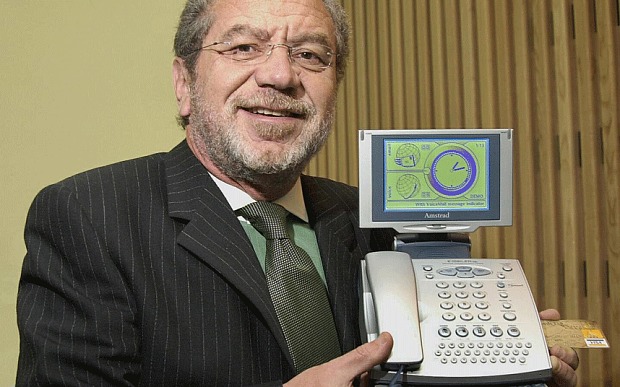
Alan Sugar - Amstrad Emailer

In the year 2000, when the internet was taking off and PCs and laptops were becoming more widely affordable, celebrity businessman Alan Sugar bet the house on his Amstrad Emailer device – an embarrassing, uneconomical and altogether pointless hybrid between a landline telephone and 1990s-era AOL. It didn’t go well. And now, in 2016, Britain’s facetious answer to Steve Jobs has something important to tell us about Brexit

People who host The Apprentice seem determine to shoehorn their way into our political discourse this year. First Donald Trump defeated fifteen human watercolour paintings to become the presumptive Republican Party nominee for US president, and now Trump’s British not-quite-equal, Alan Sugar, has parachuted into the middle of the raging EU referendum debate.

And Sugar certainly has Donald Trump’s ability to execute a 180 degree U-turn while vehemently denying that he has ever changed his position. Only six months ago, Lord Sugar could be found excoriating Brussels and ranting about how much the EU constrained his business. Fast-forward to today, however, and Lord Sugar 2.0 – newly appointed government enterprise tsar – is telling anyone who will listen that Britain leaving the EU is crazy and unimaginable.

From the Daily Mail:

Lord Sugar has urged voters not to be ‘daft’ by backing Brexit as he joined a host of high profile business figures who came out in favour of staying in the EU.

The businessman and Apprentice boss has produced a video making his pitch for Britain to stay in the EU.

He tells viewers they ‘could not be listening to a bigger gambler than me’ but says leaving the EU is a ‘gamble we can’t afford to take’.

Describing himself as an ‘East End chap’ who had built a business empire from scratch, he blasts the ‘daft ideas and duff proposals’ put forward by Brexit campaigners and said it would be a ‘massive mistake’ to quit the EU.

Lord Sugar, who was appointed as the Government’s enterprise tsar last week, says in the video: ‘Having lived in this country for 69 years, a country which I love, I just don’t want to see a massive mistake being made by the younger generation or, indeed, any of the generations who just simply do not understand the ramifications of leaving the European Union.’

Donald Trump would famously take any position, campaign for any cause, support any politician, donate to any political party so long as it won him access to people in power – that’s how a big Hillary Clinton supporter who was once on the liberal side of all the culture wars is now the presumptive GOP nominee. And it seems that Alan Sugar is an opportunistic sell-sword in the same vein.

But in many ways, there could be no more appropriate intervention on behalf of the Remain campaign than that now bestowed by Alan Sugar, the brains behind the Amstrad Emailer, that revolutionary and futuristic communications device. In fact, the comparisons between Sugar’s perennially unpopular “super telephone” and the European Union are quite striking.

Both the European Union and the Amstrad Emailer are anachronistic inventions, hopelessly outdated even before they saw the light of day (the EU as it is currently known came into force with the Maastricht Treaty of 1992, when globalisation was really beginning to take off and the idea of large, homogeneous regional trading blocs was already showing its age).

Like the Amstrad Emailer, the European Union takes something generally agreeable (tariff and barrier-free trade) and packages it in a fearsomely complicated design with a dozen unwanted embellishments such as all the additional trappings of a European state.

Like the Amstrad Emailer, persisting with a fundamentally flawed product in the form of the European Union reveals much about the stubbornness and contempt for democracy (the market, in Sugar’s case) held by the “founding fathers” and today’s leaders of the EU.

Like the Amstrad Emailer, nobody today would ever create the European Union as it currently exists. We only persist with it because forty years of steadily deepening political integration makes leaving a complex process and a daunting one for many – not to mention huge resistance from the establishment who like the status quo, which gives European leaders power with no accountability, and British politicians the trappings and rituals of office without the pesky responsibility.

So yes, we should welcome Lord Sugar’s intervention in the debate because the brains behind the Amstrad Emailer has inadvertently revealed an uncomfortable truth: engaging with today’s globalised, interconnected, multilateral world through the filtered lens of the EU is like trying to broadcast and receive in High Definition using one of Alan Sugar’s duff products.

For example: Norway, outside the European Union but maintaining access to the single market through EEA membership, does not delegate its voice in trade negotiations to a single EU position (itself an awkward compromise between the priorities of 28 squabbling countries).

Pete North gives a telling example of why this matters:

Not only is Norway an independent member of Codex, it even hosts the all-important Fish and Fisheries Products Committee. Thus, it is the lead nation globally in an area of significant economic importance to itself. When it comes to trade in fish and fishery product, Norway is able to guide, if not control, the agenda on standards and other matters. The EU then reacts, turning the Codex standards into Community law, which then applies to EEA countries, including Norway. But it is Norway, not the EU, which calls the shots.

Britain, meanwhile, sometimes even has to endure the indignity of seeing our own vote (on international bodies where we retain a seat) used against us by the European Commission, which controls that vote because the EU claims exclusive competency in matters relating to trade.

This is what remaining in the EU means – forsaking all of the benefits which could come from taking an active, fully-engaged position in all of the global bodies which pass down rules and standards to the European Union, and instead choosing to hide behind the EU’s skirts and accept an endless succession of fudged compromises because we lacked the confidence and skill to play the fuller role in world trade which is available to us.

Like the Amstrad Emailer, the European Union is the basic and highly predictable option, the kind of gift you might buy your grandparents (except nobody ever did) because you think that they would be overwhelmed trying to learn how to use a full PC. And now, while they could be buying things on Amazon, talking to the grandkids on Skype, blogging, editing holiday pictures in Photoshop or even setting up an online business, instead they are doomed to forever make low-quality, grainy video calls to one or other of the remaining six people in the country to own one of Alan Sugar’s devices.

That’s us. That is Britain, for so long as we remain in the European Union. A little old granny whose relatives didn’t think that she would be able to handle the complexity of a decent laptop, pecking out typo-strewn missives to the world on a rickety plastic keyboard and a monochrome screen while the richness and variety of the internet completely passes her by.

Why on earth would we vote Remain when we could vote to Leave the European Union and properly re-engage with the world as the influential, powerful and capable nation that we are? Why, when the brand new MacBook of Brexit sits wrapped with a bow on the table next to us, are we still fearfully clinging to our trusty, familiar Amstrad Emailer?


Postscript: This article in The Register provides a hilarious summary of the Emailer’s fortunes as the Next Big Thing in technology:

Since March 2000, he has tried tirelessly, and unsuccessfully, to sell the concept to everyone from journalists to politicians to the City – all have turned the device down.

Termed “the most important mass market electronic product since he kick-started Britain’s personal computer market 15 years ago” by some idiot on the Mail on Sunday, the emailer emerged in a blaze of glory at the same venue as the cheap PCs that made Amstrad a household name 20 years ago.

It cost £79.99 and still does and within a week we concluded it was far too expensive. With even low usage, it would put £150 per month on your quarterly phone bill. The public agreed with our analysis and no one bought the thing.

But the more it has failed to take off, the more fanatical Sir Sugar has got about it. He vehemently denied technical problems in August that year, then when the subsidiary set up to deal with the emailer, Amserve, put up a £2.3 million loss, he took up most of the company’s financial report explaining why the device was so wonderful.

The next set of results in February were even worse. Profit down 82 per cent from £8.2 million to £1.51 million. Again Sir Sugar waxed lyrical about how wonderful the emailer was – sales continued to be “encouraging”. This time Amserve took a £3.9 million loss.

He managed to persuade the then home secretary Jack Straw to back it up. Mr Straw said it was the perfect example of how technology could be used to “improve the flow of information and intelligence in a bid to decrease crime” at a Neighbourhood Watch photo opportunity. It made no difference to sales.

The IT correspondent for The Independent then incurred Sir Sugar’s wrath when he wrote, one year on from the launch, that the emailer had been a failure. Sir Sugar sent an email to all emailer owners, ranting about the piece and providing the journalist’s email address. Unfortunately it backfired because many of the received emails concerned the terrible problems they were having with the device.

As does this classic spoof article in The Daily Mash.


Amstrad Emailer

European Union - United Kingdom - Britain - Flags

Agree with this article? Violently disagree? Scroll down to leave a comment.

Follow Semi-Partisan Politics on TwitterFacebook and Medium.

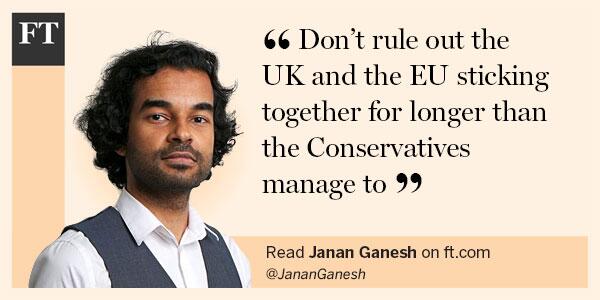
Janan Ganesh Is Wrong: Britain Can Still Make History – If We Leave The EU

Janan Ganesh - Financial Times - European Union - EU - Referendum - Brexit

A careless turn of phrase reveals a poisonous, negative attitude towards Britain held by prominent Remainers and EU apologists

What do passionate British europhiles and EU defenders really think about their own country?

This question is an eternal puzzle to Brexiteers, who have watched Remainers from the prime minister on down eagerly seize on every statement or piece of “proof” that Britain is too small and feeble to flourish without dissolving ourselves into the EU’s embryonic common European state.

And now, finally, we have something of an answer. In his latest FT column bemoaning the intra-party warfare currently consuming the Conservative Party, George Osborne biographer Janan Ganesh has the following to say about the United Kingdom:

Britain is not where history happens any more but our two flirtations with secession — Scotland’s from the UK, the UK’s from the EU — pique the curiosity of outsiders. They must look at the intra-Tory venom and assume its seepage into wider society. If Scots were lastingly politicised, and riven, by their referendum, Britons as a whole might be too. The stakes are as large, the facts as contested, the principals on each side as seethingly at odds as they were in Scotland in 2014.

And still we demur. The notable feature of this referendum is its lack of notoriety. With three weeks to go, pubs are not blazing with anticipation or rancour. Friends and relatives are not falling out. Campaign events are unmarred by anything darker than cheeky heckles. On the morning of May 30, only one referendum-related story made the 10 most-read on the BBC news website, and that was trumped by a crocodile attack in Queensland, Australia.

And there it is. Doesn’t that perfectly sum up the tone which pervades nearly all of the Remain campaign’s messaging during the referendum – the idea of Britain as a has-been nation, a place which was once consequential but no longer a place “where history happens”?

And of course this is exactly what Janan Ganesh, his colleagues at the Financial Times and many others in the Remain camp actually do believe. They (wrongly) think that we are a small island not only in geographical terms but also in geopolitical terms. They think that we don’t matter any more, that we will never again shape the world because we are not powerful enough and because we are not exceptional enough to do so.

To the mind of a Remainer, it is utterly perplexing why anybody would want a country as weak, fragile and inconsequential as Britain to leave the safe harbour of the European Union and head out into the storm. Sure, they grudgingly acknowledge, we made our mark on history in the past – and at this point they will often pause to apologise profusely for that very history – but we should never expect to do so again.

The future, they insist, belongs to those shining civilisations such as China and Russia, apparently – despite the fact that Britain remains the fifth largest economy, (by some measures) the second military power, and is home to some of the best universities, companies, popular and high culture in the world. And Britain should be grateful for any scraps we are fortunate enough to steal from a “top table” dominated by other, better countries.

But if the world really is now such a scary place that the only recourse for “fading glory” Britain is to shelter inside a remorselessly tightening political union, how come other countries, many of them much smaller than us, are not also busy dissolving themselves into regional political blocs?

The threat of terrorism affects Australia too, as we saw with the 2014 Sydney hostage crisis. Australia would also be threatened by any global conflagration involving Vladimir Putin’s Russia. And Australia is just as vulnerable to a world economic downturn as Britain – if not more so, given her remote geographic location.

So why isn’t Australia hastening to form a political union with New Zealand and other APAC countries? Why is there no Pacific Union headquarters being constructed in Malaysia, or elections being held to elect MPPs to the new Pacific Parliament? Why is there no Pacific Court of Justice being set up to adjudicate and enforce adherence to region-wide regulations and human rights laws?

Why, for that matter, is Canada not racing to form a political Union with the United States and Mexico, following the EU’s lead and turning NAFTA from a free trade group into an explicitly political union?

The answer, of course, is that political union does nothing – nothing whatsoever – to meet or tackle the most serious challenges facing our world. Australia and New Zealand are perfectly capable of intergovernmental co-operation without the need to create a new and unaccountable supranational body sitting above them and assuming their sovereignty. Canada and the United States are not only able to trade freely with each other, they also co-operate closely on military and intelligence affairs – again, without a Parliament of the Americas to pass laws binding on their respective citizens.

So the question goes back to EU apologists and British pessimists like Janan Ganesh: exactly what is it about Britain which means that we cannot follow the example of Canada and the United States, Australia and New Zealand? What deficiency afflicts Britain which means that we cannot co-operate closely with European allies on important issues without also dissolving ourselves into a political union with them?

The EU apologists won’t tell you, because they can’t. Because there is simply no good reason why Britain could not maintain exceptionally close links with the countries of Europe – remaining in the European Economic Area, retaining free movement of people, working together on common security challenges and those areas where our foreign policy interests align – while being a sovereign, self-governing country outside the European Union.

And those who persist in saying otherwise are either fearful and ignorant themselves, or they are cynically lying to promote a supranational or federalist agenda which they cannot openly embrace in public.

Why should Britain no longer be a place where history continues to be made? Why can Britain not be the first country to realise that a century-old dream of European political union being brought about by a 1950s model of centralised, supranational governance is hopelessly ill suited to the Europe of 2016? Why should Britain not be the first country to grasp this reality and strike out away from euro-parochialism, charting a better path toward global engagement which other countries may then follow?

Why, in short, do those who insist that we must remain in the European Union have such desperately stunted vision and ambition for the global future which Britain could build?


European Union - United Kingdom - Britain - Flags

Agree with this article? Violently disagree? Scroll down to leave a comment.

Follow Semi-Partisan Politics on TwitterFacebook and Medium.