The penultimate week of the Big Issue Online Journalism course had us writing features, a nice progression from having already covered News-In-Briefs, news stories and case studies.
The course really has been quite superb, and very well instructed. Personally speaking, doing some primary journalism and learning those skills has been invaluable and hopefully will be reflected in the increasing quality of my output.
Week 5 saw me interviewing Richard Hearn, the young founder of a new east London social enterprise called Generation Me / Generation Hackney. Here are the fruits of my labour.
Picture: Ian Aitken – The studio where Generation Hackney is based
By Samuel Hooper
The thirty-year-old founder of Generation Hackney rises eagerly to greet us as we arrive, picking his way forward through the studio he shares with an eclectic mix of social entrepreneurs earnestly tapping away on laptops, sipping coffee or mending bicycles in the corner.
From his hotdesk in Hackney, armed only with a MacBook, a mobile phone and his unshakeable optimism, Richard Hearn is trying to improve the lives of disaffected school-leavers struggling with the transition from education into work. “I left my job [working as a volunteer mentor coordinator for a large charity] in November and just went for it. And this is where I am now,” he explains.
Launched in November 2013, Generation Hackney aims to improve the prospects of at-risk young people by teaching them employability skills such as time management and communication before…
List your top three current threats to British national security and democracy.
What did you write down? Government electronic surveillance and public apathy toward the erosion of privacy? The government bullying a national newspaper into destroying its computers as a vengeful and intimidating act in response to the Edward Snowden leaks?
How about the government detaining relatives of journalists at the airport under risibly inappropriate anti-terrorism laws? Or maybe you cited Russia’s increasing assertiveness and Vladimir Putin’s apparent desire to reassemble the USSR? Islamic extremism and the threat of terrorism? Climate change? The Only Way Is Essex?
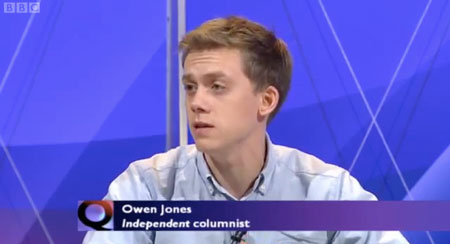
Not if you are Owen Jones, the ubiquitous, telegenic new face of left wing punditry and author of “Chavs: The Demonisation of the Working Class”. According to Jones, British democracy and journalism are most under threat from that evil right-wing juggernaut that extends into all of our homes – the BBC.
Jones has apparently had it with claims from the right of leftwing political bias at the BBC, and has responded with a whinnying, foot-stomping tantrum in The Guardian where he single-handedly attempts to redress the balance. As he sees it, the BBC has become a hotbed of right-wing propaganda, stacked with conservative personalities and pumping out unchallenged conservative viewpoints 24/7:
The truth is the BBC is stacked full of rightwingers. The chairman of the BBC Trust is Chris Patten, a former Conservative cabinet minister. The BBC’s political editor, Nick Robinson, was once chairman of the Young Conservatives. His former senior political producer, Thea Rogers, became George Osborne’s special advisor in 2012. Andrew Neil, the presenter of the BBC’s flagship political programmes Daily Politics and This Week, is chairman of the conservative Spectator magazine. His editor is Robbie Gibb, former chief of staff to the Tory Francis Maude. After the BBC’s economics editor Stephanie Flanders left for a £400,000-a-year job at that notorious leftwing hotbed, JP Morgan, she was replaced by its business editor Robert Peston.
How shocking that successful people (whom the BBC naturally looks to recruit for senior positions) have held strong political views or been allied with political parties in the past. What should happen instead, according to Jones, is that candidates for BBC positions are automatically rejected if they appear on the electoral roll, have voted in a past election or have ever expressed a political opinion on social media.
His outrage at the staffing of the BBC’s business and economics positions is particularly unreasonable. One might think that those who have worked in business and have a functional understanding of the financial industry are well placed to write or broadcast about it – assuming they are professional and operate under the same editorial policy as everyone else – given their expertise and links to the industry. But Jones seems shocked that the BBC didn’t select someone from Occupy Wall Street or Greenpeace to take on these high profile roles.
And it is not just the personalities that Owen takes issue with, but also the resulting coverage. When the global financial system teetered on the brink of disaster in 2008, Jones was apparently livid that the BBC interviewed so many people with knowledge of the industry who could explain to audiences what was happening. These people, despite being involved in the system and deeply impacted by what was happening, were not the right people to speak to, according to Owen Jones. He would have preferred more interviews with sleepy left-wing academics, aging hippies and assorted other people ready and willing to say variations on “I told you so”:
When the financial system went into meltdown, BBC interviews were dominated by City voices like stockbrokers and hedge fund managers, rather than critics of a sector that had plunged the country into disaster.
And at the end of his hit-piece, Jones makes his true intentions fully transparent. He has no interest in correcting this non-existent right wing bias at the BBC and restoring what he would see as some kind of non-partisan parity. No, he wants to transform the BBC into a fully-fledged mouthpiece of the left. It’s about giving conservatives a black eye for perceived past injustices using the BBC as a weapon, and he is willing to indulge in any amount of hyperbole or scaremongering to achieve this end:
For too long, the right has got away with weaving a fairytale of BBC leftwing bias. Until the left starts complaining – and loudly too – the BBC’s agenda will be shaped by supporters of government, big business, the free market and western foreign policy. That does not just subvert honest journalism: it undermines our democracy.
The Owen Jones phenomenon is not unique – whenever someone has a cause to promote (often a losing or flawed one, it seems) there are accusations and recriminations that the media has not jumped on the pro-whatever-the-idea-is bandwagon and given it unwavering support. Any and all instances of giving coverage to the opposing point of view is scrutinised, and any occasional discrepancies – which almost always even out over the long run when it comes to any issue or party – are held up as the “smoking gun” evidence of institutional bias.
Owen Jones’ views being airbrushed and ignored on BBC television
If Owen Jones were to take a step back from his outrage and really consider the BBC’s media coverage, someone as intelligent as he seems to be will surely have to concede that he overstepped the mark with his criticisms. No, the BBC has not shared his stridently left-wing viewpoint on almost every issue – but nor can they. They have a charter to represent and produce content for the entire country, not just left-wing activists. And from the charter come strict editorial guidelines and policies, which are carried out diligently and in good faith by human beings working to a high standard but as prone to error as the rest of us.
All of us – left or right leaning – can point to instances where television and radio and online news output has left us feeling hard done by, or shouting at the screen, convinced that the buffoon they chose to represent our side of the argument is a stooge, deliberately undermining our own, perfectly logical beliefs. But that’s just the nature of having strong political opinions. And as concerned, active citizens we should put our efforts toward actively convincing people of the merits of our arguments, not running off to a non-existent referee for redress whenever we feel the other side came out on top.
Owen Jones has enjoyed considerable airtime across the British political media, and has had ample opportunity to set forth his own strong opinions in a very articulate, persuasive way. It was the BBC, which he now chooses to castigate, that gave him many of these opportunities as part of their news coverage.
To then accuse the BBC, who have done so much to help his own career as a left-wing ‘intellectual’ and pundit, of political and institutional bias, is more than a little rich.
Democracy cannot survive without a free press willing and able to act as a check on government power and behaviour.
The relationship between the government and the media should therefore be adversarial – although it was thuggish of David Cameron’s government to dispatch the Cabinet Secretary to the Guardian’s offices to bully them into destroying their computers in the wake of the Edward Snowden scandal, rather this terrible, flagrant abuse of power than the chilling alternative of Sir Jeremy Heywood popping by every single afternoon for tea, chitchat and a list of government-sanctioned news stories for publication.
But it is this latter, far more insidious type of close, symbiotic relationship that has been prevalent between parts of the British media and the politicians on whom they report and are supposed to keep in check.
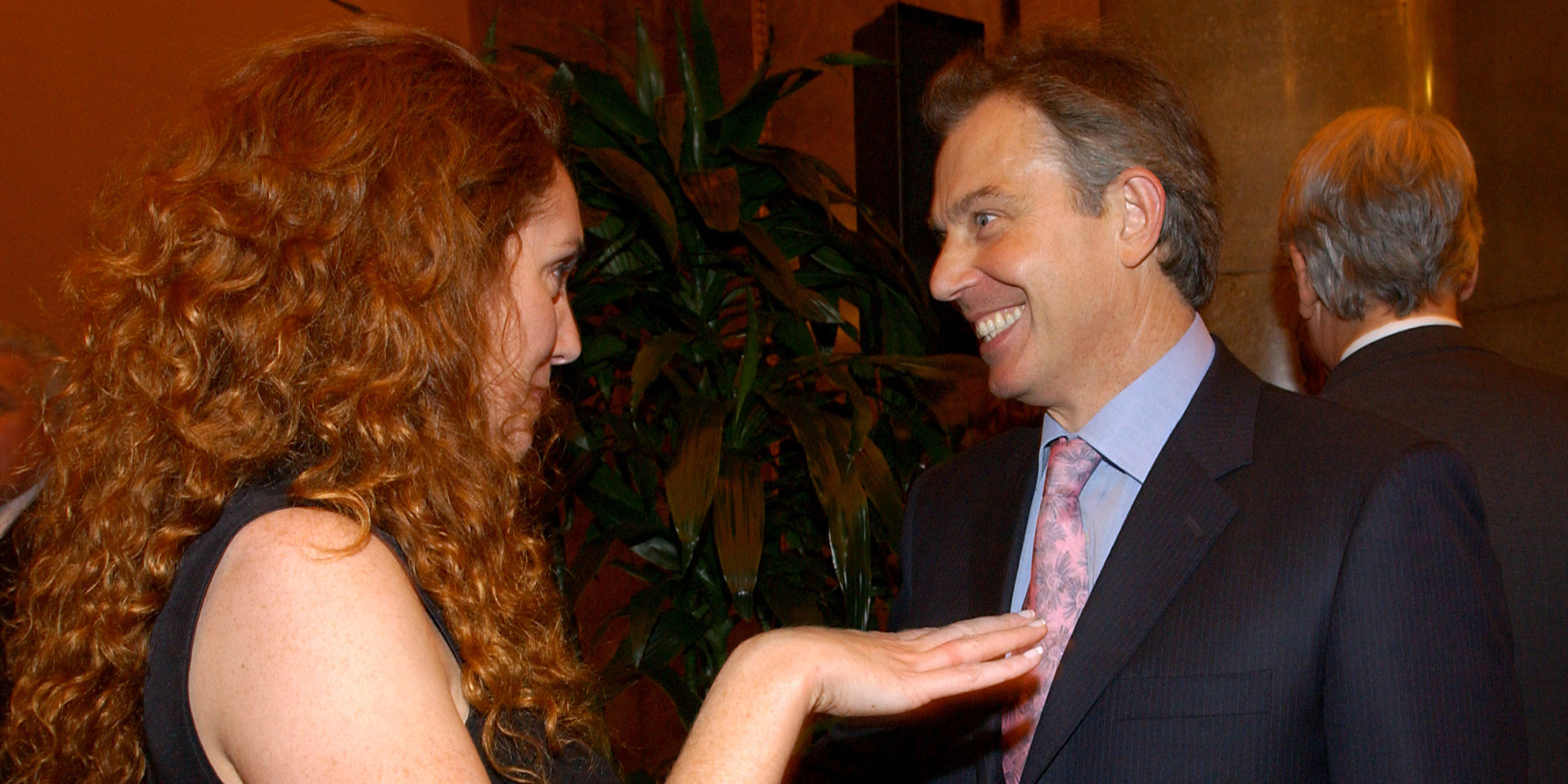
Former prime minister Tony Blair may no longer occupy Number 10 Downing Street, but the self-evident warmth of his newly revealed correspondence with Rebekah Brooks – former chief executive of News International, now on trial for her alleged role in the phone hacking scandal – shows just how overfamiliar those in power can get to those who lead the publications who supposedly scrutinise them.
The following exchange of text messages between Tony Blair and Brooks on the day after her resignation, reported by The Guardian, really says it all:
Tony Blair: If you’re still going to parliament you should call me. I have experience of these things! Tx
Rebekah Brooks: Definitely depends on the police interview first. I have Stephen Parkinson [a lawyer] here today. I have never met him but people say he is good.
Tony Blair: He’s excellent.
Rebekah Brooks: Great news. Feeling properly terrified. Police are behaving so badly.
Tony Blair: Everyone panics in these situations and they will feel they have their reputation to recover. Assume you have quality QC advice? When’s the interview?
Rebekah Brooks: Sunday probably or Monday. Cms committee. Tuesday. Stephen bringing someone called Emma Hodges and we have QC.
Tony Blair: That’s good. I’m no use on police stuff but call me after that because I may be some help on Commons.
Rebekah Brooks: Great. Will do. X
There are two issues here. The first is the impropriety of a former UK prime minister essentially offering coaching to someone involved in a very current public scandal before they are due to give evidence at a parliamentary committee hearing. While there may be no legal prohibition on this type of interaction, it seems very morally dubious. Were the subject of the hearing about anything else it could perhaps be overlooked, but since it was a hearing of the Culture Select Committee specifically on the allegations of phone hacking and the issues raised about the behaviour of the press, Blair’s offer of counsel and friendly support seems to put him squarely on the side of the alleged perpetrators rather than the victims.
The second issue is the self-evident friendship between the former news executive and the former politician. Friendships such as these are forged over time, some of which was doubtless while Tony Blair was still prime minister. If Tony Blair’s regard for Rebekah Brooks is such that he was offering her emotional support via text message at the height of the phone hacking scandal, what other acts of friendship was he bestowing upon her while he still occupied Number 10 Downing Street? And how might the publications that Brooks ran have reflected this friendship?
Some might argue that it is unfair to question the nature of this friendship. They are wrong – it is entirely appropriate. Serving as prime minister comes with certain responsibilities and standards of behaviour. It may not be part of the oath of office, but one of those responsibilities is surely to maintain professional relationships with business and the media. If both Tony Blair and Rebekah Brooks were doing their jobs properly during the period of his premiership, this would almost certainly have precluded any meaningful friendship from forming. If, however, they were behaving toward each other then as they apparently do so now, everything suddenly makes a lot more sense.
While the release of Tony Blair and Rebekah Brooks’ text message correspondence doesn’t really tell us anything that we didn’t already know – that our elected leaders are sometimes far too close to the press barons who help to control the news agenda – seeing the evidence in black and white is still unsettling.
Recalling Tony Blair as prime minister and then juxtaposing this new image of “T” sending kiss-laden text messages to the woman who then edited Britain’s most-read newspaper casts that era in a whole new, sordid light. The dirty, illicit feeling that reading these messages evokes would be more at home in the television series “House of Cards” than real-world Britain.
We deserve better from our politicians, and from the news media.
As more people come out in support of scrapping the 40% tax band – or doing something, anything that might alleviate the pinch on middle income earners – David Cameron remains resolutely set against the idea.
This time, it was the turn of one of Cameron’s own No. 10 Policy Board members, Nadhim Zahawi, to advocate for 800,000 people caught up in the fiscal drag which has seen them start paying the 40% rate on their marginal income in the last three years.
Mr Zahawi on Wednesday praised plans by Renewal, a Tory pressure group, to abolish the 40p rate entirely and deliver a tax cut worth £2,000-a-year for 2 million middle class workers.
Under the proposals, the move would be funded by lowering threshold for the 45p rate from £150,000 to £62,000.
In a speech at Policy Exchange, a think-tank with links to the Conservative Party, Mr Zahawi said: “It is a welcome development that Conservatives have started to seriously debate where next for income tax.
“Labour have the 50p, the Lib Dems have the mansion tax, we need our own iconic tax policy. I think Dave Skelton’s [from Renewal’s] contribution, and his suggestion that we abolish the 40p rate and pay for it by lowering the 45p rate was a great way of starting the conversation.”
Renewal’s plan is not perfect – £62,000 seems far too low to impose what is a very high top marginal rate of 45%, for instance. Nor is the idea of making an ‘iconic’ tax proposal just to have a handy catchphrase with which to compete with Labour and the Liberal Democrats redolent of good policymaking or government.
But this is a problem that affects people up and down the income scale, and the idea of giving some relief to those slightly higher up the scale deserved more than the immediate dismissal that it received from David Cameron. As the Telegraph continues:
Mr Cameron on Wednesday defended the government’s focus on increasing the tax free threshold.
Asked if Tory back-benchers were right to call for the 40p threshold to be raised, Mr Cameron said: “I’m a tax cutting conservative. I want to see us relieve people’s tax burden. We’ve chosen to do that through raising the personal allowance which helps everyone earning under £100,000.”
David Cameron, the tax cutting conservative. It sounds good, but it is hardly an accurate claim.
When Cameron says that “we’ve chosen” to raise the personal allowance, he neglects to admit that this was a Liberal Democrat, not a Conservative policy. Had the LibDems not manoeuvred their way into coalition government, the Conservatives would likely never have entertained the idea of a personal allowance up to or exceeding £10,000. Now that he is also rejecting the idea of doing anything at all about the 40% tax band – either scrapping it or increasing the level at which it applies – he is committed to doing nothing significant for middle income earners either.
This leaves only those who earn enough to qualify for Gordon Brown’s new top rate of income tax, which George Osborne reduced from 50% to 45%. And that is the situation currently faced by the Conservative Party – the only concrete actions of this ‘tax cutting conservative’ party have been to cut the taxes for the very highest earners. This track record is every bit as bad as the optics make it seem.
Ed Miliband and the Labour Party like to talk about the “cost of living crisis”, and they are right to do so. Aside from the fact that there is obvious electoral mileage to be gained, someone needs to talk about the fact that despite the better economic news of late, wages remain stagnant while inflation continues to eat away at purchasing power. Economic growth means absolutely nothing to people if it is not reflected in their own personal circumstances.
At some point soon, people might start realising that another UK economic recovery built on booming property prices alone is unsustainable and undesirable. And when this happens, the focus will turn to consumer spending, and why it isn’t more buoyant.
Perhaps then the foolishness of treating ever more British wage earners as higher rate taxpayers will become more readily apparent.
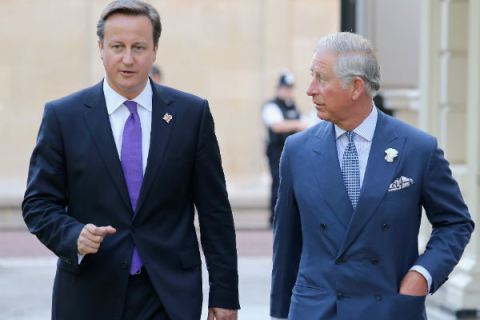
Who really gives David Cameron his marching orders?
Today has seen a rare victory in the fight for government transparency and public access to information, as a judicial review ruled that the Attorney General was wrong to veto the publication of Prince Charles’ voluminous correspondence with ministers – known as the ‘black spider letters’ – and ordered that they be disclosed.
The British government fought this development every step of the way. Dominic Grieve, the Attorney General, had used his veto to keep the letters secret after a previous ruling from an independent tribunal also ruled in favour of the public interest. However, at long last the time may have come for British citizens to read what the heir to the throne really thinks about all number of government policies and positions.
The Guardian – who waged a nine year campaign for access to the letters – report on their triumph:
Grieve had said that a cornerstone of the British constitution was that the monarch could not be seen to be favouring one political party over another. But he had said that any perception that Charles had disagreed with Tony Blair’s government “would be seriously damaging to his role as future monarch because, if he forfeits his position of political neutrality as heir to the throne, he cannot easily recover it when he is king”.
The 27 pieces of correspondence between Charles and ministers in seven government departments between September 2004 and April 2005 “are in many cases particularly frank”, according to Grieve.
Dominic Grieve and the rest of the cabinet clearly take the British people for fools. Only an idiot might think that Prince Charles is politically neutral. He has pungent and forceful views across a whole spectrum of topics from climate change to modern architecture, and his PR people take every opportunity to see that these are widely reported by anyone who will listen.
Rather than treating the British people with kid gloves as though we were sensitive little children liable to burst into tears at the sight of our parents arguing, Grieve should drop his ludicrous opposition and let us finally see what the future King thinks of his government of the people.
As the Guardian notes, the prince has taken an active interest in political matters for almost as long as Prime Minister David Cameron has been alive:
The freedom of information tribunal heard that he had been writing to ministers as long ago as 1969, when he expressed concern to the then prime minister, Harold Wilson, about the fate of Atlantic salmon.
The obvious danger is that Prince Charles’s concerns – the things that make him toss and turn at night – may well have changed and grown in the intervening forty-five years, as the number of government departments that he has corresponded with would seem to attest:
The letters concerned involve ministers in the Cabinet Office and the departments responsible for business, health, schools, environment, culture and Northern Ireland.
Worrying about salmon stocks in the north Atlantic is one thing; idly musing or ranting to ministers about Britain’s energy policy or nuclear deterrent, for example, would be another matter entirely. And one gets the strong suspicion that salmon have not remained the prince’s abiding focus.
Unfortunately, the Attorney General seems in no mood to compromise or listen to the overwhelming consensus of logic and legal opinion, and plans to appeal to the Supreme Court:
A spokesman for the attorney general said: “We are very disappointed by the decision of the court. We will be pursuing an appeal to the supreme court in order to protect the important principles which are at stake in this case.”
What important principles are these, exactly, other than the right of an unelected man to bully and intimidate junior government ministers into bending their policies and actions to his will? Should this really be the top priority for Dominic Grieve and his government office?
And why is the Attorney General going to battle to protect and enshrine the ability of society’s elites – be they financial, political, media or monarchical – to not only get their way, but then to have all record of them ever having tilted the playing field in their favour sealed from public view?
Dominic Grieve may serve as a minister in Her Majesty’s Government, but he was elected to represent we the people. Like the Guardian, I want to know how much money the government has spent on legal fees fighting to thwart the will and the interests of the people who elected them.

 Picture: Ian Aitken – The studio where Generation Hackney is based