In Memoriam

Prime Minister Margaret Thatcher, on taking office in 1979


In the course of the 20th century, it fell to two prime ministers to save the United Kingdom – Churchill in wartime, and Thatcher in peacetime. Our nation has suffered an irreparable loss today with the passing of Baroness Thatcher. May she rest in peace.

And I would just like to remember some words of St. Francis of Assisi which I think are really just particularly apt at the moment. ‘Where there is discord, may we bring harmony. Where there is error, may we bring truth. Where there is doubt, may we bring faith. And where there is despair, may we bring hope’ …

Margaret Thatcher, 13 October 1925 – 8 April 2013.

The Compassion Monopoly


Today saw the installation of Justin Welby as 105th Archbishop of Canterbury.

The service was moving, with many elements incorporated to reflect the international diversity of the worldwide Anglican communion. Although myself a Roman Catholic, I wish the new Archbishop of Canterbury the best and pray for him as he seeks to tackle the many challenges facing his church.

I was, however, momentarily distracted from the beauty of the service by this image of a protester in Canterbury, shown on the BBC News website here.

We’ll let the misspelling of the word “privatise” go.

But both Pope Francis and Archbishop Welby can hang up their hats and go home, because this lady clearly has such a direct line to the Lord that she is able to tell us God’s political stance on any issue of the day. With such an ability we should probably make her a Lord Spiritual so she can sit in the House of Lords and meddle in British lawmaking with the others.

Christ would “NOT” privatise the NHS? Really? What does He think about Clinical Commissioning Groups? Is it okay with Him if private firms perform non-clinical work for NHS hospitals (such as cleaning or catering), or must this be owned and managed by the state too? And I have a feeling I know her answer, but does our Lord support the renationalisation of the railways in Britain?

Why does the left have such a monopoly, a stranglehold on the idea of compassion in our country?

Why is it that to speak out against the state taking such a large, meddling role in all of our lives marks one out as a mean-spirited and cruel person, indifferent to the needs of others?

And why do we all buy in to the idea that in order to be charitable and compassionate, we must funnel our efforts to help our neighbours, the less fortunate and the downtrodden through an inefficient state bureaucracy?

If the counterargument is that people would be selfish and insufficiently generous without the heavy hand of government coercion and taxation to take wealth and redistribute to those in need, what does this say about the leftist’s view of human nature?

Did it ever occur to this protester that perhaps it is directly because the state plays such a large part in everything that we do, from cradle to grave, that the church to which she belongs is withering and shrinking by the year?

To a great extent, aside from the divine aspect, has the British welfare state not done away with the purpose of church, of knowing your neighbour, of being part of a community, altogether?

I ask these questions because the answers to these issues of how best to act charitably, to help your neighbour and provide for those in need seem to be self-evident to so many on the left. Of course, they say, we must give more to the government so that they can give back to us according to our need. Certainly the newly-installed Archbishop of Canterbury, Justin Welby, seems to subscribe to this mindset, from what we know of his recent remarks.

I could not disagree more vehemently.

Budget 2013 Drinking Game – The Results

Well, Budget 2013 is now behind us, though the frenzied analysis continues unabated.

We heard George Osborne’s more-of-the-same speech.

We heard Ed Miliband’s “I would do roughly the same, but make things slightly worse” rebuttal (despite the deputy speaker’s unfortunate rhetorical question asking Labour backbenchers why they didn’t want to hear their own leader).

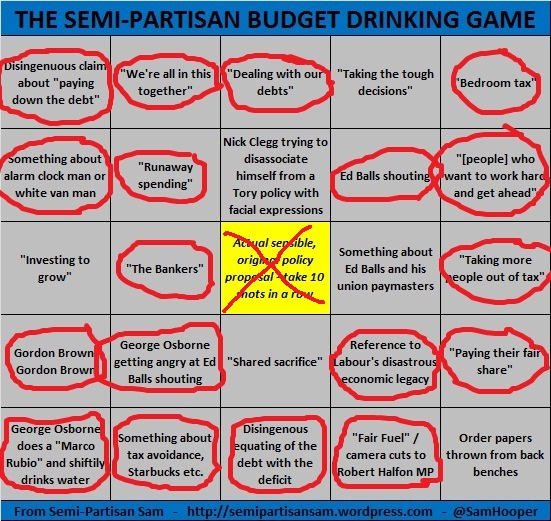
It’s time to check our scorecards and see how we fared in the Semi-Partisan Budget 2013 Drinking Game!

Semi-Partisan Budget 2013 Drinking Game - The Results!
Semi-Partisan Budget 2013 Drinking Game – The Results!


Well, the results are in and it looks as though I have done rather well.

The most magnificent triumph, of course, was my correctly predicting that George Osborne would have a “Marco Rubio” moment mid-speech, and urgently grasp for a glass of water. I awarded myself extra points for that prognostication.

Some, of course, could not be proven one way or the other – the ridiculous rules which still govern the filming of Parliament mean that you rarely get to see a full shot, so I’m not sure who was throwing their order papers, or popcorn, or kicking the seat of the MP in front of them.

But I will take 18/25 as a good result any day. The middle square, of course – an actual sensible policy proposal – was always out of the bounds of possibility, and needless to say did not come to pass.

I hope that you had fun playing, and I would be very interested to hear of any other similar Budget (or other politically) related games that readers may know about. Please do share them in the Comments section underneath this post, or send them to me @SamHooper.

A “fiscally neutral” budget. Rearranging the deckchairs on the Titanic (to use a very tortured metaphor).

Happy Budget Day, everyone!


Semi-Partisan Sam


Semi-Partisan 2013 Budget Drinking Game

If, like me, you plan to watch Chancellor of the Exchequer George Osborne present the UK coalition government’s 2013 budget to Parliament today, you might like to use this handy tool to pass the time. You can treat it as either a bingo card or a drinking game, depending on how pessimistic you feel about the budget contents…

The Semi-Partisan 2013 Budget Game

30 minutes until showtime. Enjoy!

If you do not already do so, please consider following me on Twitter @SamHooper.

Happy Budget Day!

On Horsemeat In The Food Supply

Below is the text of the letter that I wrote to my local MP, Glenda Jackson (Labour – Hampstead & Kilburn):


Dear Ms. Jackson,


Like many others, I have been reading with shock the news about the contamination of so many food products illegally labelled as beef, which in actual fact contained horsemeat (in some cases up to 100% of their content) which have been sold in British supermarkets.


I find it extremely concerning that this may have never come to the public attention were it not for the investigations of the Irish Food Standards Agency, and that our own FSA has thus far responded in a way that can only be described as passive and reactionary.


As a voter, I tend to lean Conservative – I believe in small government and limited regulation of industry wherever possible. However, I believe that a situation where the largest food retailers in our country can sell mislabeled produce for so long, and yet wash their hands of any responsibility and blame their (often overseas) suppliers, is appalling. A supermarket selling a food item under their own brand – be it Tesco, ASDA, Waitrose, ALDI, Sainsbury’s or any other – should take responsibility for their supply chain. This must include legal liability for any contaminations such as the recent horsemeat scandal. Furthermore, the FSA should have the ability, and power, and conviction, to levy serious fines for any systemic breaches such as this. As blame is clearly shared among multiple parties in this case, the British retailers affected should then be free in turn to sue their suppliers in order to recoup some of their regulatory, financial and legal costs.

My questions to you, as my local MP, are these:

1. What steps do you believe need to be taken, and will you actively promote in Parliament, in order to ensure that the UK Food Standards Agency has both the manpower to better police the nation’s food supply, and the regulatory “teeth” to effectively deter retailers and food manufacturers from taking shortcuts or turning a blind eye to malpractice such as horse meat contamination?

2. As the food supply chain reaches far beyond British shores, to Europe and beyond, how can we better ensure that food products imported by British manufacturers, processors or retailers, conform to British standards of quality and labelling?

I don’t consider this at all to be a partisan issue – clearly the mislabelling and misselling has been taking place under both Labour and Conservative administrations for some time. What matters now is a swift and effective response, adequate legal frameworks in place for affected consumers to seek redress with the guilty British retailers, and a way for those same retailers to take action against their negligent suppliers. Unless the financial pain is felt all the way up the supply chain, such practices will continue.

I thank you for your work on behalf of our constituency, and look forward to your response.

Many thanks –

best regards,