OscarsSoWhite: The Self-Flagellating, Social Justice Academy Awards

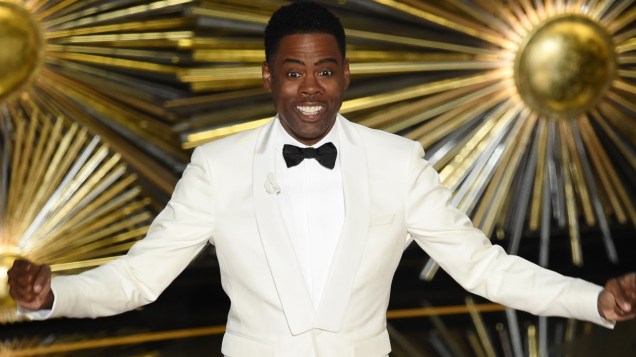
Chris Rock - Oscars Monologue - OscarsSoWhite

Chris Rock’s opening monologue was brilliant – but bombarding Oscars viewers with four hours of social justice preaching was too much, and served the messengers far more than the causes they promoted

At the opening of Chris Rock’s excellent hosting of the 88th Academy Awards in Hollywood, the comedian made a joke which sets some very important and much-needed context for the #OscarsSoWhite and social justice-obsessed debate leading up to the star-studded ceremony.

From the New York Times transcript of Chris Rock’s remarks:

It’s the 88th Academy Awards. It’s the 88th Academy Awards, which means this whole no black nominees thing has happened at least 71 other times. O.K.?

You gotta figure that it happened in the 50s, in the 60s — you know, in the 60s, one of those years Sidney didn’t put out a movie. I’m sure there were no black nominees some of those years. Say ‘62 or ‘63, and black people did not protest.

Why? Because we had real things to protest at the time, you know? We had real things to protest; you know, we’re too busy being raped and lynched to care about who won best cinematographer.

You know, when your grandmother’s swinging from a tree, it’s really hard to care about best documentary foreign short.

It is great to see Chris Rock – incidentally, one of the many high profile comedians who now refuse to perform on American college campuses because of the stultifying and censorious climate created by Social Justice Warrior (SJW) activists – making this point, which frequently gets lost in our climate of perpetual outrage.

(Though sadly, because everything and everyone is “problematic” these daysand because Social Justice Warriors ruin everythingthe bien pensant criticism of Rock’s monologue is already gathering steam).

Is it perhaps unfortunate that there were no black nominees among the various acting categories? Maybe so – although it was hardly statistically unlikely, given the fact that African Americans make up just thirteen per cent of the US population. But the mere fact that we are now arguing about whether black actors (Hispanics and other minorities seemed to do quite well in terms of winning awards) are being systematically excluded from the ultimate expression of Hollywood elitism shows in itself just how far we have come.

This is not to negate the very real discrimination against black people which still exists, particularly in the criminal justice system and law enforcement – notably several high profile killings of unarmed black suspects by the police. This blog covered the Michael Brown shooting in Ferguson, Missouri and I offered my own sympathetic perspective from having spent many months and years visiting the St. Louis area.

But one has to go back only a few short decades to encounter a time when the threat to “black bodies” (a strange term which is increasingly fetishised in the media – particularly through use by writers such as Ta-Nehisi Coates, whom I greatly admire even when we disagree) was far more universal, and not primarily the concern of black teenagers murdered while committing a minor misdemeanor, or black actors shunned by the movie industry.

What became increasingly concerning as the Oscars wore on, though, was the fact that Chris Rock’s excellent, light-hearted but pointed acknowledgement of the controversy and the shortcomings of Hollywood, was only the first salvo in a barrage of social justice virtue-signalling and white guilt self-flagellation which ultimately consumed the entire ceremony. Every segment between awards seemed to have to involve conspicuous references to the #OscarsSoWhite drama, which became grating and unnecessary after awhile.

Some people were quick to sanctimoniously declare that this was deserved:

https://twitter.com/gmgannon/status/699455425633243137

Because not only does every occasion now have to be a teaching moment for the social justice agenda, the point must be laboured again and again. Not because it does anything to actually improve the availability of good roles for black actors in Hollywood, but because each presenter who touched on the theme was then able to imbue themselves with the same “I’m part of the solution, not the problem aura”.

This reached a heady climax when Vice President Joe Biden made a surprise appearance on stage to introduce Lady Gaga and plug his campaign against sexual assaults at college. While every decent person should be able to get behind the idea that nobody should be raped while studying at university, or indeed at any other time, this was then followed by the pernicious idea that “It’s on us” (i.e. perfectly innocent members of the public) to prevent rape.

The organisation promoted by Vice President Biden, ItsOnUs.org, asks us to take the following actions in our own lives:

To RECOGNIZE that non-consensual sex is sexual assault.

To IDENTIFY situations in which sexual assault may occur.

To INTERVENE in situations where consent has not or cannot be given.

To CREATE an environment in which sexual assault is unacceptable and survivors are supported.

The first pledge seems perfectly reasonable. But the remainder seek to transform us into perpetually vigilant informants and secret police agents, scanning crowds and charging to intervene in situations where we are uncertain that consent has been given, even when we lack critical context.

The idea that the average person will ever have the opportunity to “intervene in situations where consent has not or cannot be given” is particularly ludicrous – but these days, one can quite easily imagine squads of purse-lipped student “consent educators” roaming popular nightspots and breathalysing couples leaving bars and clubs to ensure that sexual relations do not follow the consumption of beer (heaven forfend).

But scroll to the end of the ItsOnUs website and you’ll see the only possible tangible outcome of the campaign – the ability to superimpose the organisation’s logo on to your social media profile picture, thus allowing those who take the pledge to ostentatiously parade their “I, too, am not a rapist” credentials before their equally vapid friends.
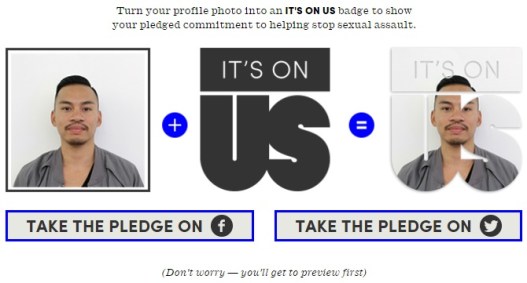
It's On Us - Rape Culture - Sexual Consent - Oscars - Joe Biden

The idea that college campus rape can be prevented by mandatory sexual consent workshops, “raising awareness” or taking online pledges in a blaze of self-promotion is utterly ludicrous. Nobody who has been raised since childhood to disrespect women or act in a sexually entitled and bullying way is going to be reformed or turned away from committing rape by being lectured by an earnest Social Justice Warrior. The revolution which must happen is in our homes, our morals and our family life, and will not be accomplished through lectures from the stage of the Dolby Theatre in Los Angeles.

But words are very much the SJW tool of choice, and the extent to which language is being weaponised in furtherance of a certain narrow agenda again became much clear later in the Oscars ceremony.

The BBC reported:

And oh, were there causes! A whole smorgasboard of enlightened liberal issues, as if everyone thought they had to live up to the tone of noble chastisement set by the diversity issue. Lady Gaga, seated at a starkly lit white piano, sang ’Til It Happens to You, the song she wrote for the campus-rape documentary The Hunting Ground, and though it’s a lugubrious number, her goggle-eyed manner seemed like an attack on the audience.

The movement for transgender rights was propped up by several mentions of the forward-thinking phrase “gender confirmation surgery”.

This, of course, is in relation to the film “The Danish Girl”, the biographical portrayal of the life of Lili Elbe, one of the first recipients of sex change surgery, who transitioned from male to female.

Eddie Redmayne’s Oscar nominated performance was by all accounts outstanding, and the issues raised about the prejudice, discrimination and abuse suffered by many transgender people are real and worthy of serious discussion. But this cannot come at the expense of our language and our shared perception of reality, and unfortunately the attempt to shoe-horn the new phrase “gender confirmation surgery” (as opposed to gender reassignment surgery) into the Oscars ceremony does just that.

You may recall attempts in the more conservative, right-wing media over the past decade to re-name suicide bombings as “homicide bombings”. This seemed to stem from the feeling that to focus on the suicide of the perpetrator gave undue prominence to the terrorist and detracted from the victims, which was of particular concern to conservative news outlets covering terrorist attacks against Israel and the West.

Unfortunately, the phrase “homicide bombings” also sows confusion, obfuscates reporting and makes it much harder for people to understand what has taken place. All bombings (or all successful ones, anyway) are homicide bombings by definition, since their purpose is to kill people. But not all bombings also involve the deliberate suicide of the perpetrator in the explosion. This is a characteristic unique to suicide bombing, and is what makes it distinct from, say, the IRA’s bombing of the 1984 Conservative Party conference in Brighton, England, where the bomber set the explosive device a month prior to the attack and was well out of harm’s way when it took place.

Regular bombing versus suicide bombing – an important distinction in terms of terrorist tactics is mirrored and emphasised by a difference in language. In the case of suicide bombing, the language rightly calls our attention to the unique aspect of that style of attack. Calling it “homicide bombing” makes such attacks indistinguishable from any other terrorist attack, and actively decreases our understanding. Some conservatives believe that this mangling of language is nonetheless desirable in order to express our particular disapproval of suicide bombing. Most sensible people would scoff at such a fatuous and superficial idea.

And this is exactly what we saw take place on stage at the Oscars last night. Not a suicide bombing, thank God. But an attempt to forcibly change the language we use, stripping away the most descriptive part of a commonly used phrase like “gender reassignment surgery” by substituting the word “confirming” instead, in order to bestow our further approval on the act.

Prevailing sentiment dictates – quite probably correctly – that transgender people are born into the wrong bodies, and that surgery which physically changes their genitalia and appearance is therefore merely correcting a mismatch between physical reality and mentally experienced reality. But now, it is no longer politically correct to talk about somebody changing their gender through means of surgery, because that sounds too drastic. Now we must say that the surgery merely “confirms” their existing, mentally experienced gender. Surgically removing a penis and creating an artificial vagina can no longer be described truthfully as a medically significant and life-changing physical alteration, but merely a “confirmation” of someone’s inner being.

Regardless of one’s thoughts about transgender issues, there should be no disputing that forcibly mutilating our shared language just to signal our approval or disapproval of an act – at the expense of clear meaning – is not merely an act of wishful thinking, trying to conjure a new reality by stating it loudly enough, but is also a bleakly totalitarian way to approach the issue. And yet this, too, was preached to us during the Oscars ceremony.

All in all, it was quite an evening.

White privilege-shaming in nearly every segment. Sexual consent shaming from no lessa figure than the Vice President. All capped off with a deliberate attempt to wrest control of the English language, bending it away from reality and toward to the will of the Social Justice Warriors and their remarkably intolerant form of tolerance.

And this is just Hollywood – that bastion of progressive opinion – talking to itself, preaching fervently to the choir.

If this is what they are prepared to inflict on themselves, God only knows what forms of indoctrination, shaming and corrective punishment lie in store for the rest of us.


OscarsSoWhite - Academy Awards - Social Justice - Virtue Signalling - 2

Agree with this article? Violently disagree? Scroll down to leave a comment.

Follow Semi-Partisan Politics on TwitterFacebook and Medium.

Tony Blair And The Shell-Shocked Centrists: The Fears Of A Fading Elite

Tony Blair - New Labour - Centrism

Pity Tony Blair. Unloved and discredited in his own country, he still fails to understand the role he played in the anti-centrist backlash on both sides of the Atlantic

A panicked, uncomprehending Tony Blair is struggling to understand the appeal of left-wing insurgents such as Bernie Sanders and Jeremy Corbyn, LabourList reports:

Tony Blair has said he finds it difficult to understand the surge to prominence of Jeremy Corbyn and Bernie Sanders amid doubts over both men’s capacity to win general elections.

The former prime minister said the two veteran left-wingers faced a “question of electability” but admitted that stagnating living standards for people on lower- and middle-incomes had generated anger at elites in Britain and the US.

Blair also warned political parties they would be powerless to help people unless they “selected someone who is electable”.

[..] Blair, who was speaking to The Guardian and The Financial Times, said candidates who could “rattle the cage” were emerging, in a reference to Corbyn, who came from the left fringe to easily beat the party establishment to claim the Labour leadership, and to Sanders, who hopes to emulate him by winning the Democrat nomination ahead of Blair’s friend Hillary Clinton.

“It’s very similar to the pitch of Jeremy Corbyn,” Blair said. “Free tuition fees: well, that’s great, but someone’s going to have pay for it. An end to war, but there are wars.”

Where to begin?

Let’s start with Tony Blair’s “pass the smelling salts!” terror at the supposedly unhinged and crazy far-left politics of Bernie Sanders. That’s the same Bernie Sanders who would be chased out of Britain with flaming torches and pitchforks for being too right-wing, were he the UK prime minister, thanks to his support of private sector-delivered healthcare and the right to bear arms.

The interesting thing – and Todd Gillespie at Spiked has also picked up on this – is that with his support for civil liberties and the rights of the individual over the big guy (corporation or government), Bernie Sanders is in some ways a better conservative standard-bearer than most of the people currently squabbling for the US presidency – and certainly far more so than our own Coke Zero Conservative prime minister, David Cameron.

In many ways, when Tony Blair comes charging into the US presidential contest in support of Hillary Clinton and against Bernie Sanders, he is not making the principled case for a pragmatic, centre-left policy platform capable of winning elections, as he so smugly claims. After all, the American Right is also tearing itself apart at the moment, and there is nothing to say that Sanders could not defeat one of the more inexperienced or unpalatable GOP candidates still standing.

No, what Tony Blair is doing here is siding with the political elite – of which he is very much a part – and the tired old orthodoxies which people have grown so heartily sick of that they are now desperately casting around for alternatives in people like Donald Trump and Bernie Sanders. A former Labour prime minister who remembered anything at all about his party’s roots might not be quite so quick to publicly embrace a US presidential candidate awash in Wall Street donations and influence.

But Blair genuinely can’t see the problem with consistently, publicly and unapologetically siding with globalisation’s winners and richest beneficiaries while either ignoring or actively harming those who are left behind. And he cannot understand why this fawning deference to money and power is creating a populist backlash which has changed the course of his party.

Which brings us on to Jeremy Corbyn. LabourList’s report of Tony Blair’s comments continues:

He suggested the sudden rise of Corbyn and Sanders, each after years spent toiling in relative obscurity on the left of their parties, reflected a loss of faith in the centre-ground of politics as well as the changing technology of political communications.

“I think there is a combination of factors behind these movements which are happening both sides of the Atlantic. Part of it is the flatlining of lower and middle income people, the flatlining in living standards for those people, which is very frustrating. It’s partly an anger for sure at the elites, a desire to choose people who are going to rattle the cage.

“And it’s partly also about social media, which is itself a revolutionary phenomenon which can generate an enormous wave of enthusiasm at speed. When I first started in politics, these things took so long to build up momentum; your decision points were well before that moment was achieved. But it’s also a loss of faith in that strong, centrist progressive position and we’ve got to recover that…

“One of the strangest things about politics at the moment – and I really mean it when I say I’m not sure I fully understand politics right now, which is an odd thing to say, having spent my life in it – is when you put the question of electability as a factor in your decision to nominate a leader, it’s how small the numbers are that this is the decisive factor. That sounds curious to me.”

Blair is absolutely right that there has been a loss of faith in centrist politics. But centrist politics is not an innocent victim. Centrist politics has delivered a cross-party political consensus which was defiantly pro-European in face of public euroscepticism, which doggedly refused to talk about immigration even as a centre-left New Labour government spurned transitional controls and allowed hundreds of thousands more economic migrants a year into Britain without ever consulting the people, which sought to label anyone who questioned this policy as racist, and which trotted out the same tired old tropes about Our Beloved NHS and precious public services while doing almost nothing new or radical to reshape them for the twenty-first century.

Many people in Britain yearn for more genuinely left-wing solutions to be offered by a political party. Many would like the railways renationalised, and the energy companies too. This blog believes that such moves would be hugely regressive and statist, and very quickly result in poorer service and less choice for consumers. But those who believe in nationalisation deserve a voice in the political debate – a voice which Labour studiously excluded for many years. If Tony Blair seriously believed that high-handedly shutting people out of his party would store up no resentment for the future and possibly one day result in a backlash, then he is quite delusional.

Blair acts as though the rise of Jeremy Corbyn is merely a function of social media, and angry far-leftists hijacking the conversation. But it goes far deeper than that. The rise of Corbyn on the British Left, Sanders on the American Left and Trump on the Right are not an inchoate expression of public rage, but rather an indicator that a fully rational public has finally realised that the political consensus of the main political parties is not delivering what they need – be it middle class job security or success on the world stage.

The growth and prosperity delivered by the centrist political consensus in Britain has not been experienced uniformly by all citizens. That much is understandable – different policies will impact different socio-economic groups differently. What is unacceptable, though, is the fact that the centrists from both main parties never made a concerted effort to tweak those policies to help people who were left behind. They simply advocated more of the same.

More European Union. More government spending on the bloated, unreformed welfare state. More uncritical praise for the NHS. And more of the depressing view of Britain as nothing more than a nation of schools, hospitals and public services rather than a great nation built on our commercial, private sector initiative, and with boundless untapped potential.

Choose to treat the people like mindless, avaricious consumers rather than thinking, engaged citizens with a stake in their world, and you had better make damn sure that you deliver sufficient prosperity to keep everyone happy and distracted. This is how the centrists have treated us for years – essentially saying “you leave the global governance and great ideological questions to us, and in exchange we will deliver you a cheap supply of flat-screen TVs and other consumer goods”.

But when not everybody can afford the flat-screen TV or the iPhone or to scramble on to the property ladder, they start to look around them and notice things. Awkward things. Things like the fact that they no longer have the final say in issues affecting them, because sovereignty has been outsourced to the European Union. Or things like the character of their towns and cities – even their whole country – visibly changing because of levels of immigration about which they were never consulted. Or things like a broken welfare state which ensnares some people in lifelong dependency while allowing others to fall straight through the safety net to their deaths.

Brendan O’Neill picks up on this point – the fact that it is those who have not benefited economically from centrist consensus politics who are most likely to recognise that all is not well with our democracy – in his excellent piece in the Spectator:

The Third Wayists are quaking in their boots. The middle-class, middle-of-the-road technocrats who have dominated politics for the best part of three decades are freaking out. These people who bristle at anything ideological, are disdainful of heated debate, and have bizarrely turned the word ‘moderate’ into a compliment feel under siege. And no wonder they do, for on both sides of the Atlantic their very worst nightmare — a revenge of the plebs — is becoming flesh.

You can see this sometimes clumsy but nonetheless forceful reassertion of pleb power in everything from Trumpmania to the staggering back to life of Euroscepticism — or what snooty moderates call ‘Europhobia’, because every point of view that runs counter to their own must be a mental illness, right?

[..] In both Middle America and Middle England, among both rednecks and chavs, voters who have had more than they can stomach of being patronised, nudged, nagged and basically treated as diseased bodies to be corrected rather than lively minds to be engaged are now putting their hope into a different kind of politics. And the entitled Third Way brigade, schooled to rule, believing themselves possessed of a technocratic expertise that trumps the little people’s vulgar political convictions, are not happy. Not one bit.

And with regard to euroscepticism specifically:

We’ll see more of this in the coming months, more defamation of those who dare to say: ‘I don’t like Brussels.’ But Euroscepticism represents, not some swirling, xenophobic disgust with Europeans, as it has been pathologised by the pleb-fearing PC lobby, but a people’s feeling of exhaustion with the ossified oligarchy of the Brussels machine. It speaks to a desire among ordinary people to take back some control over their lives and destinies. And as The Economist pointed out, this Eurosceptic urge is strongest among the less well-educated — that is, the plebs, those tired of being treated as welfare, nudging and paternalism fodder by the new political elites.

So bring it on, this revenge of the plebs. Let’s cheer their rude, intemperate injection of ideology into the flat, lifeless sphere politics has become over the past 20 years. And let’s enjoy the squirming of an aloof political class and commentariat who mistakenly thought they had put the pesky masses and their troublesome views out to pasture.

If Tony Blair does not understand the anger and disillusionment directed not just at him but toward consensus politics in general – and there is no reason to doubt that his bewilderment is genuine – then one has to ask: what happened to the political nous of the man who won three consecutive general elections for Labour?

Why, when he has one foot firmly planted on each side of a massive new fault line emerging in our politics – not between Left and Right but between consensus politics’ winners and losers – is Tony Blair unable to understand his own starring role in precipitating the earthquake?


Bernie Sanders - Refutes Bernie Bros

Agree with this article? Violently disagree? Scroll down to leave a comment.

Follow Semi-Partisan Politics on TwitterFacebook and Medium.

Support David Cameron? I’d Rather Feel The Bern

Bernie Sanders For President

Bernie Sanders or David Cameron? There’s no contest

At a time when far too many conservatives on both sides of the Atlantic have revealed themselves to be either snarling authoritarians (Marco Rubio, Donald Trump) or patrician, vacuous hairdos (David Cameron), the search for authentic commitment to individual liberty can sometimes lead to unexpected places.

Spiked are now making the controversial argument that this search leads all the way to Vermont, and to US presidential candidate Bernie Sanders.

Todd Gillespie writes:

Despite being slammed by some as a big-government lefty, Sanders’ track record is more complicated — and arguably more libertarian than has been appreciated. Even libertarian stalwart Ron Paul has come out in support of Sanders’ small-government credentials, shortly after his son, Rand, left the Republican race.

Bernie has espoused positions similar to Rand’s, even joining with him to oppose government surveillance. Last year, Sanders wrote a blistering criticism of the ‘Orwellian’ practice of spying on citizens. He voted against the 2001 Patriot Act and its dreadfully named replacement, the Freedom Act, in 2015 — both of which Clinton supported. He is arguably the only candidate left who takes positions that can legitimately be described as libertarian.

He supports freedom of speech. He backs net neutrality and opposes attempts to censor the internet. In 2005, he introduced the Stamp Out Censorship Act, which sought to prohibit the government enforcing ‘indecency fines’ on non-public media (it failed to pass). Recently, addressing students at Liberty University (a Christian institution whose president has just endorsed Donald Trump), most of whom think very differently to Sanders, he said ‘it is vitally important for those of us who hold different views’ to engage in debate.

Anti-surveillance. Anti-censorship. Pro civil liberties. Pro free speech. All more than can be said of many American conservatives, who ostentatiously flaunt their love of the Constitution – by which they mean the Second Amendment, while conveniently overlooking the First and Fourth Amendments.

Gillespie continues:

Sanders’ right-wing critics write him off as a big-state socialist. But a better label might be ‘libertarian socialist’. Yes, he has a vision of centralised government spending funded mainly by tax hikes on big business, but Comrade Bernie also envisages having a private sector with greater employee ownership. He has introduced legislation several times to increase government funding for centres that would provide training and technical support for the promotion of worker ownership and participation. He introduced the Rebuild America Act 2015, proposing an extra $1 trillion investment to renew America’s crumbling infrastructure, increasing airport capacity, improving and expanding railways, roads, bridges and broadband connection. He also wants to end crippling student debt and drastically increase loans to fuel small-business innovation. You can’t accuse him of thinking small.

Of course there is also much in Bernie Sanders’ platform to abhor – the punishing effective tax rates which would be required to fund this social democratic revolution, the increase in the size of government and the stripping away of agency and responsibility from free citizens to make their own decisions and take their own risks, for a start.

But perhaps it is also a sign of the divergence between the American and British political spectrums that I quite often find myself nodding along in agreement when the ornery senator from Vermont opens his mouth to speak. Perhaps when you move far right enough in your British politics (many certainly seem to think I am Thatcher on steroids) you actually break through and register on the far left of the US political scale.

And one thing is certain – if Bernie Sanders were prime minister of the United Kingdom, we would have a far more ideologically conservative leader than we currently have in David Cameron.

Spot The Socialist - David Cameron vs Bernie Sanders - Semi Partisan Politics - Sam Hooper

Agree with this article? Violently disagree? Scroll down to leave a comment.

Follow Semi-Partisan Politics on TwitterFacebook and Medium.

We Know More About Antonin Scalia And The US Supreme Court Than Our Own Legal System

Supreme Court - Gay Marriage - 3

If you have ever read a John Grisham novel or watched Law & Order, you probably know more about the American legal system than the average British citizen knows about our own

When the firebrand US Supreme Court associate justice Antonin Scalia died last weekend, the news made headlines around the world, and the story was covered extensively on the television and print media here in the UK.

Legal experts and part-time America watchers (like me) all came crawling out of the woodwork to offer their analysis of what impact the Supreme Court vacancy will have on the remainder (and legacy) of President Obama’s second term, the likelihood of any Obama nominee being successfully confirmed by the Senate, and the impact of a rebalanced court on American social policy.

All of this earnest discussion and analysis, over a vacancy on a court which sits thousand of miles away, and has absolutely no jurisdiction over anyone in Britain! And yet people were interested – partly because many of us likely have a greater understanding of the American legal system and its personalities than our own.

Today, conservative American publication The National Review bemoaned the fact that a third of Americans don’t know who Justice Scalia was, according to the latest opinion polling. They seize on this fact to (rightly) condemn the disengagement of those who fail to educate themselves on important civic matters:

Strangely, the percentage of people who said they had “never heard of” Antonin Scalia increased from 29 percent in 2001 to 39 percent in 2005. Was that the Greatest Generation, who read newspapers, dying off and the Millennials, who never look up from their cell phones, entering the polling sample?

This is a free country, and you’re free to not care, and free to not pay any attention to, say, one-third and arguably our most powerful branch of government. I understand the sense that it would be a better world if we could spend more time thinking less about what government is doing about more pleasant things — food, sports, movies, home furnishings, how awesome the finale of Gravity Falls was, etc.

But if you choose to pay no attention to these things, and refuse to read anything about them, watch anything about them, or learn anything about them . . . then I’d rather you left the voting to those of us who do care.

The National Review would be shocked, then, to learn just how few citizens of America’s closest ally understand the basic tenets of their own legal system. Because although I don’t have an opinion poll to back me up, I would be surprised if one third of British citizens knew that we even had a Supreme Court, let alone the names of a single one of its justices.

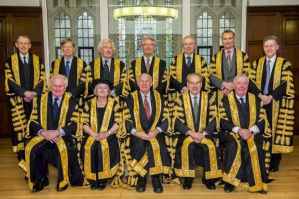
(The PC Left and rabid practitioners of Identity Politics are also missing a trick – eleven of the twelve current justices of the UK Supreme Court are old white men, with the remaining justice an old white woman. Are these people really the most qualified for the job, or did they get their positions through the chumocracy and establishment connections? Why is there no public confirmation process, to give democratic oversight to the selection of new justices? And yet how many times has the UK Supreme Court been picketed by angry Social Justice Warriors demanding ethnic balance on the court?)

I will be honest and start by admitting that before writing this piece, I could only name one justice of the UK Supreme Court – Lord Neuberger, the court’s president. And that’s awful. I write about politics and UK current affairs every day and consume several hours of news on television, the internet and social media besides, but I could only name one person on the bench of the UK Supreme Court. And if I can’t rattle off a handful of names together with a brief commentary on their respective legal and ideological outlooks, how many people are actually able to do so?

How many laymen – people without a direct professional or personal interest in the workings or judgements of the court – actually do know who sits on our own version of the Supreme Court? How many could explain at a high level how the legal system works, with the division between civil and criminal court, the work done by solicitors and barristers, and the hierarchy of trial and appellate courts? Or the difference between the Scottish system and that of England and Wales? All that I currently know, I learned from an Introduction to Business Law course while studying at university – there were no civics lessons in the 1990s National Curriculum. And most others will not have even received this basic primer.

But how are we to fulfil our potential as informed and engaged citizens when we fail to understand how one of the three major branches of government works? Most people have a passable grasp of the executive and the legislature, even if they don’t recognise the Government and the Houses of Parliament using those terms. But I very much doubt that one adult in fifty could explain the fundamentals of our legal system, let alone the many layered intricacies.

UK Legal System - Judges Procession

But flip it around. Why would we know how our legal system works, or recognise the major personalities in the British legal scene? And why should we bother to take the time to educate ourselves?

People in America know the names and ideological leanings of the justices on their Supreme Court for a number of reasons. For a start, they take their civics a little bit more seriously on that side of the Atlantic – something that we could learn from.

But more than that, the American legal system is far more responsive to the citizenry than the British system is to us. One major difference is that many local judges are elected. Now, this may or may not be a good idea – and having watched a number of local races for positions on the bench, I have my grave doubts as to the wisdom of elected judges. But you can’t deny that you are likely to feel much closer to the legal system if you have a direct say in who gets to don the black robes.

Even more important is the fact that unlike we Brits, Americans have a written constitution to act as a common frame of reference when talking about legal matters. Even half-educated Americans will talk about whether something is “constitutional” or not, and apply this test to all manner of public policy debates, from government surveillance to gay marriage. This is important, because it gets people thinking beyond the mere fact of whether they agree or disagree with a particular law, and toward the broader question of exactly why the law in question is good or bad. That’s not to say the ensuing debate cannot still be ignorant and intemperate – it often is – but at least everyone is able to take part in the debate along the same parameters.

Consider the Edward Snowden leaks, when one whistleblower’s actions laid bare the extent of secret government surveillance in Britain, America and the other “Five Eyes” countries. In America, the people – outraged at this secret, systemic violation of their privacy – were able to haul officials in front of congressional committees and debate the legality of the government’s actions with reference to the Fourth Amendment, which prohibits unreasonable searches and seizures. And in due course, the American government had to make a number of concessions and restrict its surveillance activity. In Britain, by contrast, we had David Cameron pompously telling us that he respects the “tradition of liberty” but is basically going to do whatever he wants. And what recourse have we to stop him? None.

Then there is the central role which the US Supreme Court often plays in matters of great social importance in America. In Britain, Parliament’s “elected dictatorship” is the Alpha and the Omega for nearly all significant decisions made in this country – the government can pass or repeal any law almost at will and with no reference to any higher text or law, so long as it can muster the votes in the House of Commons. The courts then simply apply what has been handed down by Parliament, which is sovereign. Refreshingly, this is not so in the United States.

Consider just some of the most famous cases – household names, even to those of us living in Britain. Dred ScottCitizens United. Roe vs Wade. Brown vs Board of Education. We may know next to nothing about American current affairs, but we know that these relate to slavery, campaign finance, abortion and racial segregation. Because in America, the president is not the only person who matters. Nor are the leaders of Congress. The third branch of government matters equally, and how the Supreme Court chooses which cases to hear and applies their interpretation of the Constitution to those cases constitutes a vital check and balance in the American system.

Can you name a comparably important British case? They do exist – the Al Rawi case, for example, with its implications for the legality of secret hearings, or Nicklinson vs Ministry of Justice, which confirmed the current illegality of voluntary euthanasia, or the “right to die”. But few people know about these cases or why they are important, because the British legal system is so much more remote and unaccountable to the people.

St Louis Old Courthouse - Dred Scott Case - 2

Finally, there is the question of sovereignty. The United States Supreme Court is the final arbiter of what is and is not constitutional, and therefore applicable to American citizens. It cannot be shunted aside by an impatient government if it holds up or overturns key legislation, and nor can it be undermined from the outside – the court determines for itself which cases it will hear, and a majority decision made by five out of nine Supreme Court justices will then bind the government and lower courts. This goes against everything that the current British establishment – who are only too happy to wreck every institution and overturn any tradition in pursuit of their short term goals – stand for.

But crucially, the US Supreme Court is also not subordinate to any external or foreign body. By contrast, the UK Supreme Court is treaty-bound to defer to the decisions of the Court of Justice of the European Union (CJEU), and must interpret all UK legislation not through the lens of compatibility with a British constitution, but rather to ensure its compliance with the European Convention of Human Rights. That might sound all well and good until one realises just how broadly “human rights” have come to be defined.

And one must also ask why we as a country do not trust ourselves enough to be the final arbiter of important cases. Are we naturally more barbarous than our European neighbours, and in need of constant judicial restraint by our moral betters on the continent? Whatever the answer, the inescapable truth is that legal subjugation to an external, supranational body is the antithesis of national democracy.

So to recap, there exist a number of deficits between the American and UK legal systems in terms of ensuring citizen understanding and engagement with the judicial branch of government, namely:

1. A weaker sense of civic duty and engagement in Britain

2. Greater democratic distance between the people and the legal system in Britain, compared to America

3. Lack of a written British constitution as a common frame of reference when discussing legal matters

4. A much clearer link between decisions made in the US Supreme Court with American social policy

5. Lack of sovereignty: the American legal system is sovereign and subordinate to no external body, unlike the British legal system which is subordinate to EU law

US Supreme Court

There is no good argument for continuing to abide such a remote, elitist and unaccountable legal system as we suffer in Britain. None. And anybody tempted to sniff haughtily at the American system, with their elected lower court judges and Scopes Monkey Trial culture wars should remember that however passionate and unseemly the public discourse can sometimes be across the Atlantic, this is only because more American people are actually engaged citizens with a moderate grasp of how their country actually works. We should be so lucky to have a system as simple, accessible and easy to explain as they have in the United States.

And it should be a source of great shame to us that our journalists, politicians and private citizens often know more about another country’s legal system through watching Hollywood movies or Law & Order than they do about our own.

The American public is rightly fixated on the issue of who President Obama will nominate to fill the Supreme Court seat left vacant by the late Antonin Scalia – incidentally a first rate mind and writer of opinions and dissents which are accessible and entertaining even to laymen like myself. They care about who takes up the ninth seat on their Supreme Court, because unlike Britain, their legal system is more than a rubber stamp for the government of the day.

The ninth justice of the US Supreme Court may well end up casting crucial swing votes in important matters of human governance in the next decades, such as the right to bear arms in self defence, the right to privacy and the right to free speech. And these decisions could well have tangible, real-world consequences for the 330 million people who live under the court’s jurisdiction, as well as anybody else to whom the Constitution applies – like your First Amendment right to free speech when you go to holiday or work in America as a British citizen.

Elevating the people and the institutions into the public consciousness is not crass sensationalism, as some may charge. On the contrary, focusing on the personalities helps to elevate the issues to a place of prominence in our public discourse, which is exactly what we should be doing here if our own elites were not so busy trying to hide from public accountability anywhere they can scurry – be it behind the black veil of EU lawmaking in Brussels or the bewigged, dusty obscurity of the British legal system.

It would be ironic if it took the death of a supreme court judge in another country to force Britain to finally take a proper, critical look at our own impenetrable legal system. But public interest in legal matters peaks only very rarely, and so those of us who want to see real legal and constitutional reform have a slim opportunity – but also an obligation – to make our case.

For as things stand, a constitution and legal system in force over 3,000 miles and an ocean apart often feels more familiar – and less remote – than our own.


Supreme Court Justices - United States

Supreme Court Justices - United Kingdom

Agree with this article? Violently disagree? Scroll down to leave a comment.

Follow Semi-Partisan Politics on TwitterFacebook and Medium.

Don’t Blame Anti-Establishment Politicians For Vile Online Abuse

Internet Troll - Cyber Online Abuse

Taking offence in the behaviour of a politician’s online supporters says a lot more about your view of that particular politician than the uniquely “hateful” nature of their fans

What do Jeremy Corbyn, Nicola Sturgeon, Bernie Sanders, Donald Trump and Nigel Farage all have in common?

Nothing to do with their political views, obviously – you would be hard pressed to imagine four more different politicians, both in terms of style and substance. But they do share something more fundamental in common: the fact that their supporters are uniquely derided as being angry and intemperate, even sexist or racist trolls, especially when compared to the supporters of their more established rivals.

How many times have you heard a wounded, thin-skinned Westminster media type complain in hurt tones that they have received “vile online abuse” from crusading Ukippers or SNP-supporting Cybernats? And this is nearly always followed by the accusatory observation that the journalist or media star in question has never been so insulted or abused by supporters of the other mainstream parties or candidates.

You have likely seen or read this lament numerous times in one form or another. Typically, they will conclude – either explicitly or by inference – that there must be something uniquely awful and unacceptable about that particular party or candidate’s views, something which either attracts a disproportionate number of crazy people, or else makes otherwise good people behave in reprehensible ways.

Here’s the Telegraph’s James Kirkup raising an eyebrow after receiving a less than loving and nurturing response from online UKIP supporters, in a piece rather preciously titled “Why are UKIP supporters so rude and horrible?”:

A brief glance through the comments sections of the Telegraph website will show this is not an isolated incident; hostile and personal remarks are a common feature of online discussion about Ukip-related stories and columns. My email inbox tells a similar story.

I’m not alone here. There is nothing unique or special about me, no individual quality that attracts such strong feelings. All of my colleagues who cover Ukip and Mr Farage regularly receive such vitriol, and several of them get it in much larger volumes than me.

[..] I’m increasingly convinced that Ukippers are one of the political groups whose members are disproportionately likely to go in for online bile. (Scottish Nationalists are another; I haven’t had the pleasure of their electronic company for a while, but in a previous job I got to know the “cybernats” fairly well.)

Kirkup’s piece is actually fairly generous – he goes on to praise Ukippers for their passion and commitment, although it comes across in a rather condescending way.

But there is no such generosity in this farewell to the Labour Party from Barbara Ellen, who took her leave after finding herself unable to cope with the fact that her preferred centrist wing of the party finds itself temporarily out of favour for the first time in decades.

Smarting from the “howling gales” of disagreement she encountered, Ellen raged:

Still the Corbynista circus refuses to leave town, with one troubling result being that the term “moderate” is starting to look tarnished and devalued – deemed too centrist, restrained, temperate, cautious. Never mind that this describes most of Britain – or that this culture of moderate-baiting is hounding people like myself (lifelong Labour voters) out of the party. Like many in the great disenchanted Labour diaspora of 2015, I don’t feel remotely “Tory lite”, but nor do I feel that there is a place for me in this brutal and monochrome, but also silly and over-simplistic, “with us or against us” regime.

And maybe there’s a faint hope that by leaving, by voting with your feet, you’ll finally quietly reasonably (moderately!) make your voice heard. It’s a sad scary moment when “moderate” starts feeling like a insult. I’d have thought that moderates were the bricks and cement of any political party – without them, the extremes become unmoored, sucked into howling gales of their own making. The leftier-than-thou can taunt the departing “boring”, “gutless”, “Tory lite” moderates all they like. In the end, we were necessary and we’ll be missed.

The media’s hysteria about boisterous and sometimes deeply unpleasant online political discourse reached its peak with their coverage of the Jeremy Corbyn campaign, with endless finger-wagging remarks about how the actions of a few anonymous knuckle-dragging trolls supposedly make a mockery of Corbyn’s “New Politics”.

Here’s the Spectator’s Sebastian Payne rending his garments in anguish at the fact that some unhinged Corbyn fans happen to say some very unpleasant things online:

It was meant to be about open debate and discussion, consensus through dialogue. But so far, Jeremy Corbyn’s leadership of the Labour party and the arrival of the so-called New Politics has resulted in division and a lot of abuse and bad feeling. In light of last night’s vote on Syria airstrikes, Twitter and Facebook have been exploding with extraordinary levels of comments and abuse that no one, MPs or otherwise, should be subjected to.

For example, hard-left groups such as Lefty Unity, have been using Twitter to stir up agitation against the MPs they disagree with.

The article goes on to cite a tweet listing the names of Labour MPs who voted for military action in Syria, and calling for party members to deselect them. Remarkably, Payne presents this as some terrible affront to civilised behaviour rather than precisely what should happen in a democracy: MPs making decisions in public, and the public judging MPs based on those decisions. The horror!

Unfortunately, our default reaction is increasingly not just to sit back and mock the individual trolls (justified), but to then also make the lazy assumption that the internet trolls somehow speak for the wider movement or supporter base (much less justified). Everyone enjoys seeing an ignorant verbal abuser put back in their box, but we are being intellectually lazy if we then go on to believe that people like the anonymous idiot silenced by JK Rowling are representative of general UKIP or SNP opinion.

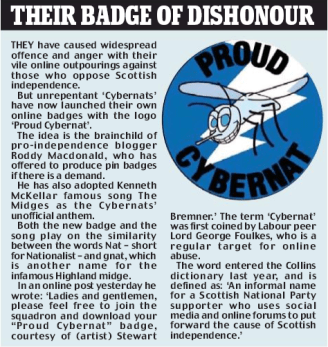
Cybernat - Online Abuse - Trolling

Exactly the same phenomenon can now be seen in the United States, where supporters and media cheerleaders of Democratic establishment favourite Hillary Clinton are lightning-quick to accuse their opponents of sexism, and to refer disparagingly to supporters of socialist rival Bernie Sanders – alas, a white male – as the “Bernie Bros”.

Glenn Greenwald does a superb job of debunking the myth that Bernie Sanders supporters are uniquely sexist or misogynistic among political supporters over at The Intercept, writing:

Hillary Clinton is the establishment candidate. Therefore, she has far more supporters with loud, influential media platforms than her insurgent, socialist challenger. Therefore, the people with the loudest media platforms experience lots of anger and abuse from Sanders supporters and none from Clinton supporters; why would devoted media cheerleaders of the Clinton campaign experience abuse from Clinton supporters? They wouldn’t, and they don’t. Therefore, venerating their self-centered experience as some generalized trend, they announce that Sanders supporters are uniquely abusive: because that’s what they, as die-hard Clinton media supporters, personally experience. This “Bernie Bro” narrative says a great deal about which candidate is supported by the most established journalists and says nothing unique about the character of the Sanders campaign or his supporters.

And the same blindingly obvious truth hits closer to home with the media’s reaction to – and coverage of – Jeremy Corbyn’s campaign for the Labour leadership:

This exact media theme was constantly used against Corbyn: that his supporters were uniquely abusive, vitriolic, and misogynistic. That’s because the British media almost unanimously hated Corbyn and monomaniacally devoted themselves to his defeat: So of course they never experienced abuse from supporters of his opponents but only from supporters of Corbyn. And from that personal experience, they also claimed that Corbyn supporters were uniquely misbehaved, and then turned it into such a media narrative that the Corbyn campaign finally was forced to ask for better behavior from his supporters.

Time and again we see establishment candidates and their fans in the media reaching for the smelling salts and clamouring to tell us how insulted and distressed they are, simply because something they said or wrote happened to tap into the coarsing vein of popular anger against a political establishment which grows remoter and more self-serving by the day. But we should recognise this for what it is – a cheap attempt to shut down the debate by rendering certain political ideas unthinkable or unsayable.

It is very much in the interests of centrists within Labour and the Conservative Party that people should fear policies with a genuine ideological twist to them, be they from the Right or the Left. When their entire pitch to the electorate consists of fatuous promises to be the most competent managers of our public services, as thought Britain were nothing more than a rainy island of hospitals and job centres, anything which attempts to inject some inspiration, ambition or bold thinking into our political debate is to be greatly feared, and thwarted at all costs.

Hence the continual efforts to portray Jeremy Corbyn’s left-wingery, something which would have been considered perfectly normal in 1986, as beyond the pale of acceptable thought in 2016.

Hence the sneering, virtue-signalling attacks on Ukippers, who have been shamefully portrayed by the media as a bunch of grunting, uneducated, economically “left behind” losers who wrap themselves in the Union flag because they are somehow more scared of change than a “normal” person.

Hence the apocalyptic predictions of those opposing Scottish independence, warning that Scotland would become some kind of tartan-clad North Korea if they went their own way.

Now, this blog believes that Jeremy Corbyn’s left wing policies are utterly wrong for Britain, that UKIP does have a certain unsavoury element within it, and that Scottish independence and the breakup of the United Kingdom would be a tragedy. But I don’t for a moment assume that the virtue of these ideas can be judged in any way by the behaviour of their most crude and sociopathic advocates. And nor do I attempt to suppress the expression of those ideas by linking overheated rhetoric on social media to any one particular idea, candidate or party.

All of which makes you wonder: If the establishment are so self-evidently right, if the centrist parties and politicians do indeed have a monopoly on Good and Pragmatic Ideas, and if anybody who proposes the slightest departure from the status quo is a juvenile dreamer or a tub-thumping populist, why not let the arguments speak for themselves?

If the establishment have the facts so overwhelmingly on their side, why do they not limit themselves to patiently explaining why Bernie Sanders, Jeremy Corbyn, Donald Trump and Nigel Farage are wrong on the issues? And at a time when political engagement is falling and faith in democracy ebbing, are the Corbyn critics and Farage haters really saying that they would rather people were disengaged than back a radical candidate?

This blog would argue that there is a certain nobility in all of the populist insurgencies currently roiling the political landscape in Britain and America. Whether one agrees with them or not (and there is often much to vehemently disagree with), they are at least attempting to drag us out of a stale and timid political consensus which has delivered prosperity for many but also failed too many of our fellow citizens.

Or as this blog remarked last year:

It is very easy to sit smugly on the sidelines, throwing the occasional rock and taunting those who risk hostility, ridicule and contempt as they struggle to find a way to make our politics relevant to the people. Anyone can be a stone-thrower. But it’s another thing entirely to roll up your sleeves, join the fray, pick a side or – if none of the available options appeal – propose new political solutions of your own.

Ukippers and Jeremy Corbyn supporters have often been steadfast in their political views for years, and as a result have languished in the political wilderness while those willing to bend, flatter and shapeshift their way toward focus group approval have been richly rewarded with power and success.

The “Bernie Bro” phenomenon in the United States and the centrist Labour hysterics about the antics of a few offensive people are nothing but a choreographed backlash from the establishment, whipped up by people who are happy to hijack issues like feminism and use them for their own short-term political advantage, or do anything else to disguise the yawning chasm where sincerely held convictions and beliefs should reside.

So, when you see a bunch of prominent, well-connected people feigning horror at the way in which people with whom they disagree are comporting themselves on the internet, your first thought should not be to dismiss the idea or candidate whom the obnoxious trolls support, but rather to question the real motives of the people weeping and rending their garments because they have been spoken to rudely on social media.

It may turn out that the trolls are still wrong, as well as being obnoxious and offensive. But many times, it will likely transpire that the people making the most fuss about the way that a particular candidate or party’s supporters are behaving also happen to have the most to lose in the event that those ideas gain a wider following. And their sudden desire for comity and a more respectful public discourse is cynical at best.

So what do Jeremy Corbyn, Nicola Sturgeon, Bernie Sanders, Donald Trump and Nigel Farage all have in common?

They are all flawed.

They are all willing to say things which make them wildly unpopular with large swathes of people.

Without their boldness and tenacity, few of us would still be discussing their top issues and obsessions – be it genuine socialist politics, Scottish independence, immigration or the coming EU referendum – and our politics would be left to the stale old two-party duopoly.

And none of these politicians, whatever their flaws, deserve to be judged by the online behaviour of their most angry, antisocial supporters.

Bernie Sanders - Refutes Bernie Bros

Top image: “#GamerGate is the future of troll politics”, Techcrunch.com

Agree with this article? Violently disagree? Scroll down to leave a comment.

Follow Semi-Partisan Politics on TwitterFacebook and Medium.