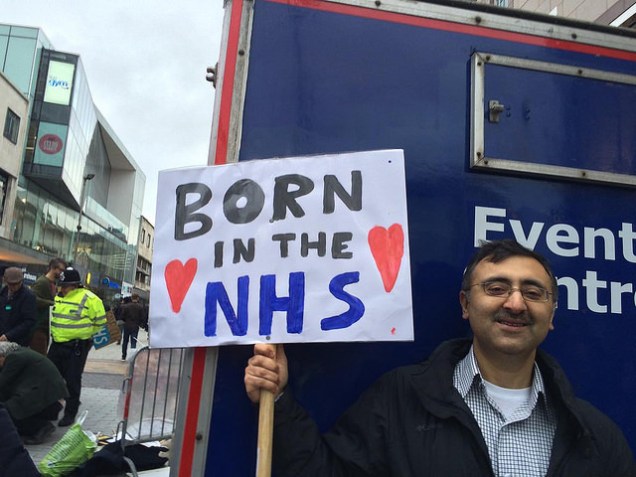
NHS Heresy, Part 2

born-in-the-nhs-idolatry-national-religion-nhs-industrial-complex

It takes real courage to speak out against the Cult of the NHS, particularly for people on the political left who are expected to be the biggest cheerleaders of all

From a brave commenter at Left Foot Forward, reacting to the same piece of sentimentalist NHS idolatry which prompted my article here:

I am disabled and faced horrendous treatment on the NHS when I unfortunately required help, I never once criticised staff individually but still every time I tried to talk about what I faced I was shouted at, told I hate the NHS, that I want to copy the US… I’ve seen the same thing happen to NHS staff whistleblowers. At this point it seems protecting “our NHS” from any and all criticism (that is not crouched in “don’t get me wrong, I love the NHS”) is more important than the wellbeing of both the patients and the staff and the functioning of the healthcare system.

I have since moved elsewhere in Europe to my husband’s country where the PUBLIC healthcare system (health insurance and private doctors are not a common thing here either), though it has flaws as everywhere does, functions as a healthcare system much better. If you want to change the pressures the NHS is under then it needs to become socially acceptable to talk about the NHS without referring to it as the “envy of the world” constantly or being accused of hating it and the staff working for it.

Heretic! Heretic!

BURN THE WITCH!

This statement takes courage, perhaps particularly from somebody who is clearly on the political left herself, and so is expected to be a particularly enthusiastic priestess of the Cult of the NHS. I admire her bravery – I fear that she (and others like her) will continue to be demonised for daring to acknowledge glaring reality.


Postscript: An alternative vision for healthcare in Britain, penned back in 2008 by Professor Karol Sikora, former chief of the World Health Organisation Cancer Program.


NHS Logo - Cross - National Religion - Worship - Idolatry

Support Semi-Partisan Politics with a one-time or recurring donation:

Agree with this article? Violently disagree? Scroll down to leave a comment.

Follow Semi-Partisan Politics on TwitterFacebook and Medium.

The Problem With Hillary Clinton

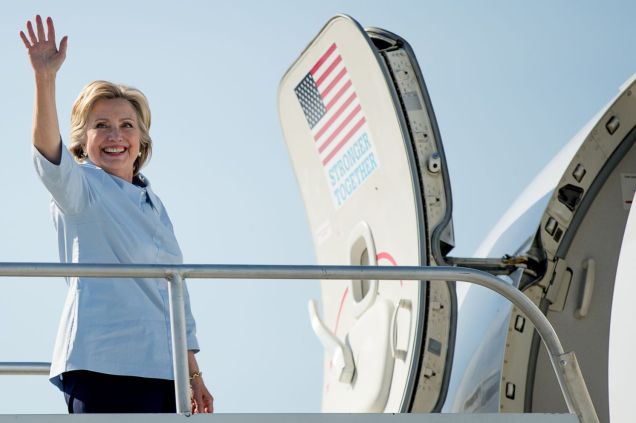
hillary-clinton-campaign-plane-2

One of the most politically damning charges against Hillary Clinton is the accusation that she has no guiding ideology or core beliefs, that she picks up and discards her positions based purely on political expediency. But don’t expect defensiveness or contrition – behind closed doors, Hillary Clinton is defiantly and unrepentantly proud of her constant triangulation

Outside the home, politicians are generally at their most candid when addressing wealthy donors at private events, safely sequestered from the general public and the media.

We know of Barack Obama’s high-handed “bitter clingers” put-down of people who cling to guns and religion having supposedly failed at life thanks to unguarded comments made to donors. Mitt Romney’s infamous “47 percent” remark, in which he was deemed to have effectively written off nearly half of the country from voting for him because they do not pay federal income tax, and which did more than anything to sink his presidential dreams, came from remarks at a fundraiser. So too did Hillary Clinton’s recent “deplorables” debacle, in which she suggested that half of all Donald Trump supporters are essentially abhorrent and unacceptable human beings with whom there can be no meaningful dialogue or compromise.

The only real exception to this roll call of dishonour is Donald Trump himself, a man utterly without shame who is happy airing his most vulgar and ignorant thoughts direct into a live television camera, even during a presidential debate, and who consequently has no need to use donor meetings as a pressure release valve to vent his real feelings.

But for those of us who like our politics with a bit of conviction, principle or even (dare I say it) ideology, then the latest leaked recording of Hillary Clinton candidly addressing a group of starry-eyed donors really takes the biscuit.

From Politico:

Hacked audio of a conversation between Hillary Clinton and donors during a February fundraising event shows the Democrat nominee describing Bernie Sanders supporters as “children of the Great Recession” who are “living in their parents’ basement.”

Speaking at a Virginia fundraiser hosted by former U.S. ambassador Beatrice Welters, Clinton says in a clip released by the Free Beacon that many of her former primary opponent’s supporters sought things like “free college, free health care,” saying that she preferred to occupy the space “from the center-left to the center-right” on the political spectrum.

During the conversation, also reported in the Intercept, Clinton confesses to feeling “bewildered” by those to her far-left and far-right in the election.

“There is a strain of, on the one hand, the kind of populist, nationalist, xenophobic, discriminatory kind of approach that we hear too much of from the Republican candidates,” she said. “And on the other side, there’s just a deep desire to believe that we can have free college, free healthcare, that what we’ve done hasn’t gone far enough, and that we just need to, you know, go as far as, you know, Scandinavia, whatever that means, and half the people don’t know what that means, but it’s something that they deeply feel.”

I don’t doubt Clinton for a moment – I am sure that she does indeed feel bewildered by people who actually have political convictions and principles which they are reluctant to bargain away in the pursuit of power. And doesn’t that speak volumes about the type of president she would be?

Here is the precise transcript of her comments.

CLINTON: It is important to recognize what’s going on in this election. Everybody who’s ever been in an election that I’m aware of is quite bewildered because there is a strain of, on the one hand, the kind of populist, nationalist, xenophobic, discriminatory kind of approach that we hear too much of from the Republican candidates. And on the other side, there’s just a deep desire to believe that we can have free college, free healthcare, that what we’ve done hasn’t gone far enough, and that we just need to, you know,  go as far as, you know, Scandinavia, whatever that means, and half the people don’t know what that means, but it’s something that they deeply feel. So as a friend of mine said the other day, I am occupying from the center-left to the center-right. And I don’t have much company there. Because it is difficult when you’re running to be president, and you understand how hard the job is —  I don’t want to overpromise. I don’t want to tell people things that I know we cannot do.

Some are new to politics completely. They’re children of the Great Recession. And they are living in their parents’ basement. They feel they got their education and the jobs that are available to them are not at all what they envisioned for themselves. And they don’t see much of a future. I met with a group of young black millennials today and you know one of the young women said, “You know, none of us feel that we have the job that we should have gotten out of college. And we don’t believe the job market is going to give us much of a chance.” So that is a mindset that is really affecting their politics. And so if you’re feeling like you’re consigned to, you know, being a barista, or you know, some other job that doesn’t pay a lot, and doesn’t have some other ladder of opportunity attached to it, then the idea that maybe, just maybe, you could be part of a political revolution is pretty appealing. So I think we should all be really understanding of that and should try to do the best we can not to be, you know, a wet blanket on idealism. We want people to be idealistic. We want them to set big goals. But to take what we can achieve now and try to present them as bigger goals.

My emphasis in bold.

The centre-left to the centre-right. That is, Hillary Clinton seeks to be the Alpha and the Omega of American politics, oscillating between two non extremes of bland opportunism guided by nothing other than her finely-honed ear for what is politically feasible without upsetting donors or special interests. And this is supposed to be inspiring? This is 21st century leadership?

Let us not be naive: all of politics is a game of compromise – or an unseemly sausage making process, as it is often described. But is Hillary Clinton really surprised that people are having trouble motivating themselves to vote for her when she openly brands herself as an out-and-proud offal grinder? Uninspiring, incremental progress laced with self-interest is what we expect at the end of the political love affair, not the seductive note inspiring us to take a leap of faith in the first place.

The trouble with this fixation on the political centre is that it pays large dividends, right up to the moment where it stops working at all. In Britain, the Labour Party discovered a route back to power which involved shedding nearly all association with their traditional socialism and accommodating much of the post-Thatcher orthodoxy, and it won them three successive general election victories from 1997 through 2005. But with a rudderless Conservative Party barely two degrees further right, suddenly all of the main political parties in Britain found themselves dancing on the head of a pin, ideologically speaking. There was nothing to separate them, from their love of an activist, paternalistic nanny state to their agreement that Britain should remain in the European Union at all costs.

And sure enough, the stale centrist political consensus in Britain, which saw the main political parties using wild rhetoric to describe what were effectively miniscule differences in policy, is in the process of crashing down. The Conservatives were destabilised by the rise of UKIP to the extent that they had to offer (and ended up losing) a referendum on Britain’s continued membership of the EU, while the failure of Ed Miliband to win power in 2015 saw Labour’s centrists routed by the left-wing Corbynites and left utterly without support or influence.

By pursuing such a doggedly centrist course, Hillary Clinton is effectively betting that the political earthquake which shook America’s closest ally will not reach American shores until she is safely ensconced in the White House. But that is an awfully dangerous gamble to make, especially when the Trumpian takeover of the Republican Party shows massive popular fury with the status quo.

For decades now, career politicians have assumed that the deciding bloc of voters requiring outreach and outright pandering were those in the centre. But what if this is no longer the case? Hillary Clinton struggled to prevail in the Democratic primary against Bernie Sanders, an ornery old socialist, and some Sanders supporters see the Libertarian/Green third party tickets or even Donald Trump as a preferable fallback to supporting Clinton. And while Clinton remains the favourite, it may be the case that she succeeds in holding the political centre, but ultimately loses the presidential election because the bottom falls out of a left-wing base which believes she has abandoned them.

And who could blame them for abandoning her in turn? This is a Democratic Party nominee who looks down on people who don’t see the appeal of political triangulation and bet-hedging as immature basement-dwellers who are just too stupid to understand how the world works. A nominee who thinks so little of her own party base that she openly muses with donors about ways to dress up the most meagre accomplishments as “bigger goals” in order to trick the proles and keep them in line.

Hillary Clinton remains the only plausible candidate for US president only because her opponent is Donald J. Trump, much as the only reason for a British small-c conservative to vote for a Big Government-supporting Conservative Party which has abandoned any commitment to fiscal responsibility is the fact that the alternative would be Jeremy Corbyn’s reheated 1970s socialism.

But keep asking people who are sick of the status quo to choose between the lesser of two evils and their responses are likely to become less and less predictable. Hillary Clinton may well succeed in slowly grinding her way to the Oval Office. But if disaster strikes, she will have nobody to blame but herself and her soul-crushingly unidealistic campaign.
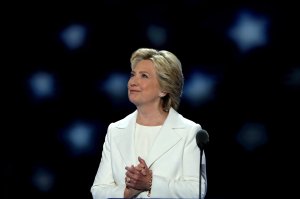
 

Hillary Clinton - DNC - Democratic National Convention - Acceptance Speech - 4

Support Semi-Partisan Politics with a one-time or recurring donation:

Agree with this article? Violently disagree? Scroll down to leave a comment.

Follow Semi-Partisan Politics on TwitterFacebook and Medium.

Jonah Goldberg On Conservatism In The Age of Donald Trump

Jonah Goldberg says it best when describing the existential danger facing American conservatism in the Age of Trump.

On Trump’s unearned reputation as a happy warrior against political correctness:

This is just flatly not true. I also don’t believe it is true that Trump is appealing to minorities based upon their status as citizens, it’s not in his rhetoric, it’s not what he says; nor do I think he gives a rat’s patoot about the Constitution, which he thinks has twelve articles. He is just making it up as he goes along, riding a populist wave.

[..] This idea that Donald Trump is against political correctness is just a fiction. He’s against being held accountable to people to political correctness for himself but he is delighted to use the exact same bullying tropes of political correctness against other people. He’s done it against me when he tried to get me fired from National Review, saying I was insulting to women and that I have to apologise or resign or be fired because I was so insulting to women. What did I do that was so insulting to women? I said that Donald Trump is staying up late into the night like a teenage girl, tweeting. Which was A, accurate, and B, accurate.

During the primaries when Jeb Bush had a completely understandable and forgivable gaffe about women’s health issues, for weeks Donald Trump was talking about how horrible Jeb Bush was on women’s issues, playing these politically correct cards. He’s a nearest weapon to hand arguer in all things because he does have no philosophy, he has no intellectual grounding whatsoever, and I understand saying “well, we don’t need any more intellectuals, what did intellectuals get us, look at Woodrow Wilson, look at Barack Obama”, I get all that.

But Donald Trump is not a practitioner or a believer in American exceptionalism. He’s rejected the term outright, explicitly, more than once, nor does he represent what we mean by American exceptionalism. His core values, as he says over and over again, are strength and winning. Getting him to talk about the Constitution is like getting my daughter to eat brussel sprouts. I mean, she’ll do it, but it’s not a pretty picture and she tries to get it over with as quickly as possible.

Interestingly, Jonah Goldberg seems to broadly agree with my assessment of the first presidential debate, awarding Hillary Clinton the win, but not by a massive degree:

I thought Trump lost the debate, but not overwhelmingly. He was clearly the winner of the first 30 minutes or so, and if he’d stayed that guy for the full 90 it would have been a hugely consequential rout. But then, Hillary implemented “Bait Trump Protocol Alpha-1,” when she brought up how he got his start with a $14 million loan from his father. (She got the details wrong, but it doesn’t matter. When you’re baiting fish or Trumpzilla, the lure doesn’t have to be real, it just has to be shiny. In fact, getting the bait just slightly wrong makes it even more irresistible, because we all have a natural instinct to correct falsehoods aimed at us, and Trump more than most.)

So Trump bit the shiny thing, and for the rest of the night, plodding, dull Hillary Clinton led Trump around the stage like a matador with a red cape. And, four days later, Trump is still charging around like an enraged bull. At first I thought Clinton’s use of Alicia Machado was odd. There are so many Trump victims out there, why use one with such a weird past? But that’s what was so brilliant about it. If Machado were a nun, it’d be harder for Trump to attack. But Trump thinks he can win this one on the merits and so he won’t let go of it. He didn’t learn the lesson of his feud with the Khan family: The only way to win such fights is to not engage in them at all. The debate wasn’t a disaster but how he handled the post-debate spin was, and continues to be.

If Trump could stay on message, if he could be a disciplined candidate, I think he’d be ten points ahead by now. But realistically, this is no different from saying if he could control anything metal with his mind, he would be Magneto.

In the immediate aftermath of the debate (at 4AM UK Time, with no opportunity for reflection or benchmarking against the reaction of others) I wrote:

Clinton did become more effective during the final 30 minutes, which her campaign will be very relieved about. And did she manage to rile Donald Trump? Yes – but no more than the country is used to seeing after his tussles with Jeb Bush, Marco Rubio or Ted Cruz.

[..] My gut says that this was a victory for Hillary Clinton on points, but a score draw in terms of public reception. Time will soon tell.

All but the most extreme Trump partisans have indeed admitted a Clinton victory on points, substance and tone. And once again, Donald Trump is crowdsourcing advice for how he should tackle the upcoming second debate at Washington University in St. Louis – advice which he will surely reject again, whether it comes from his army of supporters or his despairing, demoralised campaign team.

American conservatives who have chosen to collaborate with Donald Trump have hitched their wagon to the wrong train – in victory or defeat, he will lead them nowhere good.


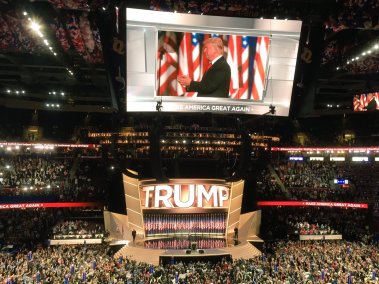
Donald Trump - RNC - Republican National Convention - Cleveland - Nomination - 2

Support Semi-Partisan Politics with a one-time or recurring donation:

Agree with this article? Violently disagree? Scroll down to leave a comment.

Follow Semi-Partisan Politics on TwitterFacebook and Medium.

Politicising The Supreme Court: A More Liberal SCOTUS Is Nothing To Celebrate

Jeffrey Toobin in The New Yorker salivates at the prospect of a President Hillary Clinton loading the Supreme Court with a bunch of zealous, ideological progressives:

For the first time in decades, there is now a realistic chance that the Supreme Court will become an engine of progressive change rather than an obstacle to it. “Liberals in the academy are now devising constitutional theories with an eye on the composition of the Court,” Justin Driver said. The hopes for a liberal Court will begin—or, just as certainly, end—with the results on Election Day.

Of course there have been times when conservative Republicans have bent the spirit or the letter of the law in pursuit of their own obsessions – cracking down too restrictively on voting rights stands as an obvious, shameful example. But liberal excitement about getting to stamp their mark on the makeup of the Supreme Court seems to extend far beyond merely righting these examples of conservative overreach:

The liberal wish list expands rapidly from there—limited only by the imaginations of law professors, advocates, and the Justices themselves. One possibility is that the Court might recognize a constitutional right to counsel in civil cases. (Currently, only criminal defendants are guaranteed legal representation.) In criminal law, the Court might adopt the idea, which Sotomayor has suggested, that the Constitution forbids incarcerating individuals who are too poor to pay fines. Several scholars have proposed a constitutional right to education, which might force increased funding for poor districts, or, even more speculatively, a right to a living wage.

These goals range from the worthy (no longer imprisoning people who are so poor that they have no prospect of paying large court fines) through the interesting-but-unworkable, all the way to the downright authoritarian and unconstitutional (a federal “living wage”).

But while the Supreme Court is the third and equal branch of government, activists on all sides of the political spectrum are playing with fire when they seek to co-opt the court to be an “engine of progressive change” (or resistance to that change) where they cannot muster popular support to achieve their goals through Congress or, if necessary, amend the Constitution.

The Supreme Court has long been politicised, and American democracy has suffered as a result. And while it may be wishful thinking that the tit-for-tat partisan drama will come to an end any time soon, liberals in particular should be careful. For their side is already ascendant or even victorious on many fronts in the culture war. Social changes which would have been unthinkable three decades ago are now a tangible reality – often a positive thing, sometimes less so. Seeking to gain the last 10% of their social objectives by turning the screws on American conservatives through the Supreme Court will only foster resentment and sow division.

Perhaps liberals genuinely don’t care. Perhaps they are fine with the idea of achieving their goals by circumventing the political process and pushing their “living constitution” interpretations to the limit of coherency. But there will be a backlash, just as there are always consequences when political elites of any stripe push stubbornly ahead with their agendas while forgetting to bring the country with them.


US Supreme Court

Support Semi-Partisan Politics with a one-time or recurring donation:

Agree with this article? Violently disagree? Scroll down to leave a comment.

Follow Semi-Partisan Politics on TwitterFacebook and Medium.

Donald Trump Crowdsources Debate Prep Advice, Again

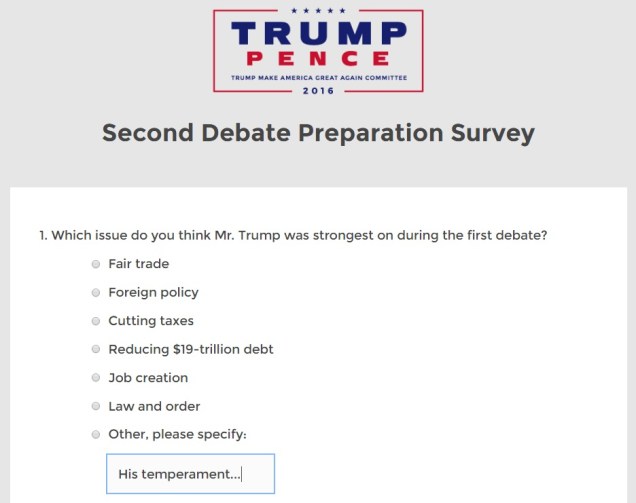
donald-trump-second-debate-preparation-survey

There you go again…

After performing so magnificently in the first presidential debate against Hillary Clinton at Hofstra University on Monday night, Donald Trump has once again reached out to his supporters to solicit their advice on how he should tackle the upcoming second debate at Washington University in St. Louis.

Among the searingly introspective questions the Trump campaign is asking this time:

4. Should Trump lay out how his business, private-sector experience will directly benefit the economy?

Well, what else has he got to run on? If not a highly polished and idealised version of his track record in business, on what possible grounds is Trump even running for office?

6. On the subject of Hillary’s emails, should Trump have brought up the fact that Hillary jeopardized our national security?

This is actually a good question. From a purely tactical perspective, Trump utterly failed to properly go after Clinton on any of her biggest perceived weaknesses – her private email server, the Benghazi attacks, the Clinton Foundation and her secrecy over her health – despite being gifted golden opportunities to do so.

9. Should Trump have called out Hillary’s massive Wall Street fundraising and the paid speeches that she refuses to release to the public?

Again, another legitimate point of concern left totally unaddressed by Trump in the first debate, so busy was he exhorting viewers to “call up Sean Hannity” to supposedly get confirmation that Donald Trump was against the Iraq war from the beginning, honest.

12. Should Trump double down on the need to rebuild our infrastructure, and draw on his own experience in construction to get the job done?

Because clearly experience in building gaudy hotels and phallic skyscrapers translates directly to updating the electoral grid, building roads, bridges and airports.

20. Should Trump attack Hillary for referring to tens of millions of American men and women as “deplorables”?

Why the hell not? Soaking in victimhood is probably his best and only shot, at this point.

22. Should Trump point to his history of employing thousands of Americans as evidence of his firsthand experience and ability to create jobs?

While there might normally be some kind of link between that most hallowed of Republican deities, “job creators“, and an understanding how to create the conditions in which economic growth and job creation (frustratingly no longer as intertwined as they once were), in Trump’s case this is far less certain. Trump advocates protectionism on a major scale, which is likely to raise prices – and lower living standards – for all consumers.

27. Should Trump paint Hillary as the epitome of D.C. corruption and the close relationship between lobbyists and politicians?

Maybe if Donald Trump didn’t have a track record of making political donations to carefully selected state attorneys general in an effort to squelch legal actions against him then this might have been a sensible approach. But sadly he does have such a record, so even whispering the word “corruption” is likely to provoke a devastating rebuttal from Hillary Clinton.

A different Republican candidate – someone like John Kasich or Ted Cruz – could likely have made the corruption argument stick, to potentially devastating effect. Donald Trump, however, will almost certainly see the corruption grenade explode in his hand if he even tries to throw it at the next debate.

My advice – not that I remotely wish Donald Trump to follow it – would be far more straightforward than this self-aggrandising survey, and encapsulated in these three points:

  1. Take the time to actually do some policy research. In the first debate, Hillary Clinton came armed with facts and figures to back up her remarks. It wouldn’t hurt to do the same.
  2. When you are caught out in an obvious lie (like your nonexistent brave and principled opposition to the Iraq War), just be grateful when the moderator doesn’t haul you up on it even harder. Don’t spend the next five minutes angrily rebutting the plain truth, you are simply writing the Huffington Post’s next day headlines for them.
  3. Stop shouting about how great your temperament is. Even your ardent supporters know deep down that your temperament is, uh, not your chief selling point.

But since Donald Trump is congenitally incapable of receiving negative feedback (or even constructive criticism) it is probably a safe bet that we will see exactly the same ill-prepared, thin-skinned brute that showed up for the first debate.

Donald Trump could still lose the debates and go on to win the presidency – particularly in the current highly charged climate, where every time he falls flat on his face or gets caught in an obvious lie is interpreted by his supporters as only more evidence of an all-pervasive anti-Trump conspiracy.

But if there was any doubt left – and at this point there really shouldn’t be – then Trump’s proven inability to remain calm and remotely serious for even half of a ninety minute debate shows that however much one may dislike Hillary Clinton, she remains the only viable choice in this election.


donald-trump-hillary-clinton-first-presidential-debate-1

Support Semi-Partisan Politics with a one-time or recurring donation:

Agree with this article? Violently disagree? Scroll down to leave a comment.

Follow Semi-Partisan Politics on TwitterFacebook and Medium.