With Military Cutbacks, Even Britain’s Shows Of Strength Reveal Weakness

RAF Russian Bomber Operation Rising Panther


The Express reports today that the Royal Air Force has recently conducted its largest air defence exercise in over thirty years, in response to the increasing frequency of Russian incursions into British air space and spheres of influence:

Operation Rising Panther, the first of six proposed air defence operations due to take place every year, will “show Vladimir Putin in no uncertain terms” that Britain is ready, willing and able counter increasing Russian aggression should the need arise, say military sources.

More than 30 aircraft, including 20 Typhoons and Tornado fighter jets as well as a range of ED-3, AWACS, Sentinal and Shadow surveillance aircraft took part in the mock attack-and-defence wargames over the North east of England, as well as ground-based command teams.

At first glance, this sounds like a positive development – like maybe the British government has finally woken up to the fact that history did in fact not end at the fall of the Berlin Wall, and that future threats to our national interest and national security will remain, and be unpredictable, for many years to come. Given the circumstances, a show of force by the British military might be no bad thing.

And so it is, until you read the small print:

The Ministry of Defence played down Rising Panther’s significance, maintaining that it was merely the first opportunity since the end of hostilities in Afghanistan to hold an air exercise of this scale.

“Due to our continuing commitment to operations overseas, this is the first time we have had the full spectrum of our capability operating together at the same time in a realistic, opposed, environment,” said Wing Commander Andy Coe in the Ministry of Defence-run RAF News.

He added that this was the first time that the RAF had used AWACS and Sentinel together because they have been “in such high demand” in theatres abroad.

It is the facts that are implied, rather than those which are stated, which are most significant here.

Continue reading

The NHS, Public Services And David Cameron’s Coke Zero Conservatism

David Cameron Conservative Party Spring Conference 2015 - A Strong Economy For A Strong NHS


“A Strong Economy For A Strong NHS” proclaims the large banner hanging above the Manchester venue where the Conservative Party is gathering for their pre-election spring conference. And right there, in letters six feet high, the Tories finally admitted that they have no real vision for Britain, that they are ashamed of what ideology they have left, and that they are determined to fight the 2015 general election timidly, and on Labour’s terms.

A Strong Economy For A Strong NHS. Have the Tories forgotten the manifold other reasons for wanting a strong economy – rising living standards, more consumer choice, powerful new innovations, material progress, a more secure and influential country? Better public services can certainly be a symptom of a strong economy, a positive indicator that things are going well. But that is not what David Cameron’s Conservative Party is saying.

The Tories are openly – even proudly – suggesting that the whole purpose of a strong economy, the very reason we should bother to get up in the morning, is to earn money to give to the government in taxes so that we can have public services like the NHS delivered back to us.

According to this poisonous mindset, we should not strive for the sake of our selves, our families, our friends and neighbours, for the satisfaction of a job well done or to leave the world a better place for the next generation. That would be tawdry. No, Britain should limit its national time horizon, our vested interest in the future, to the lifespan of its most selfish citizens, those who believe they are being progressive and compassionate by building a country that serves its own public services rather than the other way around.

The banner proclaims, in bold capital letters, that the Tories have lost their way under the leadership of David Cameron and George Osborne, and that a majority of the Conservative party is now firmly committed to fighting the 2015 general election on Labour Party terms and traditionally Labour issues.

Continue reading

We Have Created A Generation Of British Students Scared Of Clapping

Trigger Warning
Trigger Warning


“They say cut back, we say fight back!” shouted the angry horde of LSE students, some wearing face masks as though expecting trouble, as they marched down London’s Kingsway earlier today in protest of tuition fees, austerity, UKIP and the usual shopping list of lefty student grievances. These young students – women and men – were loud and purposeful; they certainly didn’t seem like the kind of people who would wilt at the first sign of disagreement or confrontation.

110 miles northwest of this rabble, however, a very different group of students was gathering in Solihull for the National Union of Students Women’s Conference 2015. And at this gathering, the delegates were deemed so sensitive and vulnerable that the simple act of clapping was discouraged for fear that it would “trigger anxiety” among them:


This isn’t the first time that clapping has caused controversy on university campuses. In February, Spiked Online published a damning report detailing growing illiberalism at British universities:

Continue reading

British Prime Ministers Should Have Term Limits, But Wider Constitutional Reform Is Needed

David Cameron 2015 election Term Limits Parliament Constitutional Reform


After the initial shock at David Cameron’s casual announcement that he intends to limit himself to two terms in office as Prime Minister should he win the 2015 general election, the nature of the media response is changing.

First came confusion and uncertainty as to what (if any) impact the announcement would have on the outcome of the election campaign currently upon us. Then came speculation about the impact on the Conservative Party, and whether the Tories would find themselves riven with infighting and jostling for position from the start of any new administration, effectively making David Cameron an instant lame duck. And then there were some rather tenuous claims from the left that Cameron’s decision was “arrogant” and presumptuous.

This blog believes that a far more interesting question is the mystery of who will replace Ed Miliband in the quite likely scenario that he fails to lead Labour out of opposition and back in to government, and is gently encouraged to fall on his sword on 8 May.

But now there is a school of thought among those riding to Cameron’s defence which holds that the Prime Minister’s actions were principled and honourable, and that his example should be formalised through the introduction of term limits for the role of Prime Minister.

Daniel Finkelstein, writing in The Times (+), is the latest high-profile convert to the cause:

Ten years is quite long enough for anyone to be prime minister. It’s not a good idea for anyone to enjoy power in perpetuity even if they have to get re-elected from time to time. Instead of this charade of asking the prime minister a question to which we all deserve an answer, and then calling him a fool or presumptuous if he answers, or a liar and evasive if he doesn’t, why don’t we just solve the problem for him or her?

We should have a term limit for prime ministers. Two terms and that’s your lot. And if you quit half way through your term, your successor should require an election within months. David Cameron’s answer should be compulsory.

Continue reading

British Politicians Ignore The Big Picture – But We Are To Blame

The Prime Ministers Visits Pensioners In Westeminster


In recent months, this blog has grown increasingly exasperated with the lack of anything resembling a coherent, overarching vision for Britain’s future offered by any of the main political parties, with the possible exception of UKIP (whose vision is very specific but not always appealing).

As Britain stumbled out of the financial crisis and Great Recession, we seem to have gone back to the days of fumbling along as a country, lurching from crisis to crisis, permeated throughout with a sense of “managed decline” rather than the positivity and optimism of more crusading governments – Margaret Thatcher’s first two administrations, or even New Labour under Tony Blair.

Yesterday, this sense that our national ambition appears to have evaporated, and that the people vying for the office of Prime Minister are little more than dull technocrats who want to minimise risk and wield power just for the sake of it, led me to ask:

What would it take for a British politician to tear up the current playbook (written by risk-averse party strategists so deeply buried in polling data that they have lost all sight of the bigger picture) and actually speak honestly and from the heart about the challenges facing Britain, and how we will overcome and surpass those challenges together?

What would it take for a British politician to take the moral high road and not seek to play one group of us off against another, instead reminding us that we are all united through our British citizenship, and that our fates – from the richest homeowner in Knightsbridge to the poorest council house tenant in Wolverhampton – are inextricably bound together, for better or worse?

What would it take for a British politician to suggest that as a country we might actually consider setting our national ambitions slightly higher than just having decent public services, that the country of Britten and Shakespeare and Berners-Lee and Hawking is still able to forge and reshape the world in a way that no other nation can?

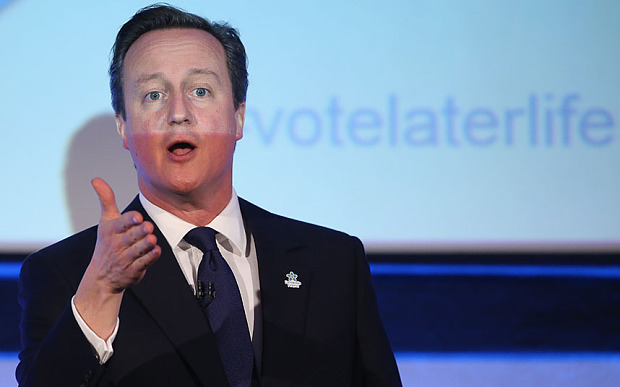
Today, in the course of being heckled by a forum of elderly voters, David Cameron made unfortunate reference to his potential legacy. The Telegraph’s Matthew Holehouse reports in today’s election live blog:

Ill-advisedly, Cameron referred to his “political epitaph” in his speech.

“I don’t just want my political epitaph to read that I balanced the books, and cleared up the mess I inherited.

I am here today because I want a different kind of Britain,” he said.

Okay, so David Cameron wants to do more than balance the budget – probably just as well, considering the fact that even this basic accomplishment seems to be beyond the reach of either Labour or the Conservatives at present. But what is it that Cameron wants to achieve? What is this “different kind of Britain” that he wants to bring about?

Continue reading