In choosing a new Tory leader and prime minister, promise and potential are not enough – experience and temperament matter too
A new candidate profile in the Telegraph paints a sensitive – and very human – portrait of Conservative Party leadership candidate Andrea Leadsom.
In the wake of the rather ludicrous ‘mothergate’ drama, Allison Pearson interviewed Leadsom and reports:
When Andrea Leadsom came on the phone yesterday afternoon I could tell from her voice that she’d been crying. After what had happened, the last thing she wanted was to talk to another journalist, but she agreed, with great trepidation, to speak to me as we’d planned.
Following what she thought was a friendly, professional meeting with a Times reporter on Friday, she found herself accused in a banner headline of saying that, as a mother she had the “edge” over the childless Theresa May in the race to be prime minister.
[..] When I ask if she would like to apologise to Mrs May, she says: “I’ve already said to Theresa how very sorry I am for any hurt I have caused and how that article said completely the opposite of what I said and believe.”
She refuses to say how the message was conveyed to the Home Secretary, but she admits she has felt “under attack, under enormous pressure. It has been shattering.”
[..] It’s been a brutally hard week which makes you wonder why anyone would go into politics. On the phone, I asked Andrea Leadsom when she last cried. There is a pause. “Twenty minutes ago,” she admits with a wobble. But, don’t worry, it’s not a sob story. She doesn’t believe in those. Meanwhile, she’s off to make a roast chicken stretch for the children’s friends who just turned up unexpectedly. “Lots of roast potatoes.”
Putting on a brave face, making the best of things, and soldiering on, she is much like swathes of Tory voters up and down the land. Will they really ignore her, as all the pundits predict, when it comes to the ballot in September? Not everything has to end in tears.
One feels for Andrea Leadsom, who not only seems like a fundamentally decent human being and with her long previous career outside politics much closer to the ideal of the citizen politician than many of the grey, indistinguishable drones (including Labour leadership challenger Angela Eagle) who have been marinating in the Westminster cesspool for their entire careers.
But it is very concerning that Leadsom has allowed what is essentially a media storm, entirely unconnected with policy or the fate of the country, to affect her so gravely. What we are witnessing is the emotional response of someone who is not used to being vilified in the press and the court of public opinion, and who seems to be shaken to her core at having been misrepresented and criticised.
Such treatment is part of the job description for any British prime minister, particularly in our current polarised age when it is all but guaranteed that any conservative prime minister will immediately be treated like evil incarnate by the socialist half of the country regardless of what they say or do. Such mundane events as being misrepresented by a newspaper or trashed in the press because of a careless choice of phrase ought to be like water off a duck’s back to a seasoned politician. Clearly this is not so for Andrea Leadsom, who has not yet developed the emotional armour to withstand the heat of battle.
Of course, one can argue that this should not be the case; that we cannot simultaneously call for more “normal” people to enter politics and then hold them to the standards of nonchalance in the face of political treachery set by the hardened political class. But sometimes idealism must fall before realpolitik. Even if it is the case that the Westminster media and political class are unnecessarily fratricidal, a British prime minister must still be able to deal with immeasurably complex and fraught issues of domestic security and foreign policy.
This isn’t the Sunday League – with her audacious leadership bid, Andrea Leadsom is asking us to believe that she is capable of playing in the Premier League, an instant promotion spanning several important intermediate steps. A junior minister who has never attended cabinet has a very different sense of what constitutes high stakes than someone who has held one or more of the great offices of state. The latter is almost certain to have wrestled with fiendishly difficult political decisions, the repercussions of which may even be life or death. The ability to do so while maintaining composure and clear thinking is of the utmost importance in a prime minister.
Of course personal temperament is not the only thing that matters. A candidate’s policy beliefs (with attitude toward the coming Brexit negotiations being top of the list right now) also matter enormously, as does their track record. But I get the strong sense that in our justifiable desperation to avoid acknowledging that someone so illiberal and authoritarian as Theresa May is the best of a bad option for leading the country in this difficult time we are sweeping Andrea Leadsom’s naivety, inexperience and rookie temperament under the carpet.
This would not be a mature way to behave. The choice between Theresa May and Andrea Leadsom must be made on the basis of who they are today, the policies they advocate and what they have accomplished, and not based on who they may become or whatever else we try to project on to their respective candidacies.
Andrea Leadsom may show future promise – promise which this blog very much hopes to see nurtured and realised in the coming years – but promise alone is not enough.
The ultimate decision over which Conservative leadership candidate would make the best Tory leader and prime minister must be made based on the best evidence available as to a candidate’s ideology, policy platform, track record, personality and temperament.
And much as it pains this blog to admit it, that choice should be Theresa May.
–
Agree with this article? Violently disagree? Scroll down to leave a comment.
The Labour Party is Jeremy Corbyn’s party now. If rebellious centrist MPs don’t like it, it is for them to leave and find (or found) a new party, and new voters to support them
This blog has little time for the left-wing politics of Jeremy Corbyn, but has consistently supported his leadership of the Labour Party – not out of some mischievous desire to make Labour unelectable, but because centrism is a disease which has sucked the meaning and consequence from British politics, allowing indistinguishable governing elites from all parties to consistently act in their own interests rather than the national interest (see: European Union). And in our current centrist malaise, this blog has common cause with anyone who promises to give the British people a genuine ideological choice.
The naivety and numerous missteps in Corbyn’s first year in charge of Labour have been frustrating to watch, as they have only given further ammunition to those bitter centrist forces who never accepted the validity of his leadership in the first place, and who have been working tirelessly (and in many cases openly) to undermine their leader since the day he was elected. And this blog has had occasion to take Corbyn to task several times for his controversial stances, particularly in the realm of national security and foreign policy.
But Corbyn now finds his leadership under sustained and determined attack by a Parliamentary Labour Party determined to be rid of him in order to resume their previous, uninspiringly bland centrist course. Though this rebellion was precipitated by the shock Brexit victory in the EU referendum (with many sullen Labour MPs blaming their leader for failing to uncritically sing the EU’s praises loudly enough during the campaign), the Labour coup has in fact been building for months. Even I, at the outermost margins of the London political scene, am aware of the late night plotting which has been taking place in homes and pubs with a view to deposing Jeremy Corbyn – in some cases before he had even been formally elected as leader.
And now, ten months later, things are finally coming to a head.
The Parliamentary Labour Party’s stalking horse in this campaign is Angela Eagle. Yes, that complete and utter nonentity Angela Eagle, the former shadow Business Secretary with the voice and mannerisms of a Dalek.
Angela Eagle today kicked off her challenge to Jeremy Corbyn’s leadership, saying that her priority is to “heal” the Labour Party.
The former Shadow Business Secretary, who resigned from the frontbench last month, accused Corbyn of “hiding” from his critics. She said that Labour needed to be “strong and united” to deal with the fallout from the Leave vote in the EU referendum, and that Corbyn is now unable to deliver that.
Setting out her pitch to be Labour leader on ITV’s Peston show, Eagle said: “I think we need someone who can heal the party.
“I think we need to have somebody that can lead the Labour Party forwards and unfortunately Jeremy has lost the confidence of the vast majority of his parliamentary party.
“We need a strong and united Labour Party that can put a very compelling case to the British people to deal with the challenges that Brexit will give.”
And the rebels intend to create this “strong and united” party by fixing the rules to prevent Jeremy Corbyn from automatically appearing on the ballot in the first place.
The two rivals made televised pitches to supporters this morning in broadcast interviews after a dramatic series of developments ended the stand-off over the embattled leader’s position.
Ms Eagle suggested Mr Corbyn should not automatically be on the ballot. “He will have to find the nominations”, she said.
“I’m a gay woman with strong, Northern, working class roots. I think I’m the right person for this job at this time”.
So this would-be Labour leader is already resorting to crass and superficial identity politics to get on the ballot, presenting her socioeconomic background and sexuality as traits which would somehow make her a better leader.
What fatuous nonsense. What the Labour Party really needs is not some wheedling, self-entitled centrist who thinks that being a gay woman gives her additional plus points, but an authentic leader who can actually connect with Labour’s disillusioned base by actually reflecting some of their fears, priorities and aspirations.
And it gets worse:
Former shadow business secretary Ms Eagle said Mr Corbyn had “failed to fulfil his first and foremost duty, that is to lead an organised and effective Parliamentary Labour Party (PLP) that can both hold the Government to account and demonstrate we are ready to form a government in the event of a general election”.
Speaking earlier this morning Angela Eagle did not set out any policy areas where she differed from Mr Corbyn but said he was not able to win a general election.
Angela Eagle’s leadership bid is particularly risible because given a prime spot on the Sunday shows to set out her own alternative policy stall, she failed to name a single substantive difference between herself and Jeremy Corbyn. One would think that rattling off a few clear dividing lines would be easy, given how terribly left-wing Corbyn supposedly is, but apparently we are supposed to be sufficiently entranced by Eagle’s winning personality that we don’t need to see an alternative policy platform.
In fact, the article goes on to mention that Eagle’s greatest selling point is apparently her “electability” and ability to connect with the British people – a skill which she has thus far failed to demonstrate during her own utterly unremarkable political career.
But it’s okay – the Guardian (always the voice of the power-hungry metro Left rather than the true socialists or the working classes, and who supported Yvette Cooper of all people for the leadership) tells us that Angela Eagle is “tough”:
Many believe the former shadow business secretary and chess champion is up to the challenge. “She’s tough – in the best possible sense of the word,” a former colleague, who rates her chances highly, observed.
[..] The leadership contest really began for her on 27 June, when she became the 15th member of Jeremy Corbyn’s frontbench to leave, tweeting that she had done it “with deep regret, and after nine months of trying to make it work”.
Let’s be honest. None of the former shadow cabinet ministers who resigned in an attempt to destabilise Jeremy Corbyn’s leadership and force his resignation tried to “make it work”. They were simply biding their time, waiting for the opportune moment to strike against him. And following defeat for the Remain side in the EU referendum and with the fear of an impending snap general election, the timetable was accelerated.
When Angela Eagle and others speak of “healing” the Labour Party, what they mean is dragging it back to the old settlement where the left-wingers knew their place, shut up and didn’t cause any trouble. The plotters have no interest in reaching a consensus or balance of views across the party – they just want to return to the centrist days where Labour competes for power by trying to look as similar to the Tories as possible while yammering on about compassion a bit more. That’s what the rebels are familiar with, and that is what they think offers them the greatest chance of returning to power. Their minds cannot conceive of another path to victory, one based on principle and persuasion rather than compromise and trickery.
What is most offensive about the behaviour of the Parliamentary Labour Party is the arrogance of Labour MPs who think that the fact that they sit in parliament gives their voices greater weight and importance than the overwhelming majority of Labour members and supporters who overwhelmingly supported Corbyn in the leadership election. For a party which supposedly exists to lift up the oppressed and give the ordinary working people a voice, the Labour rebels show a remarkable disdain for their own internal party democracy. And now, bizarrely, they seek to blatantly subvert the wishes of their own party members while still demanding the loyalty (and campaign support) of the very activists whom they are in the process of betraying. This is the arrogance of the permanent political class.
And just contrast this low political skulduggery with what Jeremy Corbyn has been doing.
This weekend, Jeremy Corbyn spoke at the annual Durham Miners’ Gala, an important fixture in the socialist calendar. In an unprecedented move, many serving Labour MPs from the Northeast were disinvited from attending the reception by Gala organisers because of their war of attrition against their own party leader.
The Durham Miners’ Gala attracts at least 100,000 people annually, but this time many Labour MPs from the north-east had tickets to the official reception rescinded by the leader of the Durham Miners’ Association, Dave Hopper. He accused those who had backed the parliamentary vote of no confidence in Corbyn as traitors and “New Labour remnants” who “cannot stand any form of democracy and appear to be interested only in themselves”.
This is the toxic state of relations between the party’s working class base and its elite, out of touch parliamentary caucus. An event like the Durham Miners’ Gala should be de rigeur for any self-respecting Labour MP, and for these MPs to be banned from attending shows the scorn, contempt and even hatred in which they are now held by people who should be their supporters.
All of the warning signs are there: The huge gains for UKIP at Labour’s expense in the 2015 general election. The spurning of centrist Labour’s slavishly pro-Brussels stance in the EU referendum. The banning of centrist MPs from the Durham Gala. And still the Parliamentary Labour Party is treating the party membership and their own working class base with complete and utter open contempt. Still they are sending the message that working class people are only welcome when they shut up, vote Labour and don’t try to influence policy in a more authentically left-wing direction.
And yet against this backdrop, Jeremy Corbyn addressed the Durham Miners’ Gala. This is what he had to say:
There’s a lot of debate about what’s happening in the Labour party at the present time. And I am inundated with questions, questions, questions all the time. And I have patience that is infinite to answer questions, questions and questions.
But one I got today really did puzzle me. They said are you coping with the pressure that’s on you? I simply said this: there is no pressure on me. None whatsoever. Real pressure, real pressure, real pressure – is when you don’t have enough money to feed your kids, when you don’t have a roof over your head, when you are wondering if you are going to be cared for, when you’re wondering how you are going to survive, when you’re wondering how you’re going to cope with the debts you’ve incurred, you’re wondering if your lovely employer is going to give you a call to give you a couple of hours of work, or not bother, or change their mind when you’re on the bus on the way to do that job.
That is the real pressure in our society.
For those people struggling on low pay, struggling on zero hours contracts, not knowing what’s coming from one week to the other, not knowing if they’ll be able to pay the rent, not knowing if they are going to be homeless, not knowing if their children will end up in care, that’s the kind of brutal pressure that’s put on people every day of the week in this country.
Watch the video at the top of this article. Hats off to Corbyn’s speechwriter for a powerful and actually well-written peroration, and to Corbyn himself for an authentically passionate delivery. Whatever else you might say about Corbyn, he shows more eloquence and passion in two minutes here than Ed Miliband managed to muster in five years of cerebral, ineffective opposition.
Here is an embattled leader, stabbed in the back by nearly his entire shadow cabinet (including a number of complete nonentities who would never have had shadow ministerial careers at all were it not for Corbyn), who even now is making speeches highlighting the struggles of the poor, the sick and the marginalised rather than his own plight. I’m sorry, but that’s a class act – and one which only serves to show the petty sniping and plotting of his rebellious colleagues in an even more damning light.
There is no way that this ends well for the Labour Party – and the fault lies entirely with the centrists. Even if they succeed in keeping Jeremy Corbyn off the ballot paper and unjustly ending his leadership, their petulant, childish and subversive actions have created a new normal for dissent within the party.
If Ed Miliband had suffered just one of the many acts of defiance and insubordination from his shadow cabinet that Jeremy Corbyn endures on a near daily basis, the offending MPs would have been banished to the cold extremities of Westminster political life before you could blink (much as nobody really remembers who Adam Afriyie is following his impertinent challenge to David Cameron’s leadership back in 2013).
But how things have changed. Now, it is apparently perfectly acceptable for Labour MPs to openly speculate about their leader’s skills and abilities on the Sunday shows, or for shadow cabinet ministers to vent their frustrations to sympathetic newspaper columnists. Now, even the most junior shadow minister is free to air their grievances in public, party and message discipline be damned. In fact, the level of childish playground politics we are now witnessing makes the unedifying tussle between the Blairites and Brownites look like the model of courteous debate.
The Labour rebels are deluding themselves if they think that this rotten and cowardly behaviour will go back in the box once Corbyn is deposed. It won’t. Such behaviour has now been legitimised by senior Labour figures, including Angela Eagle herself. And these same tactics will be used mercilessly against any compromise, unity or centrist candidate who manages to steal the crown from Jeremy Corbyn – by angry leftists and other centrists who simply want to steal power for their own faction.
This is what Labour’s petulant, rebellious centrists have wrought. A leader undermined by the seething resentments and petty career aspirations of his ideologically rootless, C-list challengers, and a party rendered utterly ungovernable thanks to a complete breakdown in discipline.
But one thing remains clear: after being elected leader outright on the first ballot with nearly 60% of the vote, Jeremy Corbyn remains the one with a mandate. And a quick scan of the swelling membership roles underlines the fact that this is Jeremy Corbyn’s party now. It no longer belongs to the centrists.
This blog has no time or sympathy for the Labour centrists, but one can appreciate their dilemma, serving in a party under a leader they cannot (or will not) support. But it is for them to leave the party. Jeremy Corbyn, love him or loathe him, has earned the right to lead his party. He won a huge mandate from the party membership less than a year ago, and retains widespread popularity.
And if Angela Eagle and her fellow plotters don’t like it, it is for them to leave the Labour Party and go in search of a new party and new supporters.
The door is open, and they most assuredly will not be missed.
–
Support Semi-Partisan Politics with a one-time or recurring donation:
–
Agree with this article? Violently disagree? Scroll down to leave a comment.
The EU’s defenders in the middle class and political/cultural elite love to believe that they are supporting a grand and noble project, but close their eyes to the economic and democratic damage wrought by this failing supranational union
An opinion piece in the New York Times provides a welcome antidote to that newspaper’s fatuous, instinctive pro-Europeanism.
Had I had the right to vote, which I have lost after 30 years living in Italy, I would have voted to remain in the European Union. But I do not think it a scandal that others think differently. If it was a scandal that people voted to leave, then surely it was a scandal to have held a referendum at all. And if it is a scandal to hold a referendum on an issue central to the destiny of a nation and about which its people feel deeply, then I have misunderstood the meaning of freedom and democracy in the West.
So why the extraordinary incredulity and indignation? Why the sense of betrayal? Why do so many people find this result unacceptable? It seems that over the last 30 or 40 years the idea has taken hold that there can be no peaceful or productive future for Europe without the European Union. As a result, anyone who voted to be outside it must be discredited as pernicious or ignorant, perpetrator or victim of some sinister populism. In the United States, this unhelpful reaction has taken the form of likening the leaders of the Leave campaign to Donald J. Trump. But Britain is not America and this was not a presidential election. Immigration played a role, but no one in the Leave campaign was suggesting Muslims be banned from Britain. On the contrary, some Muslims supported the Brexit vote. To see the debates of other countries in terms of one’s own internal politics is always a failure of imagination.
All this shock, horror and kneejerk denigration might be understandable if the European Union were notching up important successes and resolving its member states’ many problems, or if, at the very least, it had a figurehead with whom European citizens could identify, someone of whom one might say, “However badly things are going, I have faith in so and so, I believe he or she really does have the interests of my nation at heart, really is concerned about unemployment in my town,” be it Newcastle or Naples.
Obviously the EU has no such figureheads. Its vaunted “founding fathers” are unknown and unloved by all but the most starry-eyed euro federalists, its parliament a fraud, its stolen anthem a joke and its leaders held in widespread contempt. It cannot appeal to any sense of collective destiny because the loyalty of the vast majority of EU citizens lies first and foremost with their own nation state.
And Parks is quite right to note that the EU is failing across most of the metrics by which one might reasonably judge success. Economic growth, employment and social cohesion have all been thrown under the bus in the name of European political union, while the countries most let down by the EU project remain within the union only because they suffer from a national form of Stockholm Syndrome.
Parks points out:
But the Union’s greatest failing is that after decades of regulations of every possible kind it has not brought the nations of the Continent closer together. Day by day Italians are told whether their government’s economic policy has been accepted or rejected by Berlin, but about the Germans they know little or nothing. In each country, we follow our own national news media and are locked into the agendas of our own political systems. We are separate nations but not sovereign nations. We obey the dictates of Brussels and read Jonathan Franzen and “Harry Potter.” We watch American films and follow the American elections far more closely than those of any other country in the European Union. Is this a community?
But best of all is when Parks turns his gaze on the middle class and political elites who remain the EU’s strongest defenders:
The middle classes, the cultured elite, love the idea that they are taking part in a historic project that will bring peace and prosperity to the Continent, put an end to war, take steps to defend the environment, protect Europeans from superpower ambitions and multinational depredations, etc., etc. I love this idea, too. Like so many others, I take comfort in this noble enterprise.
But when the project does not bring prosperity, when it does not do enough to protect the environment, when its protectionist trading policies systematically damage the economies of the third world, I, like everyone else, don’t want to think about it; we prefer to close our eyes. This is not the narrative we like to believe we live in.
[..] With Brexit this decades-old spell is set to break. And how does the liberal elite on both sides of the Atlantic react to this deafening alarm? They scream foul and blame the dumb British working classes for spoiling the party. It might be wiser to examine our own attachment to a narrative that is going nowhere.
But the defiant liberal elite will not let go of their false narrative, preferring to nurture a sense of grievance and display to the world a shameful contempt for democracy.
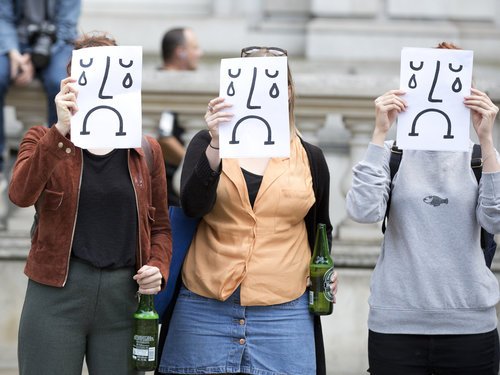
Just this weekend, grieving metropolitan Remainers held a “Picnic against Brexit” in Green Park, in what was billed as an opportunity for people to “heal” and “comfort” one another. Disappointed Remainers are literally treating their defeat in the EU referendum as a kind of emotional trauma, an unendurable shock to the system for a group of people who have had their way since 1973, came to rely on the EU’s comfort blanket and who simply cannot conceive of life as a citizen of an independent country.
An emotional reaction of this strength is only possible when one genuinely believes that one is fighting on the side of righteousness and possesses a monopoly on the virtues of wisdom, compassion and truth. It is much like the arrogance of tearful Labour supporters who simply could not understand why the country rejected Ed Miliband and re-elected the Evil Tories in the 2015 general election. The strong overlap between these two groups of people is no coincidence.
For people who make up a supposed intellectual and moral elite, the Remainers-in-denial are extraordinarily unperceptive. Even now, they can not accept that the 52% of their fellow citizens – including many working class voters – who voted to leave the EU might have a point, that their beloved European Union might not be the wonderful and benevolent force for good that they insist it is. On the contrary, they stubbornly continue to insist that those who voted for Brexit did so either out of ignorance or malice, and work to prevent Brexit from happening.
This will not end well. Sneering contempt for the political opinions and values of ordinary people has not done the elites any good this electoral cycle, in Britain or America. If the elites are at all interested in bridging the divide and repairing their relationship with the rest of the country then they must start displaying the kind of introspection and empathy demonstrated by Tim Parks in his NYT article – and far fewer disdainful middle class picnics against democracy.
The British people have made clear that they want their two main political parties to once again stand for recognisably different policies, values and objectives. But the response of calculating, stale and ideology-free centrist MPs seems to be to reorganise themselves in order to avoid dealing with a reality they would rather ignore
Politics is finally getting interesting again. After more than two decades of stale, centrist managerialism following the resignation of Margaret Thatcher, we are finally starting to see real ideological and intellectual dividing lines re-emerging in our political discourse.
After a long and dismal period where it barely mattered whether you voted for Team Red or Team Blue, so similar were their policies, we face the delicious prospect of which way people vote actually mattering once again. This is a good thing. Dry, stultifying conformity might just about be acceptable when things are in a good state, everyone is prosperous and happy, and a safe pair of hands is all that is required to keep the good times rolling.
But while many prosperous, metropolitan professional types (including nearly the entire British political class) may have been coasting through life thinking that everything was fine and dandy, in fact things were not fine for millions of their fellow citizens. And when the status quo is failing so many people, a consensual, moderate and determinedly un-radical form of politics is the very last thing which will bring about the required change.
This is why we should celebrate the short-term chaos which is roiling British politics. For too long we have been cursed by a Labour Party which cares more about making its middle class, urban supporters feel good about themselves than actually delivering tangible improvements in the lives of the working poor and the dispossessed or responding to their concerns about our democracy and our country. And since Thatcher’s departure, the ideologically rootless Tory Party – this blog describes the Cameron cohort as Coke Zero Conservatives, the same conservative taste you recognise but with none of the caffeinated, calorific oomph which makes it worth drinking – has adopted one socialist, redistributionist policy after another in a desperate, failed bid to shake off their so-called “Nasty Party” image.
In other words, within the space of twenty years the two major political parties have converged to such an extent that they were almost indistinguishable from one another – Ed Miliband’s Labour Party went into the 2015 general election flogging coffee mugs on their campaign website which promised to “control immigration”, while David Cameron’s Conservative Party manifesto was creepily subtitled “A plan for every stage of your life” – statist control freakery if ever there was.
The result of this, we all know, was the rise of the fringe parties – the incredible success of the Scottish National Party despite their utterly woeful record actually wielding power in Scotland, and the rise and rise of UKIP which set the wheels in motion for David Cameron’s bitterly regretted decision to offer the country a referendum on our continued EU membership.
Since the shock victory for Brexit in the EU referendum, things have only gotten worse for the forces of dull, greyscale centrism. David Cameron resigned in justified humiliation having waged a deceitful and bullying campaign in favour of remaining in the EU, in which he threatened his own citizens with punishment if they voted the “wrong” way, and yet still managed to lose. Meanwhile, the Labour Party, whose parliamentary caucus never accepted Jeremy Corbyn’s leadership and sought to undermine it from Day One, decided to make their last stand. Unfortunately, that last stand appears to be the utterly bland and uninspiring figure of Angela Eagle, whose coming leadership challenge will be utterly obliterated by Jeremy Corbyn, who remains very popular with the expanded Labour Party membership.
In other words, this has been a bad time for the establishment. Our poor superiors have endured setback after setback, with their preferred centrist candidates being routed as the public justifiably yearn for the return of authenticity and ideological coherence to their politics. And now they face a setback which cannot be endured – the prospect of seeing their country taken out of the European Union (that great escape from accountability for Europe’s governing elites) against their will.
But they are not going to take this lying down.
The Guardian reports on an utterly despicable new development – the fact that centrist Tory and Labour MPs, terrified at the prospect of the bland, consensual form of politics in which they thrive being brought to an end, are now proposing to unite in order to form a new centrist political party.
Tory and Labour MPs have held informal discussions about establishing a new political party in the event of Andrea Leadsom becoming prime minister and Jeremy Corbyn staying as Labour leader, a cabinet minister has disclosed.
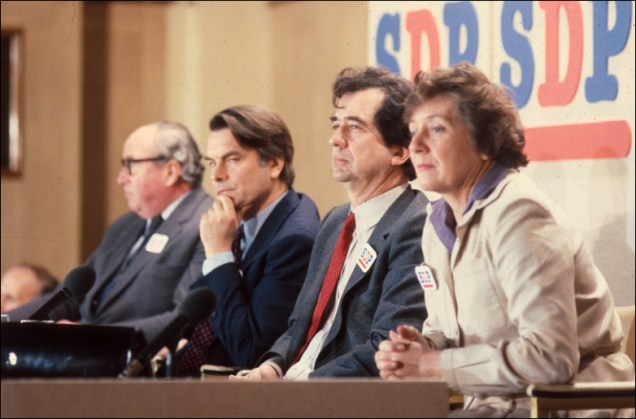
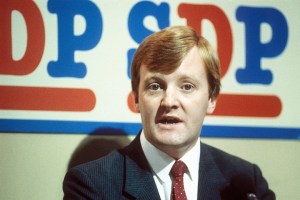
Senior players in the parties have discussed founding a new centrist grouping in the mould of the Social Democratic party (SDP) should the two main parties polarise, according to the minister. Talks should be taken seriously, though they are still at an early stage, according to the source.
“There have been talks between Labour and Tory MPs about a new party,” the minister said. “A number of my colleagues would not feel comfortable in a party led by Andrea Leadsom.”
It is understood that MPs in both parties who campaigned to remain in the European Union believe there is an opportunity to build on the newly founded relationships between centrist MPs in both parties made before the EU referendum.
A Tory party source said Labour and Conservative MPs who campaigned in favour had become closer during the campaign and increasingly come to regard themselves as “a tribe”.
In other words, if the centrists do not get their way (as they have done uninterrupted since at least 1991) then they will take their toys and leave, founding an entirely new political party for their own glorification rather than doing the hard work of convincing existing party members that they are wrong.
This seems to be prompted largely by the fact that certain prima donna centrist MPs, used to enjoying the trappings of power and influence which come from senior positions in government or opposition, are unable to tolerate even a brief period in the wilderness while more unabashedly ideological leaders have their turn running the show, and so must orchestrate a way for their own failed and reviled centrist clan to continue pushing their self-serving, wishy-washy agenda.
In Labour’s case, this is just about understandable. Jeremy Corbyn is indeed vastly different to what we have been trained to think a Labour leader should be since the days of Michael Foot. The post-Clause IV, post-Blair accommodations with capitalism mean nothing to Jeremy Corbyn, and he is proud to admit as much. Under Corbyn’s watch, the Labour Party has indeed become markedly more left wing. Therefore, a convincing case could indeed be made that moderate, centrist Labour MPs have no place in the party of Jeremy Corbyn. But since Corbyn is supported by a thumping majority of Labour Party members, it would rightly be for the centrist MPs to toddle off and find a new home (and new supporters). Labour is Corbyn’s party now, not theirs.
The Conservatives, though, have far less of an excuse. It would be interesting to know whether the Tory SDP plotters come predominantly from the older guard or from the 2010 and 2015 intakes. Logic would suggest that many of the more recent Tory MPs, who entered parliament in the dismal Age of Cameron, are most ill at ease at the prospect of being led by a superficially more Thatcherite leadership candidate like Andrea Leadsom. But then Theresa May hardly fits the profile of progressive conservatism, with her flinty-eyed authoritarianism, disdain for civil liberties and championing of a large, overbearing nanny state to watch over us and regulate our speech and behaviour. None of these are endearing qualities in a future Tory leader and prime minister, so any Conservative MP happy to wear the blue rosette for Theresa May but happy to shack up with Labour in case of Andrea Leadsom clearly has a very broken and opportunistic political compass.
The Guardian article continues:
A senior Labour party source confirmed that at least one Conservative minister and one of the shadow cabinet ministers who resigned last week had been involved in discussions about such a reshaping of British politics.
“There is a feeling that there might have to be a new party at the centre of British politics,” he said. “It’s early days, but the conversations are at a pretty high level.”
The suggestion comes as the Liberal Democrat peer Shirley Williams demands a central role for all pro-EU parties at Westminster in shaping the UK’s relationship with the EU. She warns that, without a cross-party consensus on the final deal, the country could fall apart in bitter post-Brexit division and acrimony.
Trust Shirley Williams to be at the centre of this subversive attempt by the political class to reorganise themselves so as to thwart the will of the people. She may play the part of the kindly faced elderly lady very well, but is there any more noxious emblem of our centrist malaise than Baroness Williams? I can think of none.
We now witness the depressing fact that a group of Conservative and Labour MPs – we do not yet know how large this potential grouping may be – have a shared love for keeping Britain chained to the antidemocratic EU which transcends whatever minor differences they may have on policy. And those policy differences between Tory an Labour are undoubtedly very few in this centrist age. Therefore, in a last-ditch effort to avoid being dragged out of the EU kicking and screaming, these MPs are now willing to betray the constituents who elected them to parliament by defecting to join a “worst of all worlds” Party of the Damned, a cesspit of wishy-washy MPs who startle like shy fauns at the first sign of passionate ideological debate.
Even before the official result of the EU referendum was declared, there were noises being made by pro-EU Remainers in denial that some means should be found to overturn the public’s vote to leave the European Union on one spurious pretext or another. Most popular now is the idea that the referendum should be ignored or re-run because the public are gullible fools who were tricked by the slick lies and distortions of the official Vote Leave campaign (as though the Remain camp was not engaged in lies, threats and downright cheating of its own). And it now seems that this is to be used as cover, an excuse to legitimise the subversion of British democracy by a group of spoiled sore losers accustomed to always getting their way.
We must not allow these machinations to succeed. While Labour MPs – so diametrically at odds with a leader who commands overwhelming support among the party membership – should arguably do the decent thing and walk off into obscurity and irrelevance by attempting to form a new party of the centre-left, there is absolutely no excuse for Tory and Labour MPs joining together to create a hybrid centrist party – particularly when neither of the two remaining Conservative leadership candidates can be described as right-wing ideologues in the mould of Thatcher.
That such a dramatic step is even being considered shows the rot in our national and political life wrought by the EU. We are now lumbered with a largely useless political class, wobbly-lipped MPs who are terrified at the prospect of Britain governing herself and not having our government’s every decision vetted by the omniscient supranational European government in Brussels. These plotting MPs are behaving like children suddenly separated from their parents in a busy crowd – screaming, weeping, arms outstretched in anguish at having been ripped away from that which gives them comfort and succour, their alpha and omega. It is an unseemly, pathetic exhibition which they are putting on in their desperation to stop Brexit, stop the realignment of British politics along more ideological lines and return to the happy days when fast-track ministerial careers were their for the taking so long as they managed to be sufficiently bland, predictable and uncontroversial.
Hopefully before long we will learn the names of these Labour and Tory MPs who care so much about their future career prospects but so little for their own constituents that they would abandon the parties under which they were elected in order to create a new centrist holding party to achieve through political skulduggery what they were not able to achieve at the general election or the EU referendum.
And hopefully those MPs concerned will then quickly face the full wrath of their constituency parties and associations for having entertained such self-serving thoughts.
God willing, none of them will be in parliament by the time of the next general election, having been deselected and replaced by new MPs for whom socialism, conservatism, ideology and principle are not such dirty words.
–
Agree with this article? Violently disagree? Scroll down to leave a comment.
Disappointed Remainers may be anxious and upset at having their European identity “ripped away from them”, but Brexiteers have been voiceless and disenfranchised for their entire lives. The collective middle class hissy fit from sore loser Remain supporters is nothing more than their privileged reaction to not getting their own way for once
Melissa Kite tells an anecdote in The Spectator which will be immediately familiar to any Brexiteer stuck behind “enemy lines” with a social circle consisting primarily of disappointed Remain supporters:
‘Of course, there will be no air quality now,’ said a friend, shaking her head over my support for Brexit.
‘You what?’
‘Air quality,’ she said. ‘Or green belt. Or Sites of Special Scientific Interest, preserving the countryside and wildlife… All those really good EU regulations have all gone now.’
‘What on earth are you talking about?’ I started to feel exasperated, inwardly thinking, ‘Uh-oh, here goes another friendship…’
‘All those EU regulations safeguarding everything. All gone. No more air-quality rules. No more SSSIs.’
‘So you’re saying Brexiteers have ruined the air now, are you? That’s where we are up to with the scaremongering? No more air now we’re out of the EU.’
‘Well, I’m just saying…’
The air of surly resentment against Brexiteers – ranging from generalised “woe is me” laments to very specific lists of the many plagues of Egypt which will now befall them in an independent Britain – is getting tiresome in the extreme.
And it gets worse:
‘Oh my god! The scaremongering!’ I moaned. ‘I’ve had it up to here with it!’
‘Fine. We won’t talk about it,’ said my friend, who is a science teacher and ought to know her stuff when it comes to SSSIs and all that malarkey.‘I’m just saying, they’ll probably build all over the green belt now. And big business will take over the world…’
‘Stop it! I can’t take any more! There’s nothing you can say that will make me regret backing Brexit. Even if you tell me they’re going to build a million houses on every last inch of the green belt, and turn all the air into carbon monoxide, I still want to be able to elect the people who make the laws that govern me!’
‘Fine. We won’t talk about it. Although you could elect them if you bothered, but no one does…’
‘Not the MEPs! They don’t make the laws! The commissioners make the laws and they’re unelected… Oh my god, I’m turning back…’
‘Fine, let’s just not talk about it at all. My son just got a job and he’s bought two new suits…’
I assumed she was going to say, ‘…that were made out of toxic, poisonous wool because all the safety laws have been scrapped so he ended up in A&E…’ but she didn’t.
Of course Brexiteers would be equally grumpy if the result had gone the other way (as many of us expected it to), but it is hardly comparable. Remainers at least got to enjoy the European Union for all this time. Brexiteers had to suffer it.
But certainly, this blog would certainly have been apoplectic in the event of a Remain vote, and with good reason. Remainers love to whinge that the Leave campaign won based on lies and distortions, while conveniently overlooking the fact that the prime minister and chancellor debased their high offices by using the full machinery of government and Whitehall to work incessantly for a Remain vote.
Whether it’s the £9m government propaganda mailshot, the Obama intervention, Cameron’s violation of purdah rules or the way in which the Remain campaign shrank the debate to focus purely on the economy and then wheeled out expert after expert to suggest that the avoidance of short-term economic disruption should be our sole concern (while utterly ignoring the democratic question), the Remain campaign is just as guilty of lies and obfuscation as Vote Leave.
More to the point, Remain had a massive advantage in the status quo factor which makes it prohibitively difficult for the radical option to prevail in a referendum. Not only did they have the 24/7 support of the British government propelling them onward, they had a built-in advantage of thousands of wavering voters who would ultimately vote for continuity. And still they could not triumph. Without these aids, the margin of victory for Leave would likely have been even greater.
So while Remain supporters may be disappointed now, it is worth remembering that nothing will change for them until Britain actually leaves the EU (whenever that may be), and that many of the things which they treasure to the extent that they were willing to bargain away our democracy may still be available to them. Certainly if Britain pursues an interim EFTA/EEA access solution (as this blog advocates) then their economic nightmares will prove utterly unfounded while their precious freedom of movement is left largely untouched.
And while Remainers may be devastated at the prospect of soon no longer being EU citizens, Brexiteers have had to endure being in the EU against our will since 1973. And while I’m dreadfully sad that Remainers will not get precisely what they want handed to them on a silver plate for once in their lives, many Brexiteers have suffered what we see as an undemocratic, unjust status quo for our entire lives. Let’s not get so caught up in concern for the Brexit-inspired mental trauma of Phoebe and Rupert from Islington that we forget the fact that Jack and Gary from Sunderland have been losing out for decades, and only now are getting the opportunity to taste victory for the first time in their lives.
Of course, much of the commentariat struggles to wrap their heads around the fact that Brexit is not a calamity for everyone. They live among Phoebes and Ruperts, and rarely (if ever) meet Jacks or Garys, let alone identify with their lives, struggles and ambitions. That’s why the Guardian finds endless examples of delicate people whose anxiety has gone through the roof and have retreated to their safe spaces in terror, but then extends the same nauseating sympathy to celebrating Brexiteers, assuming that we uneducated rubes have been tricked to vote against our own interests and will soon regret our vote for democracy and self-governance.
What we are now witnessing, with these tearful examples of pampered middle class pseudo-trauma and calls to ignore the result of the EU referendum or to keep holding votes until the British public give the “right” answer, are nothing but a collective hissy fit from people who have had their way since 1973 and are furiously, childishly determined that nobody else should ever get to influence the future of their country and exercise control over their lives.
And while remaining magnanimous toward individuals and genuinely disappointed EU supporters in general, we should treat any further such selfish, self-pitying sentiments with the scorn they richly deserve.
–
Agree with this article? Violently disagree? Scroll down to leave a comment.









 Semi-Partisan Politics