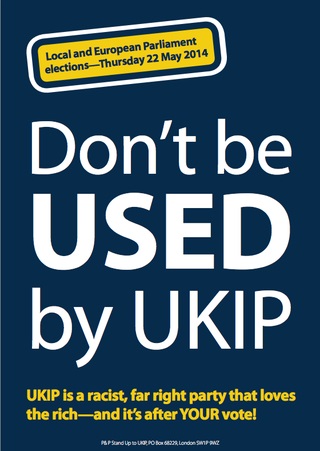
It’s official – there is nothing more fashionable in British politics than to accuse UKIP and their supporters of being closet (or indeed overt) racists. Everyone is at it, from the Scottish “artist” who has taken to painting over the party’s election billboards with grey paint to the scores of people who turned out to heckle and jeer at the UKIP public meeting in London on Wednesday.
Cooler heads might wonder if opposing unchecked immigration from European Union countries (as bad a policy as that may be) is actually more of an economic argument than a race-based one, and that fearing competition from eastern European workers actually indicates rather a high degree of respect for their work ethic and productivity rather than the sneering superiority of an English racial supremacist. But cooler heads are in short supply, and the three main political parties (with some noble exceptions in their ranks) are only too eager to pile on the attack to stave off their own looming electoral humiliation.
The fact that organisations such as Unite Against Facism think it worthwhile to picket UKIP events speaks to the success with which the liberal left have been able to equate opposition to economic migration with racism and nationalism, but more importantly it cheapens and diminishes the important work that they do. UAF rightly stand against racism and bigotry wherever it threatens, but using their name and status to attack a legitimate and moderate political party will rightly be construed by many as “crying wolf”, lessening the impact of their more considered protests.
The commentariat class seems amazed and bewildered that the non-stop repetition of the UKIP-racism mantra and frequent articles about wayward UKIP candidates is not causing a mass exodus among UKIP’s supporters. According to the conventional wisdom, we should all read these stories and extrapolate the bizarre or hateful opinions of the few to represent the many – if one UKIP candidate turns out to be an epic racist, so must all of the others, and the people who support them.
If they had slightly more awareness of their own personal biases and a lot less contempt for the British electorate, these commentators might realise that the yawning gap between reality and what they think should be happening results from the fact that the British people, broadly Eurosceptic and increasingly supportive of UKIP’s goals, are perfectly able to distinguish between the unhinged crazy people who exist at the fringe of a political party (and sometimes sneak through the vetting process) and the general goals and intentions of the party as a whole.
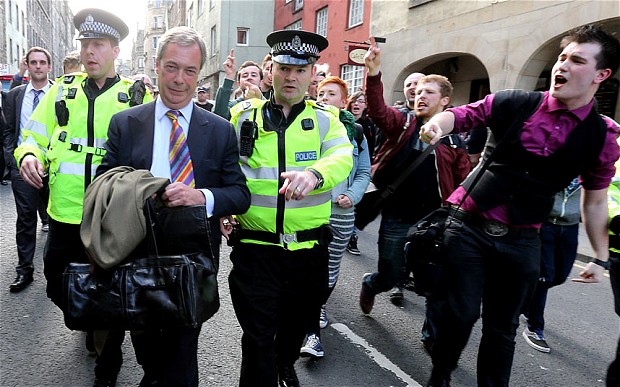
UKIP’s stubbornly persistent high poll numbers are not some terrible reflection of the fact that British people turn a blind eye to racism and bigotry, but rather reflect the fact that voters know that the racist and bigoted people seizing the spotlight do not speak for the whole, and that opposition to economic migration (right or wrong) does not equate to racism.
The distinction is lost on much of the mainstream media and those in the public who are opposed to UKIP’s aims, largely because it suits their purposes to tarnish a growing political party and electoral threat with the toxic smear of racism. But these people delude themselves if they think that calling a moderate political party “racist” and insinuating that their many supporters are either nationalist sympathisers or credulous fools will come without a significant cost.
UKIP devotes its energies campaigning for what it sees – again, rightly or wrongly – as Britain’s national interests and has little to say about the main political parties other than pointing out that when it comes to addressing the inexorable growth of the European project, there is nothing to choose between them. The established parties, however, bereft of any honest or coherent arguments of their own when it comes to defining Britain’s relationship with Europe, have resorted en masse to base character attacks and smears.
Nick Clegg and the Liberal Democrats once liked the idea of a referendum on Britain’s EU membership, but now they disown the idea, the thought of consulting the British people only being appealing when they could be trusted to give the desired answer. David Cameron talks in woolly platitudes and promises negotiated EU reforms and British exemptions that he is unlikely to be able to deliver. None of the political parties who have had the chance to attempt meaningful reform of Britain’s relationship with the EU have followed through on their prior promises, and so the public are hardly fools – let alone racists – to reach out to the one party that has not yet let them down on the matter.
Some of the more intelligent critiques of UKIP have attempted to draw comparisons with the Tea Party movement in the United States. This is a lot closer to the truth. Nigel Farage would have no truck with Nick Griffin, the leader of the British National Party (despite the attempts of some to draw out similarities), but would probably get on famously with the likes of Sen. Ted Cruz of Texas or Rand Paul of Kentucky, both of whom, for all their flaws, have strong small government credentials.
Read UKIP’s manifesto or campaign literature and what you will see overall is a small-government oriented, non-interventionist party that believes in maximum personal freedom. They even support libertarian goals such as the establishment of a flat-rate income tax. Like the American Tea Party, an element of cognitive dissonance creeps in when you observe the discomfort with/opposition to gay marriage, but the general thrust of their policies is toward empowering the individual over the government, and the British government over undemocratic decrees from Brussels.
There is no excuse for ignorance about UKIP’s past and present policies – they are readily available on the internet, and any British political commentator still willing to throw around the accusation of racism should be able to draw on supporting evidence from these manifestos in order to maintain their credibility. But the anti-UKIP brigade will search in vain – the ‘smoking gun’ of racist or nationalist invective is simply not there to be found.
Eleanor Roosevelt once said “Great minds discuss ideas; average minds discuss events; small minds discuss people.” In the panic and scramble by the British political establishment to respond to the surging popularity of UKIP, there has been talk of events and an inordinate amount of talk about individual people – rogue candidates and their wacky, off-message personal views. The volume of discussion – and intelligent criticism – of UKIP’s actual policies, however, has been negligible. Small minds predominate.
Interestingly, the one and only time that UKIP’s ideas were put to the test thus far (in nationally televised debates),UKIP triumphed and the establishment lost, badly. So is it any wonder that armed with such unpopular policies of their own and facing a huge credibility gap, the major political parties and their respective cheerleaders in the media have been only too happy to promulgate the idea that UKIP is a racist party?
The only problem with their strategy is this: millions upon millions of normal, decent and tolerant people support UKIP’s stance on Europe and other matters. The establishment’s response to this fact so far has been either to pen hand-wringing and patronising columns fretting about how the public’s inchoate anger at politics-as-usual is causing them to be duped like fools into supporting a nascent far-right party, or to accuse them outright of harbouring racist views. In other words, as the establishment would have it, UKIP supporters are either racists or gullible fools. The third option – that they might be semi-intelligent people with a legitimate political point – is not widely accepted.
On Thursday 22 May, the British political establishment – Labour, Liberal Democrat and Conservative alike, and their friends in the press – will find out whether shaming and insulting up to one third of the electorate in the run-up to an election increases or decreases their resolve as they enter the voting booth.
If the aftermath is messy and humiliating for them, it will be no more or less than they deserve.

 Semi-Partisan Politics
Reblogged this on oogenhand and commented:
” but more importantly it cheapens and diminishes the important work that they do. UAF rightly stand against racism and bigotry wherever it threatens”
Interesting observation…
LikeLike
It seems UKIP are becoming a vote of dissention amongst UK voters. I feel immigration is a subject that most parties shy from, but it is valid, economically speaking. My general concern is how UKIP propose to roll out their policies. Some of their ideas about certain issues clash with what many people would see as freedom and empowerment. However, they are saying what others perhaps want to, but dare not do so. For me, any party should have the right to voice their politics, that is democracy. In FPTP voting system, I think UKIP have been quite resilient and ignoring their input/threat/popularity would be a mistake for those currently in power. Thanks for posting.
LikeLike
Many thank for your comment! I agree that a lot of UKIP’s support comes from the “protest vote” contingent, so it will be interesting to see how their poll numbers hold up going past the European elections and into the 2015 general election.
From my perspective as a sometime UKIP-sympathiser, I am annoyed that so much of the debate has revolved around immigration, because this is the one area that really fails to get me excited. I believe in an open and liberal immigration policy, I think it’s a good thing for the economy on the whole. Where UKIP play to my libertarian-leaning instincts are on the areas around tax, government spending and pushing back against the volume of EU regulation which impacts on British business and job creation – but sadly most of these arguments have been eclipsed by the immigration debate. To give UKIP credit, this is not totally their fault – the other main parties have deliberately played up this aspect of UKIP’s manifesto because they have so little to say when it comes to all the other stuff. But nonetheless, the debate has been quite heavily skewed on one topic.
Though UKIP are likely to do well in the European elections under proportional representation they will no doubt struggle to make an impact in the general election under FPTP barring some kind of electoral pact – but I can still envisage them gaining an MP or two. If the Green Party can do it…
Anyway, many thanks for reading and contributing, it’s great to hear your perspective.
LikeLike
Thanks. I think the situation will be interesting in the General Election too. UKIP said no to a possible Coalition with Conservatives, so that will make any other political pact no doubt awkward (for other parties), if not all!
I am not a UKIP follower really, I suppose what appeals most is the ‘renegade’ element and the fact they are making other parties sweat.
I am currently working for an AM, won’t say for which party. So following the EU, General and AM elections will be a given!
Thanks again for posting, Bex
LikeLike
An interesting perspective, but most of the social media -based opposition to UKIP that I have seen recently actually centres on their policies, which will leave a significant chunk of the population (low earners, women hoping to have children) worse off.
I agree that opposition to UKIP should focus on its policies. But when every other week seems to bring a revelation that causes one of its members to leave the party, I understand why the media focus on the scandals. Bongo-bongo land, Lenny Henry and all that. Perhaps the deeper truth is simply that our island nation always has been and always will be a little bit xenophobic, and it’s just as well to channel those tendencies in the political arena where (in the current system) they will inevitably be moderated and compromised, instead of boiling under the surface.
LikeLike