ObamaCare, Four Years After Signing

obamacare

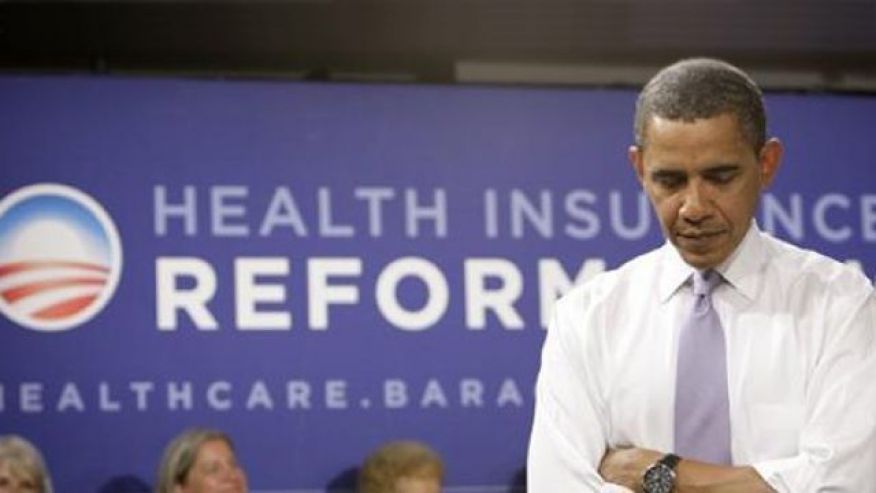
The Patient Protection and Affordable Care Act – otherwise known as the ACA or ObamaCare – was signed into law four years ago this week after tortuous rounds of planning, posturing, arm-twisting and televised negotiating in Washington.

And while many of the features (to say either ‘benefits’ or ‘drawbacks’ immediately displays one’s political bias) of ObamaCare are only now taking effect, this is a good moment to take stock, step back from the thrust and parry of partisan bickering and reflect on what has actually happened since America decided – with the GOP kicking and screaming defiance to the bitter end – that as a country they would no longer tolerate the spectacle of millions of people without health insurance or reliable access to preventive medicine.

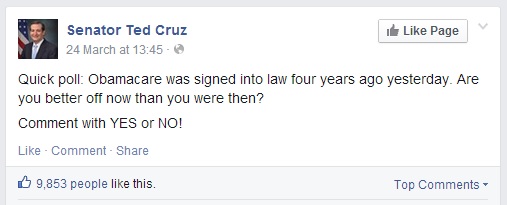
Tea Party darling Ted Cruz, the junior senator from Texas – who fancies himself an intellectual heavyweight and a man of deep principle – took the opportunity to reflect by posing a question to the public on his Facebook page:
tedcruz1


Perhaps surprisingly, given the likely political leanings of a Ted Cruz facebook follower, the majority – the real, undeniable, vast majority – of responses to Cruz’s question are unabashedly, overwhelmingly in favour of ObamaCare.

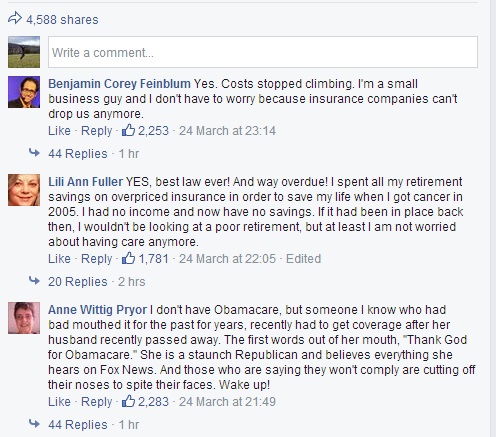
The following responses are the most recent as of the time of writing, and are entirely representative of the rest:
tedcruz2


The warmth of these responses to the effect of ObamaCare – some from staunch Republicans – is quite arresting, and really reveals the gap between the GOP rhetoric on healthcare reform and the way it is perceived by many of those directly impacted.

This is not to say that there are not dissenters among those who answered Ted Cruz’s question on facebook – there are plenty. But the fact that they are in such a minority (and that they often failed to directly answer the question in terms of impact on their finances or lives) again exposes a fundamental weakness in the Republican party’s full-throated opposition to the bill.

While there are certainly – as with any major legislation – those who have lost out as a result of ObamaCare, either through having to change their healthcare plan, pay a higher premium or lose some other benefit – for every one of these cases, there seem to be other people being rescued from catastrophic personal and financial ruin or uninsurability. It is quite telling that when Ted Cruz opened the floor to the public to make their voices heard – without the controlling hand of opinion pollsters or leading questions in focus groups – the message painted was overwhelmingly positive.

The GOP has long tried to paint the passing of ObamaCare as the sudden imposition of socialism on America (conveniently forgetting huge programs such as MediCare for seniors, which are real, tangible socialism in action) against the will of the people and the founding values of the nation. In GOP-world, everyone is a small business owner or unspecified “wealth creator” being taxed to death in order to fund this extravagant giveaway by the “takers”. The real world, as glimpsed through the windows of Ted Cruz’s Facebook page, appears to contradict this worldview.

With ObamaCare, as with most big policies, there is merit in the arguments of both supporters and detractors. President Obama’s signature domestic policy achievement is not without multiple flaws, but those who oppose it undermine themselves by the fact that they made no effort to tackle the glaring problems in America’s healthcare system – sometimes laughably called the “greatest in the world” by ignorant people who have never set foot outside the United States – before Obama took office, and then decided to adopt a position of total, unwavering obstruction once reform efforts got underway – even denying and repudiating policies and ideas once favoured by their own side as conservative reforms.

The Republicans could very well win total control of Congress at the midterms this November, and then go on to win back the presidency in 2016. If they do so, they will have to decide – and admit to the world – how much of their opposition to ObamaCare is real and principled, and how much was political posturing and pandering to the base. And the measure of this will be the provisions that they seek to repeal and those which they keep.

If the Republicans want to be a serious party of government again – and sadly, there is currently very little sign that they do, even though America sorely needs a sane right-wing voice as part of her political discourse again – they will have to confront people like those who shared their positive stories of ObamaCare on Ted Cruz’s Facebook wall, and tell them precisely which of their newfound securities will be ripped away, and why.

Over 7 million Americans have now signed up for health insurance through the various ObamaCare exchanges. If the Republican Party is to regain power, it must face a political day of reckoning with each and every one of them.

Who Is To Blame For The Left’s Stalled Agenda?

The masterminds
The masterminds


If you were wondering exactly how deep goes the rot in the American conservative commentariat in the Age of Obama, you need look no further than the editorial and letters pages of the Wall Street Journal.

When these pages are not screeching warnings of an imagined upcoming Kristalnacht for wealthy Americans to be carried out by the seething, envious masses, they have taken to publishing seemingly highbrow retrospectives on the Obama presidency, paying particular attention to America’s failures and shortcomings under President Obama, whilst brazenly whitewashing the conservative or Republican part in those failures.

Danniel Henninger has the honour of writing the latest of these historically revisionist editorials on the WSJ’s aptly named “Wonder Land” blog – apt because what is written there bears so little resemblance to fact, or reality. In this piece, Henninger asks “The left can win elections. Why can’t it run a government?”

The editorial gets off to a bad start, attempting to link three quite ideologically disparate politicians and use their waning fortunes as evidence of a socialist malaise:

Surveying the fall in support for the governments of Barack Obama, New York City’s progressive Mayor Bill de Blasio and France’s Socialist President François Hollande, a diagnosis of the current crisis begins to emerge: The political left can win elections but it’s unable to govern.

It may have become what now passes for a fact by some on the American right, but in truth – if you look up the dictionary definition or compare his policies to those of previous Democratic presidents – Barack Obama is not a socialist. Therefore, Obama’s troubles have little to do with the travails and setbacks experienced by President Hollande of France, a legitimate socialist whose actual, socialist policies continue to do damage to that country.

Henninger then spends the rest of the article expanding on his cheeky proposition that the political left can win elections, but are unable to govern once in power. He fastidiously examines every possible reason for Obama’s failure to advance his agenda, save the most glaring one – the fact that the Republican opposition have consistently been more interested in token opposition, nihilism, public posturing and pandering to their base than they have bothered to engage in the processes of government while in opposition.

But Henninger is less interested in any kind of introspective analysis of the rights own complicity in America’s current difficulties than in spewing misleading half-truths:

Once in office, the left stumbles from fiasco to fiasco. ObamaCare, enacted without a single vote from the opposition party, is an impossible labyrinth of endless complexity.

The merits and drawbacks of ObamaCare aside, the blanket Republican opposition was more a strategic move to damage the Obama presidency than a principled stance (Republicans having long been content to leave “the best healthcare system in the world” and all it’s flaws untouched and unaddressed), and Henninger conveniently forgets that Anh Joseph Cao of Louisiana provided a solitary GOP vote for the draft version of the health bill.

Henninger’s next exhibit is the world’s response to climate change, an issue which he says has more political support than any other in our time:

No idea in our time has had deeper political support. Al Gore and John Kerry have described disbelievers in global warming as basically idiots—”shoddy scientists” in Mr. Kerry’s words. But somehow, an idea with which “no serious scientist disagrees” has gone nowhere as policy. The collapse of the U.N.’s 2009 Copenhagen climate summit was a meltdown for the ages.

It may or may not be correct to state that global warming is the greatest area of consensus in world politics at the moment, but what is truly laughable is Henninger’s neglect to admit that all of the opposition to taking any action on climate change comes from his own side. In doing so, he really answers his own question, except that it is not so much the left who are terrible at governing, but more that the ideologically inflexible American right are brilliant when it comes to using whatever political power they still wield to throw a spanner in the works and thwart the majority.

Sometimes it may be right to use opposition power in this way, in order to prevent abuse of power by that majority – but using that same tactic over and over in response to every initiative from the governing party is overkill, and the opposite of good governance.

Henninger sums up:

Making the unworkable work by executive decree or court-ordered obedience is one way to rule, and maybe they like it that way. But it isn’t governing.

True – and Henninger can rightly point to numerous cases where the left has taken these shortcuts to governance, especially recently. But he fails to take the next step and ask why President Obama and the Democratic party are behaving as they are, showing a complete unwillingness or inability to examine the GOP’s own role in creating the acrimonious partisan deadlock for which executive orders and court judgements have been the only pressure release valve.

Under the presidency of George W. Bush, the Republican Party had a tight grip on the reigns of power, holding the executive branch and both houses of Congress for a time. And in this time meaningful legislation was passed, sometimes in the face of vociferous opposition from the left and from libertarians. Significant legislation such as the PATRIOT Act, Sarbanes-Oxley and the 2003 Partial-Birth Abortion Ban Act were all shepherded through Congress without Democratic Party histrionics or threat of filibuster.

One can argue that the Republicans’ willingness to remain united as a single block in order to successfully oppose legislation is a sign of strength, and that the Democrats’ tendency to fracture and allow members of their caucus to be picked off in order to garner support for conservative proposals is a sign of weakness. But in that weakness is also the flexibility and willingness to compromise – hell, to acknowledge that some people in America hold a different point of view – that is so utterly lacking in today’s GOP and in much modern conservative thinking.

The American left may sometimes be catastrophically bad at advancing their agenda, framing the debate and winning the now all-important war of words (death panels, death taxes, job-creators) when courting public opinion, but the American right plays a daily role in the left’s emasculation. In many ways, even in opposition the Republicans have seemed like the playground bully who grabs hold of his prey’s wrist and turns his fist against him, all the while asking why the hapless victim likes punching himself so much.

Blanket, unthinking opposition to everything that the governing party tries to do has been effective for the GOP of late. They have successfully stopped President Obama’s legislative agenda in its tracks. The conservative strategy has been proven to work very well, but good responsible governance it is most certainly not.