How Should The West Respond?

Predictably, Andrew Sullivan has some of the best coverage of the unfolding situation in Ukraine, with a longer post detailing his fuller thoughts due tomorrow. Worth reading and following.

Andrew Sullivan's avatarThe Dish

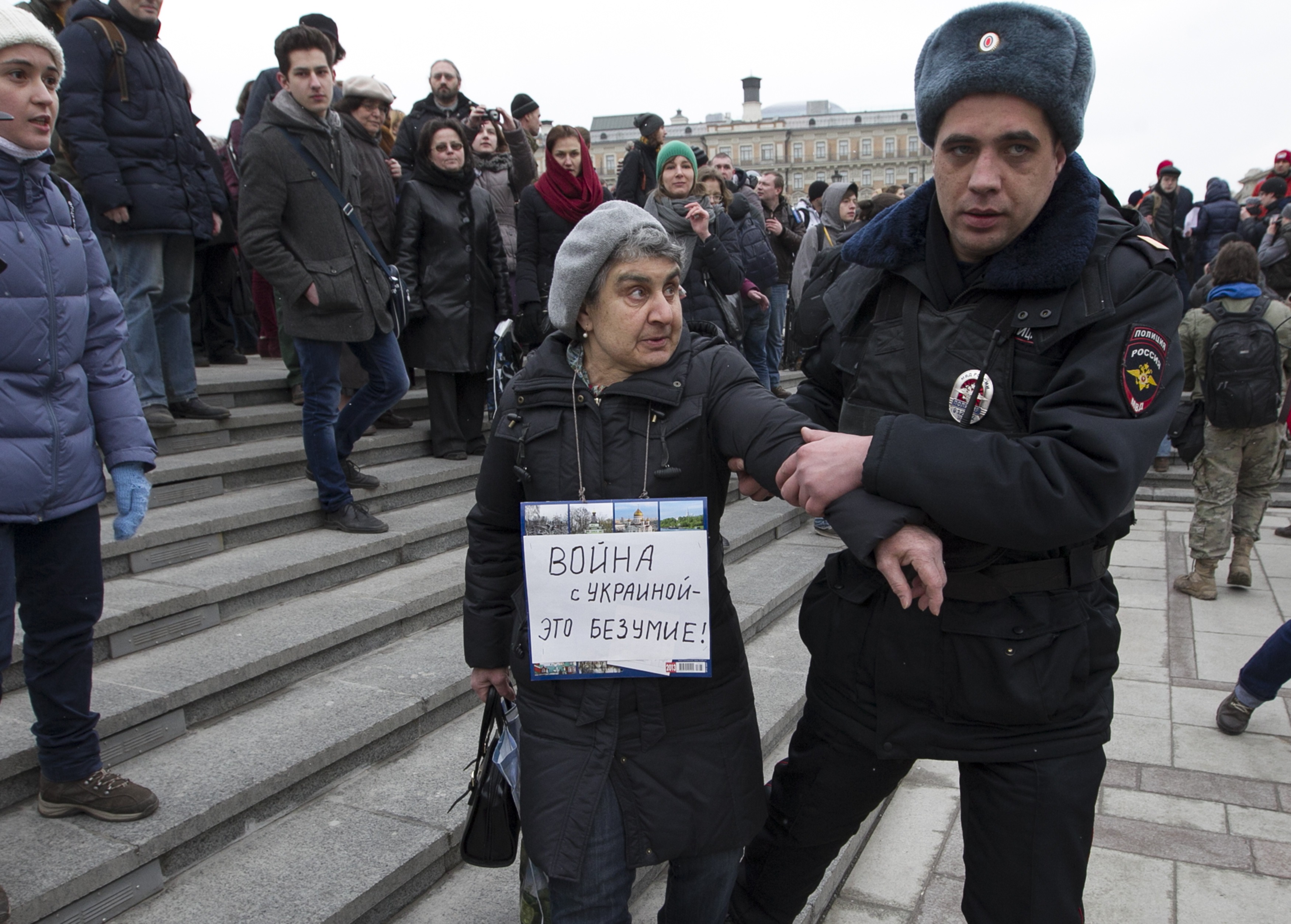
Russian Anti-War Protesters Detained In Moscow

I’m still absorbing all the information I can, and hope to post something at length tomorrow. But this much seems clear to me: Putin has panicked. To initiate a full-scale war with Ukraine, after effectively losing it because of the over-reach and corruption of Yanukovych, opens up scenario after scenario that  no prudent Russian statesman would want to even consider, let alone embrace. That doesn’t mean he won’t continue to over-reach or that we should be irresolute in confronting this aggression; just that we should be clear that the consequences of further escalation will be deeply damaging for his regime – and certainly far graver for him than for the West.

Obama and Putin spoke on the phone last night. Here’s what Leon Aron wishes Obama had said:

Ideally, the conversation would have been one in which the American president was speaking not only for the U.S., but also for…

View original post 674 more words

Welsh Policing And Constitutional Chaos

welshpolice


The Police and Crime Commissioner for South Wales, Alun Michael, has generated headlines by requesting something eminently sensible – the devolution of greater policing powers to Wales, and greater control over the criminal justice system.

The BBC reports:

Mr Michael, a former Home Office minister, said creating the four Welsh commissioners meant that in practice Whitehall has already devolved decision-making about most police activity.

He said the four Welsh commissioners “despite their political range (two Independents, one Conservative, one Labour and Co-operative) have immediately started to work together on Wales-wide issues, with some excellent and fruitful meetings with Welsh government.”

Writing in the Institute of Welsh Affairs journal, he added: “So common sense, pragmatism and purpose have brought about de facto devolution and it’s only a question of when the machinery of government will catch up”.

If it is the machinery of government Alun Michael is waiting for, it could be a very long time indeed before anything happens. The British government, after all, has permitted the organic development of the completely illogical current system where Northern Ireland and Scotland have overarching police structures while Wales and England do not.

Experimenting with different policies and approaches is exactly what should happen in the UK, but it can only happen if powers are devolved equally between the home nations. Establishing the role of police and crime commissioners was a good first step at promoting local police accountability, but this now needs to be backed up by devolution of policing powers to Wales and elsewhere.

As with so many important constitutional matters, change has thus far only come about when aggrieved people in one home nation or another have shouted the loudest. The result has been a constitutional system that resembles a messy patchwork quilt, making no sense either to outsiders or to the people who live under the various jurisdictions.

Welsh First Minister Carwyn Jones has also pointed out the lack of common sense behind the status quo:

Mr Jones said then: “Decisions that affect Wales should be taken in Wales.”

Policing and criminal justice were now “the only mainstream public services which are not devolved to Wales”, and this status quo “is becoming increasingly hard to justify”, he added.

The illogical and unequal devolution of powers to the different corners of the United Kingdom has always been hard to justify; this is nothing new, but always worth pointing out.

Sadly, victory for those who advocate localism and devolution will only further complicate the constitutional situation. But nonetheless, the government would be well advised to heed this call, especially if it is repeated in the findings of the Silk Commission next year. Constitutional incoherency may be harmful and frustrating, but anything would be better than facing another independence referendum.

What UKIP Does Well

nigelfarage

The normal model for distracting media attention away from your political party when negative stories start swamping the agenda goes something like this:

1. Party member says or does something offensive

2. The media picks up on the story and it becomes widely circulated

3. If the political party is small, the received wisdom is that the story is a symptom of the party’s immaturity and extremism. If the political party is large, the commentary will be that it is a sign of general malaise in the political system

4. Party leader comes out swinging, criticising the media for focusing on sensationalist, insubstantial nonsense rather than serious policy differences

When the big three party leaders (Cameron, Miliband, Clegg) attempt this move for the hundredth time, it sounds formulaic and insincere, an obvious attempt to wrench the media’s attention back to their scripted talking points. But somehow, when Nigel Farage adopts the same strategy, he actually appears convincing. And he had the need to do so yesterday at UKIP’s conference in Torquay, when he was inevitably asked to defend or renounce those members of his party who have strained or flat-out violated the boundaries of political correctness.

James Kirkup praised Farage’s approach in his Telegraph Evening Briefing:

Ukip’s virtues came to the fore when Mr Farage was talking about the curious and colourful views expressed by some of his party. Instead of doing what other politicians do and disowning the off-message stuff, Mr Farage embraces it and turns it into an attack on homogenised political class:

“We’re not career politicians, you’re absolutely right. Unlike [Nick] Clegg, Cameron Miliband, d’you know what? I actually had a job – I worked. And this is obviously fairly extraordinary in modern-day politics when almost everybody goes straight from Oxford University into a research office, they become Members of Parliament in their middle-to-late 20s and they’re all very PC and no one really says anything or stands up for their convictions, and with us you’ve got people from all walks of life. There are 34,000 paid-up members of the party and some people have views that are mildly eccentric. I would have thought that was just consistent with democracy.”

How refreshing it is to hear an honest answer from a political leader, and how sad that examples of this kind are so rare. As I wrote on this subject last year:

And so we have a whole generation of MPs from all parties – people like Chukka Umunna – who are basically airbrushed, well-groomed and telegenic candidates who never really lived in the real world before entering politics and who have no idea what they would do with their lives if they ever had to leave it … [We should not] be looking for the next bland, cookie-cutter candidate who has gone through the 7-step “become an MP by the age of 35″ programme. If a candidate’s life up until that point has been all about gaining political power, what chance is there that they will ever want to relinquish it and do anything else after their first term? Their second? Their third? Their fourth? Until retirement beckons?

Blaming the recent flooding in England on the government’s pro-gay marriage stance, or suggesting that the country has become something akin to a foreign land (as Farage regrettably went on to do later in the same appearance) are ludicrous. But there is something to be said for a big tent political party that doesn’t automatically excommunicate its members for going off-script.

The upcoming European elections will prove a good test of just how much the British electorate values this trait.

Finally, An Argument For Scottish Independence

One world, but many more favourable aviation tax regimes


Finally, a positive reason to vote for Scottish independence in the September referendum, and it comes not from Alex Salmond, the SNP or the Yes to Independence movement. It comes, instead, from that most iconic of companies, British Airways.

The Telegraph reports:

Asked about the Scottish referendum on BBC Breakfast, Mr Walsh said: “If anything, it might be marginally positive because, I suspect, the Scottish Government will abolish air passenger duty because they recognise the huge impact that tax has on their economy.” 

He added: “So, it is probably going to be a positive development, if it does happen, for British Airways.” 

The Scottish Government’s White Paper – the blueprint for independence unveiled last November – proposed a 50 per cent reduction to air passenger duty. 

It said Westminster’s refusal to devolve the power had “hampered our ability to attract new direct flights” and said halving the tax would boost Scotland’s international connections.

This argument from Walsh is quite unassailable. The punishingly high level of Air Passenger Duty make the UK one of the most expensive places to fly from, or through, in the world. The government may whine that they need to be seen to be doing something for the environment, but as with all other taxes the revenue goes into the same big pot to be frittered away on the same wasteful expenditures – certainly nothing to do with environmental protection or carbon offsetting.

While the UK government wrings its hands and does nothing as Britain’s disjointed aviation policy stymies economic growth, at least the Scottish Government wants to attract business and tourism rather than repel them.

But what we really have here is not an argument for Scottish independence – though BA’s chief executive rightly notes that his particular company would perform marginally better if independence came to pass. Rather, it is an argument for a more enlightened and business-friendly aviation policy, and/or for greater devolution of tax matters within the UK. It would do the UK government great good to see lower aviation taxes bringing economic benefits north of the Scottish border, and perhaps chasten them into lowering air passenger duty throughout the rest of the country.

This intervention by Willie Walsh is being hailed by Alex Salmond and the pro-independence movement, and it certainly comes as a welcome respite from what has been a non-stop volley of bad news and negative endorsements as business after business has raised concerns about the prospect of Scottish independence and the damage caused by the current uncertainty.

But as a justification for splitting up the United Kingdom, it lands well short of the runway.