Glenn Greenwald, now writing for The Intercept, makes a very good point about journalistic integrity in the context of the ongoing Russian invasion and occupation of Crimea.
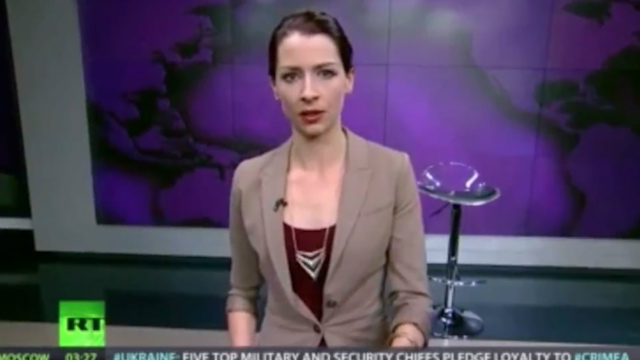
In the midst of this developing story, one of the anchors at Russia Today, the Kremlin-funded English-language news channel presenting a Russian perspective on the world, made news of her own by denouncing Russia’s actions at the end of her segment. The clip is available to view here:
The money quote is this:
I can’t stress enough how strongly I am against any state intervention in a sovereign nation’s affairs. What Russia did is wrong. I admittedly don’t know as much as I should about Ukraine’s history or the cultural dynamics of the region, but what I do know is that military intervention is never the answer. And I will not sit here and apologise or defend military aggression.
Greenwald wonders aloud how so many of those voices condemning Russia for invading a sovereign country can do so with a straight face when they themselves agitated for, or were apologists for the US-led war in Iraq:
Enthusiastic supporters of a wide range of other U.S. interventions in sovereign states, both past and present and in and out of government, are equally righteous in their newfound contempt for invasions – when done by Russia. Secretary of State John Kerry – who stood on the Senate floor in 2002 and voted to authorize the invasion of Iraq because “Saddam Hussein [is] sitting in Baghdad with an arsenal of weapons of mass destruction” and there is “little doubt that Saddam Hussein wants to retain his arsenal of weapons of mass destruction” – told Face the Nation on Sunday: “You just don’t in the 21st Century behave in 19th Century fashion by invading another country on completely trumped-up pretext.” The supremely sycophantic Face the Nation host Bob Schieffer – as he demanded to know how Russia would be punished – never once bothered Kerry (or his other Iraq-war-advocating guests, including Defense Secretary Chuck Hagel and Washington Post columnist David Ignatius) by asking about any of that unpleasantness (is it hard at all for you to sermonize against invasions of sovereign countries given, you know, how often you yourself support them?)
This is just as true for the press as it is for television talking heads or armchair generals. As Greenwald shows by quoting the example of CBS’s Bob Schieffer, the implicit assumption in many questions asked by television news hosts in America (and indeed in Britain) is that the invasion is unprecedented, wrong and contrary to international law. And while the invasion is indeed all of these things, this same level of proper journalistic scepticism was mysteriously missing when we were the aggressor.
Indeed, those few brave American media personalities who did speak out against the impending invasion of Iraq, and who dared to question the legitimacy of the Bush Administration’s every unconstitutional action, soon found themselves banished to the western journalistic equivalent of Siberia. Well known journalists or personalities such as MSNBC’s Phil Donohue and Ashleigh Banfield certainly felt the consequences, as Greenwald points out in an addendum to his piece:
Both Donahue and Arnett were fired because of their opposition to the U.S. war. Arnett was fired instantly by NBC after he made critical comments about the war effort on Iraqi television, while a memo from MSNBC executives made clear they were firing Donahue despite his show being the network’s highest-rated program because he would be “a difficult public face for NBC in a time of war”.
During that same time, MSNBC’s rising star Ashleigh Banfield was demoted and then fired after she delivered a stinging rebuke of misleading pro-war TV coverage by U.S. outlets, while Jessica Yellin, at MSNBC during the time of the war, admitted in 2008 that “the press corps was under enormous pressure from corporate executives, frankly, to make sure that this was a war that was presented in a way that was consistent with the patriotic fever in the nation and the president’s high approval ratings” and that executives would change stories to make them more pro-war.
While it is too soon to determine the medium-longer term impact of Abby Martin’s words on her career at RT, the contrast between this act of journalistic independence on a news channel so close to the Kremlin and the recent history of the American (and British) news media is sobering and discomforting. Though the post-PATRIOT Act consensus is finally starting to fray given the recent NSA scandals and revelations, at a crucial period in American history significant dissent or journalistic scepticism was almost entirely absent from the domestic press.
That is not to say that press freedom in America/Britain and Russia are in any way comparable – despite a worrying background noise of increasing official encroachments, regulation and intimidation, the press is far more free in America than in Russia, and any sane journalist would wish to operate in the former climate rather than the latter.
But while infinitely preferable to homogenised Russian state propaganda, western media has shown itself capable of being bullied into self-censorship on occasions, be it the panicked urge to appear ‘acceptably’ pro-war and support the policies of George W. Bush in 2003 or the far more recent insidious suggestion by David Gregory in 2013 that journalists who report on leaked classified information should consider themselves co-conspirators.
As always, before climbing atop the highest parapet and waving the Stars and Stripes or the Union Jack, we would do well to re-examine our own recent, tarnished history – be it our history of military intervention abroad or journalistic coverage of those adventures.
Doing so will not make Russia’s egregious actions in Crimea any more palatable or legitimate, but it will at least allow us to look Russia in the eye as we denounce them.


Well it’s interesting to see someone on RT differing from the predicatably pro-Russia, anti-West line they usually seem to take. Granted we need something that’s critical of some of the things the West do (you mentioned Iraq, a good example methinks) but it usually is quite clearly biased.
As for NBC, wouldn’t its being a commercial organisation interested mostly in chasing ratings and profits explain why its journalists were fired? I think for a truly free and unbiased press we need a mix of sources some of which some may need to not be profit-driven (though not necessarily tied to governments either).
LikeLike
I quite agree that RT does not deserve many plaudits – they certainly have clear and predictable biases which are well known. But in the one key area of allowing on-air talent to express dissent against a current military action, they have done something that the American media pointedly failed to do in recent history, which I think deserves acknowledgement – more as a kick up the backside for the western media to do better than a desire to shower compliments on the Russian press, which (with very few exceptions) exists only as propaganda outlets for the Kremlin.
On NBC, I agree that the rating and profit motive is key, but so is access to government officials for commentary and information. Were NBC to allow the likes of Donohue and Banfield to continue broadcasting, they would almost certainly have been frozen out by the Bush administration, putting them at a significant competitive disadvantage. The sycophantic need to please and appease power is a very real problem.
And on the need for a mixed media incorporating profit-driven and non-profit, we are in complete agreement. All models bring with them their own strengths and areas of legitimacy.
LikeLike