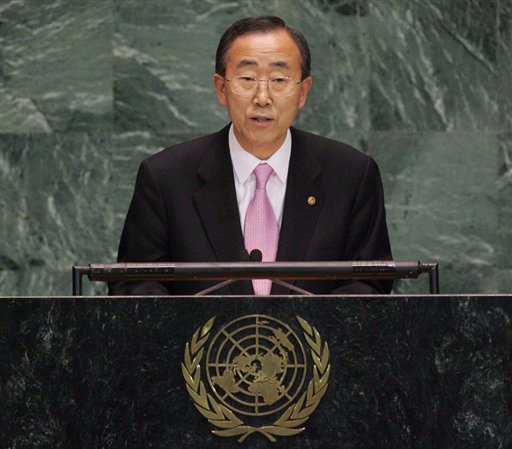
To much internal fanfare, the United Nations is trailing the release their super official, totally comprehensive report into the alleged use of chemical weapons in Syria. Though the report is (amazingly, still) not to be published until next week, the Telegraph reports that this did not stop Secretary-General Ban Ki-Moon from hinting at its contents:
Mr Ban did not say that Syrian government forces had carried out the suspected chemical arms attack near Damascus last month that was investigated by UN experts, but chose to point out that the Syrian leader had “committed many crimes against humanity”.
“Therefore, I’m sure that there will be surely the process of accountability when everything is over,” he said on Friday, in remarks that will increase the pressure on the Syrian regime and could even hamper high-level negotiations.
A UN team is expected to send its report on the Aug 21 attack to Mr Ban on Monday. He stressed that he still did not have the report, but predicted: “I believe the report will be an overwhelming report that the chemical weapons were used.”
While it is nice to see that the official machinery and bureaucracy of the UN is finally about to acknowledge the fact that chemical weapons were used, the glacial speed at which they reached even this laggardly point bodes very ill for the usefulness of the United Nations in any future conflict, or indeed any global event that moves faster than cold molasses on a winter day.
This is a problem, because everyone else in the world – from Russia to the Pope to anyone who saw the videos of victims writhing on the ground and thought to themselves “hmm, those don’t look like gunshot wounds” – has already acknowledged the use of these weapons of mass destruction, and moved onto the question of culpability (which is also nearly resolved, save for Russia who have chosen to disguise their flagrant opportunism and self interest as principled skepticism).
So what do we do when the United Nation takes three weeks longer to determine something that is already a glaring and acknowledged fact in the real world? Clearly, this situation cannot be allowed to continue, when so many of the future problems that are likely to beset the world – military grade cyber attacks, border skirmishes, internal separatist rebellions and pan national natural disasters – will require a rapid response in order to prevent massive and unnecessary escalation of the conflict at hand, or the deaths of more innocent civilians.
This is not to impugn the work of the UN chemical weapons inspectors, who I am sure did an entirely professional and competent job collecting and analysing the evidence taken from the chemical attack sites. And if a comprehensive suite of laboratory tests takes a couple of weeks to complete, then there is little that can be done to hurry it along.
But we should be clear that the problem faced by the United Nations is not to do with technology or resources, but entirely to do with the workings of the institution itself. The truth is that the United Nations, despite the good that it has done in some areas, faces a massive challenge to its credibility, from skeptical people in all nations.
From fact that the five key victors from the Second World War enjoy exalted status as permanent, veto-wielding members of the security council (as a Brit, I wouldn’t want to give that up; who would?) to the fact that countries with truly odious records frequently hold rotating membership of important committees on human rights or climate change, to the fact that many UN apparatchiks seem more keen on jetting around the world lecturing sovereign governments and trying to impose their preferred left-wing policies on a bemused population, the UN has lost any claim it ever really had to a democratic mandate or moral legitimacy.
Despite these manifold institutional failings, we cannot simply brand the UN “unfit for purpose” and leave the organisation – we still need some system in place, a forum where the countries of the world can meet to resolve conflicts and tackle pan-national issues. But the United Nations either needs to start moving faster in response to developing global crises, or we all (individuals, politicians and governments) need to stop holding aloft the will or approval of the UN as the official moral or legal stamp on any action that is taken around the world.
Given recent and not-so-recent events, that rosy image of the UN is tarnished beyond repair.

 Semi-Partisan Politics