The Daily Smackdown: David Cameron’s Transparent EU Posturing

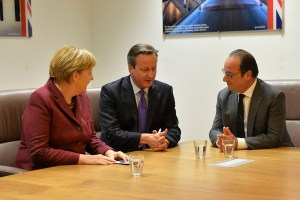
David Cameron - Angela Merkel - Francois Hollande - EU Renegotiation - Brexit

David Cameron has no respect for our intelligence if he thinks we will be fooled by claims that he is seriously considering campaigning for Brexit

Like this blog, the Times instantly saw through the prime minister’s latest desperate, amateurish attempt at brinksmanship and the dissemination of information by an often credulous media.

When David Cameron’s allies leaked that the prime minister was seriously considering recommending a Leave vote in the referendum if his renegotiation continues to be “theatrically spurned” by his EU partners, the story seemed too transparently false to be true. And it is.

The Times commented:

“It is patently clear that [David Cameron] cannot and will not become the man who tossed aside Britain’s EU membership. The hints from his allies that he might do so were a desperate negotiating tactic that has rightly backfired. This sort of melodrama is more likely to make negotiating partners giggle than give way.”

Absolutely. Every one of Cameron’s actions since he reluctantly promised the referendum as a too-little-too-late anti-UKIP defence has reeked of his desperate desire to keep Britain in the European Union at all costs.

As this blog pointed out yesterday:

Anybody with even one foot rooted in reality should be able to tell that this latest court gossip is nothing but spin. Having (unsurprisingly) gotten nowhere with his renegotiation efforts thus far, David Cameron needs to appear tough and resolute for the home audience. After all, it is pretty embarrassing that the leader of a global power and the world’s fifth largest economy has achieved precisely nothing, despite having embarked on a well-publicised begging tour of Europe. When begging and pleading with the Czechs for permission to change UK welfare rules yields no fruit, some kind of strong public stance is essential to preserve any kind of dignity.

The prime minister has never been able to force the words “Brexit” or any other specific phrase about Britain leaving the EU from his lips, and only on rare occasions has he even alluded to the fact that “nothing is off the table” if he judges the results of his renegotiation to be unsatisfactory.

Of course, since Cameron went into the British renegotiation carrying no demands at all – a point worth emphasising, and well made by Richard North at eureferendum.com – he is hardly likely to find his own efforts wanting. Who, given the chance to mark their own homework, would give themselves an F?

And when it comes to nothing being off the table in the event of failure, it remains easier to imagine the prime minister succumbing to a tearful, foot-stamping tantrum on live television than it is to picture David Cameron addressing the nation and declaring that Britain’s national interest would be better served by being outside the European Union.

EU Democracy - Brexit

Agree with this article? Violently disagree? Scroll down to leave a comment.

Follow Semi-Partisan Politics on TwitterFacebook and Medium.

Credulous Media Swallow David Cameron’s EU Renegotiation Myths

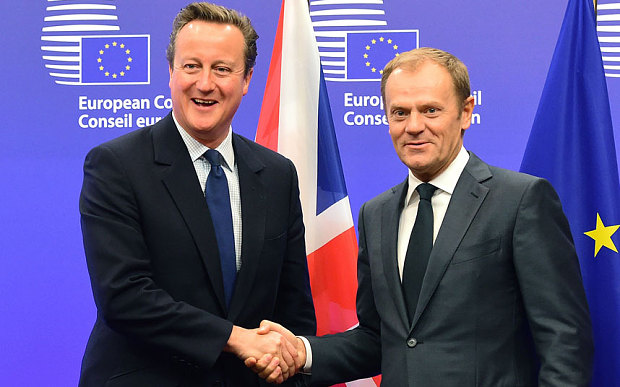
David Cameron - Donald Tusk - EU Renegotiation - European Union - Brexit

Nobody in their right mind seriously believes that David Cameron will campaign for Britain to leave the European Union. But that didn’t stop the media from earnestly reporting Number 10’s Brexit bluster

David Cameron is about as far from being a eurosceptic as a Conservative prime minister could possibly be. Sure, he was forced by the rise of UKIP into pledging a referendum on Britain’s EU membership – despite having previously stated that he didn’t think a referendum was appropriate – but this was only ever a matter of political expediency, not heartfelt desire for Brexit or deep conviction that the people should have the right to decide their own destiny.

But this has not stopped the media from willingly and credulously lapping up the latest spin emanating from Number 10 Downing Street – the risible idea that if David Cameron’s EU partners continue to treat him like the pesky kid at the adult’s table, he might seriously campaign for Brexit.

From the Telegraph:

David Cameron has privately conceded he will have to campaign to leave the European Union if he continues to be “completely ignored” by Brussels, the Daily Telegraph has learned.

[..] It has now emerged that Mr Cameron is telling senior figures in his party that he will be willing to campaign for a British exit if EU leaders do not back down over his key reform plans.

“He has said that if he is completely ignored or if they give him nothing he will campaign to leave,” the source said. “He has made that clear.”

Anybody with even one foot rooted in reality should be able to tell that this latest court gossip is nothing but spin. Having (unsurprisingly) gotten nowhere with his renegotiation efforts thus far, David Cameron needs to appear tough and resolute for the home audience. After all, it is pretty embarrassing that the leader of a global power and the world’s fifth largest economy has achieved precisely nothing, despite having embarked on a well-publicised begging tour of Europe. When begging and pleading with the Czechs for permission to change UK welfare rules yields no fruit, some kind of strong public stance is essential to preserve any kind of dignity.

And let’s be frank – the Telegraph didn’t so much “learn” that Cameron is considering campaigning for Brexit through canny investigative journalism, but rather they probably received a tip-off authorised by the Conservative Party hierarchy to place that narrative into the news cycle.

And what a successful stunt it has been. Now we are duly talking about how the prime minister feels so frustrated with the progress of his renegotiation that he is considering this drastic step, when deep down they (and most of us) know that David Cameron would sooner leave his daughter unattended in Nigel Farage’s local pub than recommend to the British people that they vote to leave the EU.

The truth, of course, is that this was always a sham renegotiation. David Cameron didn’t even bother to consult with the British people as to what they wanted out of any new settlement with Europe before jetting off to Brussels to set out his puny demands, so how could he claim to be representing the public’s real concerns?

This whole exercise has been about starting with the outcome of a “Remain” vote and then working backwards to determine the least possible number of concessions required from the EU to deliver that goal, rather than starting with a hard-headed assessment of Britain’s own national interest or public sentiment. And such a back-to-front renegotiation was never going to bear fruit.

As Mark Wallace points out in Conservative Home:

The conventional wisdom is that the Prime Minister has cut back his list of renegotiation demands in order to reach a swift agreement, in which he can claim victory and then hold an early referendum. That probably was his hope; it would certainly make political sense. Unfortunately for him, each aspect of that plan is foundering while the clock ticks down.

With every day that this supposed renegotiation goes on, Britain looks more and more like the weak supplicant nation asking its superiors for scraps from the table – and being rebuffed. This would be humiliating enough, but it is also self-reinforcing. The fact that our EU partners have already seen Cameron going cap-in-hand around the capitals of Europe begging for concessions (rather than boldly stating the UK’s national interest or presenting a radically different vision of EU membership) means that they are emboldened to give away fewer concessions when he comes knocking again.

Right now, the EU has bigger fish to fry than the Brexit question. And with immigration and terrorism top of the agenda, EU leaders feel confident in pushing our renegotiation way down the list of priorities because they know – even if our credulous media claims not to know – that David Cameron will campaign for a “Remain” vote, come what may.

France and Germany are both diplomatically canny countries. If they suspected for a moment that their treatment of David Cameron might seriously cause him to snap and embrace the Brexit cause then they would immediately start making more conciliatory noises. Secretly they might be glad to be rid of Britain, but they know that Brexit would be a stunning, unacceptable repudiation of their vision for Europe. Thus the fact that there is no diplomatic panic in Berlin or Paris is proof that Angela Merkel and Francois Hollande know that their British counterpart remains utterly pliable and sickeningly eager to please.

David Cameron can continue to authorise leaks suggesting that he is contemplating campaigning for Brexit, if it makes him feel better when he is politely ignored by the leaders of other countries a fraction of our size and power. He can promise all the table-thumping rows in the world, too.

But the one thing he cannot do is convince those of us who see through his cheap tricks that he is a real eurosceptic, or that he would ever allow his name to go down in the history books as the man who led Britain out of the European Union.

David Cameron - Angela Merkel - Francois Hollande - EU Renegotiation - Brexit

Agree with this article? Violently disagree? Scroll down to leave a comment.

Follow Semi-Partisan Politics on TwitterFacebook and Medium.

Paris Terror Attacks: The World Turns On Its Dark Side

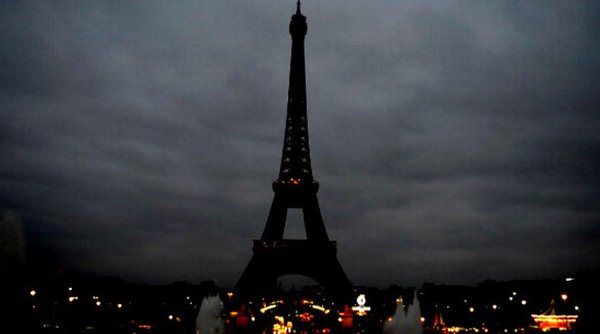
Paris Terror Attacks - Eiffel Tower Dark - 2

Our hearts break for Paris and the French people. For the sake of the victims and their families, our response to these latest terror attacks must be more than the standard denial and clichéd mistakes

Since awful showpiece terrorist attacks like those that tore through the heart of Paris last night are becoming a regular occurrence, it is worth reminding ourselves of the standard political response in their aftermath. It goes something like this:

Day 0: Expressions of shock, sorrow, anger and solidarity

Day +1: Insistence that now is a time for mourning, not asking difficult questions about how or why the atrocities were committed

Day +1, later: The first difficult questions are asked, particularly of the government and security services

Day +2: The intelligence services dust off their wishlist of draconian new powers, and strongly suggest that if only they already had these powers, the attack could have been avoided

Day +2, later: Some brave soul pokes their head above the parapet and tries to start a discussion about the link between unlimited multiculturalism and homegrown extremism, to near universal c0ndemnation

Day +3: The official narrative is established – “we will defeat this terror by giving our intelligence services the tools they need, and making radical or hateful speech illegal”

And so, within a week, the status quo reasserts itself. More civil liberties infringements, more free speech crackdowns, more government surveillance – and then more terror attacks, weeks or months later.

The status quo is not working. As this blog noted shortly after the Charlie Hebdo attacks:

Attempting to start a meaningful conversation about the root causes of Islamist terrorism is, apparently, highly unseemly and inappropriate so soon after an attack. And yet those who make this claim never explain why talking about the root causes of Islamist terrorism in its immediate aftermath is opportunistic and wrong, while conveniently it happens to be the perfect time for governments to demand sweeping, draconian new powers. And that is exactly what we now see.

One thing should now be absolutely clear, though apparently it needs constant restating: There can never be enough surveillance, never enough restrictions on movement, never enough laws banning hate speech to prevent a small number of determined, radicalised citizens – and likely non-citizens who have taken advantage of Europe’s loose borders – from going on the rampage and causing the kind of bloody mayhem that we now see, again, in Paris.

With the exception of the Stade de France, these were soft targets. It is simply not possible to protect every restaurant, every corner bistro or every theatre from a jihadist army of two who turn up in a car, spray innocent people with bullets and speed off to their next target. Concrete road blocks, razor wire, metal detectors and CCTV are of no use against these nimble threats.

So whatever else is said in the aftermath of these latest Paris attacks, let no one pretend that more government surveillance and more draconian crackdowns on free speech – either that of the Islamists or the Islamophobes – are the right answer. At best, these policies – favoured by the French and British governments – are a sticking plaster on an open wound, addressing the symptom but not the problem.

And that problem is the same as it was on 7 January, when Islamist gunmen stormed the offices of Charlie Hebdo, massacring journalists and shoppers at a Parisian kosher supermarket. The problem is that there are people living among us – a very small, but determinedly growing number, either citizens or recent migrants – who may hold the same passports as us and walk the same streets as us, but who feel no connection with us.

Those who propose nothing but even more security would apparently be content to live in a society where a small, segregated minority still hate us, but are thwarted in their attempts to kill us by omnipotent security services. They would be happy to live in a divided, ghettoised, multicultural dystopia, so long as the terror plots are always successfully thwarted.

Those of us who believe in the western and enlightenment values of freedom and individual liberty should not be satisfied with this goal – which is unattainable anyway, since perfect security can never be achieved. We should want a society which is open and welcoming to those who wish to come and contribute, but not credulously undiscriminating in accepting everyone. We should want a society where people feel bonds of kinship and affection which transcend racial and religious boundaries, where a healthy sense of patriotism ensures that there are common shared values which unite us all. But when patriotism and a robust defence of western values is seen as gauche, unseemly and culturally insensitive, there is no way to transmit these essential values to those who most need to receive them.

No government action taken by France in the aftermath of the Charlie Hebdo attacks could likely have prevented these new attacks on Friday 13 November – simply not enough time has elapsed for any bold new government policies to have taken effect. But appallingly, neither have any bold new government policies been proposed, let alone implemented. France still struggles with the existence of economically deprived, socially isolated immigrant communities who feel no allegiance to the country where they live – people who often feel more Muslim than French. Weak to nonexistent border enforcement makes it impossible to properly who control who comes and goes.

Meanwhile, the West – and Europe in particular – is in the midst of its own identity crisis, increasingly uncomfortable defending the principles of liberal democracy, free speech and tolerance. Many would rather bury their heads in the sand and deny the existence of the problem than insist that everyone abide by certain values and standards of behaviour. Too often, a warped strain of Islam has been allowed to run side-by-side with Western culture in a dual, effectively segregated society. And the growing Western culture of victimhood only adds fuel to the jihadist fire.

As Frank Furedi wrote on the tenth anniversary of the 7/7 London bombings:

The redefinition of terrorism as an ideological competitor is linked to the decline in the self-belief of the West. Even before the events of 11 September 2001, never mind 7 July 2005, there was more than a hint of defensiveness about the ability of Western values to prevail over those of their hostile opponents. One conservative American observer gave voice to this sentiment, and concluded that ‘protecting Western culture from foreign assault requires domestic revival’. A decade before 9/11 he warned that ‘the 21st century could once again find Islam at the gates of Vienna, as immigrants or terrorists if not armies’. Today there is little evidence of a domestic revival. Indeed, Western governments are sensitive about their very limited capacity for inspiring their own publics. The problem of engaging the public and gaining its support is one of the most striking features of the post-9/11 political landscape.

[..] There are signs that, in the decade since 7/7, some sections of the British establishment have woken up to the fact that what drives homegrown jihadism is the failure of society to clarify its values and way of life. The constant calls from Cameron and others to teach British values in schools represents an indirect recognition of the absence of such values from young people’s lives. But the values that inspire must be lived; they can’t be recycled through a shopping list of good intentions. Until there is a more courageous attempt to address this problem, tragedies like the London bombings of a decade ago will always be a possibility. The real threat is not the poisonous ideology of Islamic State, but Western society’s failure to live out and stand up for the principles of liberal democracy.

As it is in Britain, so it is in France. Neither country has done enough to tackle the sense of alienation or the crisis of British / French values which make radicalisation possible.

Tim Stanley touches on these points in his moving tribute to Paris in the Telegraph following yesterday’s terror attacks:

The brutality of this attack shows that we are not dealing with an enemy that can be negotiated with, only confronted and beaten. Perhaps that confrontation will be existential. Are we doing enough to integrate everyone, enough to fight poverty, enough to eradicate prejudice? Are we confident enough about our own values to teach and promote them? Are our security measures appropriate? Do we all have to come to terms with living with permanent anti-terror measures (I hope not). And what will our society look like as a consequence of this conflict? Less free, perhaps?

Are we doing enough to integrate everyone? I don’t think that any French or British politician could say that enough is being done. Worse still, it isn’t even a top priority at the moment.

Are we confident enough about our own values? Clearly not – in many cases, we have so little confidence in our own values that we fail to insist that others (recent immigrants and segregated communities) abide by the enlightenment values which have served us so well. In fact, sometimes we make an ostentatious virtue of parading our tolerance of thoroughly anti-enlightenment values, in warped service to “multiculturalism”.

Are our security measures appropriate? Our intelligence services will walk a tightrope here, insisting that they do everything they can to keep us safe, while making clear that if we do not grant them additional powers, any future blood spilled will be on our hands.

But Tim Stanley’s final question is the most pertinent: Do we all have to come to terms with living with permanent anti-terror measures?

That question is best answered with another question: What concrete actions are we taking that might feasibly lead to the rolling back of the semi-permanent anti-terror measures and powers which are now a depressingly familiar part of life? What one single thing are we doing that might mean we need less security and less surveillance a decade from now?

The regrettable answer is that we are doing virtually nothing. The world continues to turn on its dark side, and we can reasonably look forward to a future of more random terror, more sombre presidential addresses and the familiar sight of militarised police SWAT teams crawling over our major cities. This is the new normal, and nothing we are presently doing is going to change that fact.

It is now Day +1. This time, can we break with rotten, failed convention and actually talk about root causes?

Paris Terror Attacks - One World Trade Center - New York

Top Image: Eiffel Tower, darkened after the 13 November attacks: Auskar Surbakti Twitter feed

Bottom Image: One World Trade Center, New York, lit in French colours: Jon Swaine Twitter feed

Scroll down to leave a comment.

Follow Semi-Partisan Politics on TwitterFacebook and Medium.

It Is Not Britain’s Job To Save The EU From Its Own Worst Instincts

David Cameron - European Union

They’ve bribed us with cheap international calls, and threatened us with bogus figures about fictitious job losses. Now, the “Remain” campaigners want us to vote to stay in the EU to save Brussels from itself

What to do when the two best weapons at your disposal – bribery and coercion – are not achieving the desired effect?

Well, if you are the “Remain” campaign and you are desperately trying to come up with plausible new arguments to convince the British people to stay shackled to a failed, anti-democratic political union, then it is eventually going to come down to begging, pure and simple.

Cue Mark Field’s latest piece in CapX, which is dedicated not to any of the things that the European Union can offer Britain, but rather to all the reasons why the EU needs Britain to stick around – namely, to save the Brussels machine from its own worst instincts.

Field recounts conversations with some Swedish legislators, who are apparently “terrified” at the prospect of Brexit:

It took some Swedish counterparts to remind me recently just how crucial Britain’s role in the EU is to fellow members who believe in the Anglo-Saxon values of free trade and competition, and share our desire to resist “ever closer union”. The notion of Brexit is terrifying to Northern European allies who look to the UK as an essential bridge between the EU and the English-speaking world, a critical counterweight to the Franco-German axis and the asker of awkward but essential questions over reform. They see an EU which Britain has been instrumental in shaping, citing the expansion eastwards into pro-western countries like Poland, the promotion of the single market, open competition for goods and services, new trade deals and English as the dominant language.

Continue reading

A Portuguese Coup: How The EU Suppresses Democracy Without Trying

There may be no tanks on the streets, but only because that’s not the EU’s style. The European Union has now mastered the art of the bloodless, self-administered government coup

Television stations continue to broadcast. People continue to work, shop and go to school. In fact, life goes on as normal in nearly every way. But there is still a coup taking place in Portugal today.

At the beginning of October there was a general election in Portugal. The governing centre-right government led by prime minister Passos Coelho lost seventeen seats and their parliamentary majority, and though they remained the largest party they were unable to form a new government. After a few weeks of political horse-trading, the leader of the Socialist Party, Antonio Costa, forged a coalition deal with two other left-wing parties, the Left Bloc and the Communists. Together, they held a wafer-thin majority and could plausibly claim the right to govern.

But unfortunately, some of these left-wing parties held the Wrong Views. They were against the existing “austerity” terms of the bailout provided to Portugal by the European Union. Some of them – quick, fetch the smelling salts – were against the European Union entirely. And for holding these eurosceptic positions – views which were validated by the Portuguese electorate less than a month ago – they were prevented from forming a majority coalition government.

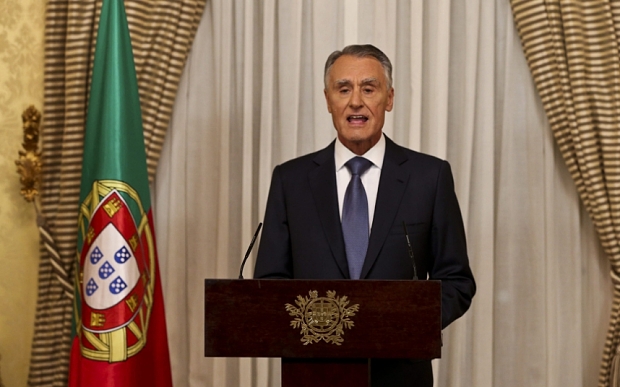
With these chilling words, the Portuguese president openly admitted that which has been an unspoken reality in Europe for some time – that democracy may exist, so long as it does not stand in the way of ever-closer European union:

Continue reading