“Margaret: Death Of A Revolutionary”

A documentary is just starting on UK’s Channel 4 TV (Saturday 13th April, 7PM), entitled “Margaret: Death of a Revolutionary”.

My interest was piqued when I saw that Channel 4 was showing a documentary about Baroness Thatcher – their news channel is skewed so far to the left that it defies belief, so I was curious to see what they would have to say about Britain’s post-war saviour.

But it was the description of the programme in my Sky TV guide that really affronted me:

“Martin Durkin presents his radical thesis: that Margaret Thatcher was a working class revolutionary, and that she believed capitalism was in the interests of ordinary people, not the toffs.”

Everything wrong with the British left-wing encapsulated in one sentence.

Where to start?

Why is this a “radical thesis”? I think that we are supposed to take this line of nonsense as a piece of magnanimity from the left – that the holier-than-thou leftists among us are willing to grant that maybe Thatcher was (albeit misguidedly) trying to help the less fortunate in society, and not just the “toffs” (don’t get me started on that word) that we all assume were the only people she really cared about.

What nonsense.

Of course Thatcher believed that capitalism was in the interests of the ordinary people. Because it is. This isn’t a “radical thesis”. The ignorant left may have accepted the nonsensical trope that capitalism benefits only the wealthy Monopoly-men style captains of industry and the “toffs”, but the rest of us sure haven’t.

We of sound mind know that capitalism (as opposed to corporatism, which is entirely different, and which Thatcher promoted no more than any other British politician) inevitably helps the “ordinary people”.

And did the person who wrote the programme description lose their mind? Who does he think the Right-to-Buy scheme benefited? The “toffs” weren’t the ones living in state-owned council housing, who were suddenly given the opportunity to buy their houses and move into the ranks of the middle class. Who did the deregulation and privatisation of failing state-owned industries benefit? Yes, wealthy people who had money sloshing around and could afford to snap up shares did well, but so did many middle-class people, as did the whole population who no longer had to deal with fuel crises and substandard products.

Yes, of course Margaret Thatcher believed that capitalism benefits “ordinary people”. Because it does. Nationalised, state-owned industries sure didn’t benefit us. Three day working weeks didn’t benefit us. Power cuts, garbage piling up, dead bodies laying unburied, industrial unrest, the country being run by the unions, none of these things benefited us.

And Channel 4 has the nerve to present their quirky notion that maybe Thatcher had the interests of “ordinary people” at heart as a radical thesis. That in fact perhaps Margaret Thatcher, the grocer’s daughter from Grantham, wasn’t actually in the pocket of the landed gentry and the “toffs” after all.

I despair of the left sometimes.

The Sheer Unimportance of North Korea

The press coverage lavished on the every theatrical ranting of North Korean leader Kim Jong-Un and his propaganda machine is rapidly becoming ridiculous.

Reports The Telegraph:

That American pledge to defend South Korea and Japan is crucial to deterring the North from full-scale war. “Kim Jong-un has to understand, as I think he probably does, what the outcome of conflict would be,” said Mr Kerry.

“I think we have lowered our rhetoric significantly and we are attempting to find a way for reasonableness to prevail here,” he added. “The rhetoric that we are hearing from North Korea is simply unacceptable by any standards.”

The North voiced yet more belligerence on Friday, turning its venom on Japan, saying: “If Japan makes a slightest move, the spark of war will touch Japan first.” The statement added that “Japan must come to its senses” or else Tokyo would be “consumed in nuclear flames”.

Yeah, yeah, yeah.

Kim Jong-Un is a pudgy, spoiled little tinpot dictator, presiding over a desperately poor nation and an army which, while large in size, is comically antiquated and under-equipped, and not at all prepared for significant combat.

Like most rational people, Kim and the senior officials around him who pull the strings, do not have a death wish, and are not about to launch a nuclear strike against anyone, with very low chance of success but the certainty of total destruction in retaliation.

It should be obvious to a small child that Kim Jong-Un is sabre-rattling (if I hear the term “bellicose rhetoric” one more time on the news, or read it in print, I think I will go mad) purely to shore up his authority and support at home. Given the fact that none of the poor enslaved citizens of North Korea will ever see the stern-faced responses that our own leaders somehow feel compelled to give every time their babyfaced dictator throws one of his tantrums, we have to ask ourselves why do John Kerry and William Hague (and countless other military and diplomatic officials) feel the need to respond publicly when those responses will be seen only by their domestic audiences?

And incidentally the people at Fox News, who have been covering the latest tensions with great glee as another “Obama foreign policy crisis” would do well to discover some humility and remember that it was their beloved president, George W. Bush, who allowed North Korea to go nuclear in the first place.

That is all.

Santorum Lurks

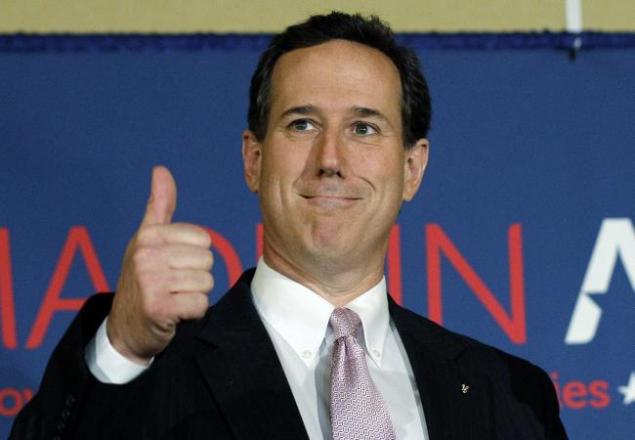
Rick Santorum

In case anyone was worried that Rick Santorum had taken his Republican primary election loss, or the GOP’s presidential election blow-out too much to heart, they need fear no longer.

RealClearPolitics reports that, undeterred by the now undeniable shift away from his socially regressive, paternalistic, authoritarian positions on just about all social issues, he is laying the groundwork to run for the Republican nomination once again in 2016.

Scott Conroy from RealClearPolitics writes:

The main event during Santorum’s impending return to Iowa will be his keynote speech in Urbandale at the annual spring fundraising dinner for the Iowa Faith & Freedom Coalition, a Christian conservative group that holds deep influence among evangelical caucus-goers in the state. He also is slated to participate in a Des Moines luncheon on behalf of a pro-life medical research group.

In both appearances, Santorum is expected to defend what he has called the “soul of the Republican Party” against forces within it that are increasingly eager to downplay or reconsider longstanding aspects of its platform.

His eagerness to remain on the front lines of this intra-party fight comes after Santorum spent much of the 2012 campaign defending his hard-line positions on social issues while also aiming to expand his appeal by touting his blue-collar credentials and economic populism.

Apparently, Rick Santorum is particularly eager to ensure that the GOP does not follow in the footsteps of Senator Rob Portman and others, and continue to “evolve” on those social issues where they are increasingly at odds with public sentiment:

But well before the 2016 GOP field begins to take shape, Santorum’s paramount political priority is to push back against the winds of change within the party. In particular, he’s focused on a de-emphasis — and in some cases an evolution — of stances on social issues in order to attract more moderate voters in general elections and acknowledge shifts in the broader electorate’s views.

In an interview with the Des Moines Register this week that set the stage for his upcoming visit, Santorum was asked about the recent avowals of support for gay marriage made by Republican Sens. Rob Portman of Ohio and Mark Kirk of Illinois.

Santorum dismissed the growing notion that further movement within the GOP on the issue is inevitable, given polls showing a majority of Americans now support same-sex marriage.

“The Republican Party’s not going to change on this issue,” he said. “In my opinion, it would be suicidal if it did.”

I suppose one must admire Santorum’s consistency. He doesn’t believe that the GOP should evolve politically in terms of their stance on gay marriage, just as he rejects the notion of biological evolution in nature.

Two universal truths of politics in the United States of America – Iowa will continue to play a disproportionately large role in vetting and selecting presidential candidates given it’s sparse population and lack of relative real importance in the union; and Rick Santorum will remain thoroughly uncompromising on all matters social and “moral”.

Music For The Day

The final movement from Aaron Copland’s Third Symphony, performed by the New York Philharmonic Orchestra under the direction of Leonard Bernstein.


A happy weekend to all!

Thatcherism’s Losers

The public and media reaction to the recent death of Margaret Thatcher has played out in exactly the way that I and probably everyone else in the nation had been predicting for the past decade.

The former prime minister was lionised in the right-wing press, and indeed by myself, as someone who quite literally saved the country, halting and then dramatically reversing what was considered by many to be a slow and inevitable national decline.

She was remembered as a “divisive” leader by the left-leaning media, some of whom grudgingly acknowledged the necessity of many of the economic policies which Thatcher brought about, while others chose to set reality aside and focus exclusively on the negative aspects of her time in office.

Some people showed their bad taste by holding spontaneous celebratory street parties on hearing the news.

And finally, of course, everyone got huffy with everyone else for not responding to Baroness Thatcher’s death by their own personal definition of the “appropriate” way.

Of course it is fitting that we recognise and remind people of the enormous positive contribution – the most significant of any post war politician – that Thatcher made to the United Kingdom, and to the world. But we would be doing ourselves an intellectual injustice, and helping to ensure that the next visionary British conservative leader (whoever he or she may be) will also be labelled as “divisive” and hated by many, if we do not understand the lingering bitterness which led to speeches such as this one, made by the Labour Member of Parliament for Hampstead & Kilburn (London), my local MP Glenda Jackson:


Harsh and bitter words, borne of harsh and bitter experiences. But were the people who lost and suffered the most from 1979-1990 really let down by the prime minister, or by someone or something else?

I would argue that it was not the prime minister herself who failed Thatcherism’s biggest losers, but by the long line of political leaders in Britain heading back to the end of the Second World War and the subsequent post-war settlement, which brought about the nationalisation of industry and the freedom from competition that allowed so much of the British economy to atrophy and wither over time, gradually becoming less and less sustainable and competitive with each passing year, until only the harsh but necessary medicine of Thatcherism was able to save the country, at a much higher social cost than might otherwise have been the case.

We can see an excellent modern-day example of this exact argument being made by the highly popular Republican governor of the state of New Jersey, Chris Christie:


Replace the phrase “unfunded pension obligations” with “state-owned industries” in this speech and you have an eloquent defence of Thatcherism that you can deliver in a single minute. Christie explains that he understands the anger and frustration of the people in his state who are materially losing out in terms of stagnating wages for public sector jobs, trimmed pensions for retired state workers, and a host of other measures that the governor considered harsh but necessary in order to put New Jersey on a sound and sustainable financial footing, but that his policies are necessary because none of his predecessors had the political courage or common decency to level with the electorate about the problems that lay ahead, and the changes and sacrifices that would have to be made.

In Britain, those who lost out the most tended to work in inefficient, state-owned industries such as coal mining or car production, where Britain simply did not have a competitive advantage. They had effectively been lied to, and shielded from competition, by nearly all of the political leaders in Britain since the end of the Second World War. Just as generations of New Jersey politicians had promised their public sector workers generous pension and benefit entitlements that they knew would become unsustainable over time, so generations of British politicians promised the population here that heavy industry, state-owned monopolies and industrial relations tilted in favour of union bosses were sustainable in the long-term.

Could and should more have been done to support people who lost their livelihoods as the Thatcher reforms took effect across the country. Absolutely. And we need to ensure that when a future conservative leader makes the next set of necessary reforms (the urgent rationalisation and shrinking of the public sector in Britain) that adequate support is given to people in terms of new job placement and new skills training. There are parts of the United Kingdom where over 50% of employment comes from the public sector, a ridiculously high number – people busily providing and receiving government services to and from each other, and only half of the workforce engaged in private sector activities that generate value and wealth. But as we move away from this failed model, it is not morally acceptable, or politically viable, to rationalise the public sector without providing the necessary transitional support. We can, for example, have no more communities decimated – though the British public must also play their part by increasing our notoriously low labour flexibility and being willing to relocate for work.

Margaret Thatcher achieved much during her time in office. Lord knows that in today’s age of focus groups, granular polling of every single issue and the obsession with following public opinion, we need a leader who is a true conviction politician, and who persuades people to their cause rather than slavishly seeking positive headlines in The Sun or The Daily Mail.

But while conservatives such as myself celebrate the extraordinary legacy of Margaret Thatcher, we need to be sure that we formulate and advocate policies that avoid her pitfalls as well as emulate her great victories.