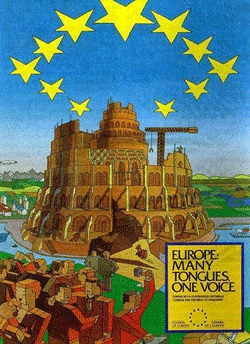
The Spirituality of the European Union

EU church religion


St George’s Day brings yet another wildly misguided and inappropriate intervention from a Church of England bishop, this time the Rt Rev Michael Langrish, Bishop of Exeter.

While back-handedly praising Prime Minister David Cameron for the zeal of some of his reforming efforts, he goes on to expound at length on the question of whether Cameron might be – wittingly or unwittingly – undermining the “deep spiritual roots” of the European Union.

From The Telegraph:

The Rt Rev Michael Langrish, who sits in the House of Lords, told Peers that he was concerned that Mr Cameron’s policies could contribute to the “loss of the European soul”.

He told how the European project has “deep spiritual roots” and said the Church of England “engages with the EU itself through its own representation and structures”.

The Bishop of Exeter is, of course, a Lord Spiritual, one of those Church of England bishops given the right and authority – unique among leaders of all other religions and denominations in this country – to sit in the upper house of the British parliament and meddle in our lawmaking. The Telegraph continues:

Speaking in the House of Lords this week the Rt Rev Langrish insisted that the Church of England has a “European perspective”.

“It may be thought that the Church of England does not have a particularly European perspective, but that is far from being the case,” he said. “Through its diocese in Europe it is present in all the member states of the EU. It has effective links with other churches throughout Europe and is active in the Conference of European Churches. Together with our partner churches, we are also deeply aware of some of the roots of the EU and the vision of its founders in Catholic social teaching.”

First of all – deep spiritual roots? Really? I am not wholly ignorant of Catholic social teaching, and I am probably better informed than most about the history and development of the European project from its humble beginnings as the European Coal & Steel Community. In my misguided undergraduate days I curated a half-hearted, rightly neglected website called the Pro-European Alliance which aimed to explain some of this history and spin it in a way that case favourable light on the modern-day European Union.

Bishop Langrish’s attempt to describe the institutions, mechanisms and workings of the EU as having any spiritual dimension to them whatsoever seem to be a rhetorical step too far. That is not to say that there was or is nothing noble in the idea and reality of the EU. Binding the fractious nations of Europe together through increased trade, some common institutions and a mechanism to resolve local disputes was undoubtedly a good thing. So potentially a tenuous argument could be made that the existence of an organisation such as the EU served or serves some spiritual goal.

But the European Parliament? The Council of Ministers? The Commission, which hasn’t produced an audit-worthy budget and financial statements for years beyond counting? The European Courts? How do any of these inefficient, undemocratic, self-serving institutions, created by bureaucrats to serve the interests of bureaucrats, nourish the roots of spirituality? In any way?

The only way that one can see any spiritual element to any of this is if one subscribes to the view that the nation state and international institutions are the most suitable – or only acceptable – forums for key aspects of the modern welfare state such as regulation, income redistribution and the like to be administered. That people are inherently selfish, thoroughly unaltruistic, and that only through government coercion (either at a national or European level) can we make ourselves administer fair justice and look after the weak and vulnerable in our societies.

And of course this is exactly what large swathes (though not all) of the Church of England does believe today – see “Christ would not privatise our NHS” as just another recent, damning example. Build and maintain a big state sector to do all of the things that humans are too selfish or wicked to do of their own volition for the good of their fellow men, and criticise anyone who holds opposing views from the pulpit every Sunday.

The Bishop concludes:

“I hope that the failure of successive British Governments to articulate a coherent and constructive policy towards our European partners and to manage to take public opinion along with this will not contribute to that loss of the European soul.”

When the Bishop of Exeter defends the spiritual roots of the European Union and attacks David Cameron for seeking to repatriate powers from the EU and return them to the nation state or to the individual, not only is he wrong, but in so doing he is no less than abdicating his own Church’s spiritual roots and its responsibility to empower and enlighten the individual.

On St George’s Day

AGF5X3


Today is April 23rd, St. George’s Day.

Saint George is the patron saint of England, and so by all rights I should be lounging in the sun in a pub’s beer garden, drinking a pint of proper English ale and celebrating all that is great and good about my country.

I am, of course, doing none of those things, and not just because I have to work today.

Ed West, writing in The Telegraph, has an interesting perspective on why he is unenthused about our national day of identity celebrating and enforced cheerfulness:

In summary, the whole national day was invented to sell tat, just as Irish national identity was created to sell beer and expensive woollen fabrics to Americans. I have no interest in celebrating St George’s Day, not because I’m ashamed of our national identity, but because I’m secure in it. After all, I don’t need to ask myself what being a West “means” or what my family identity is; it’s just my family. English people never used to ask what Englishness meant, because there was no need to; it was one of those things. You knew it when you saw it.

The idea of what a national identity should mean has only arisen in the age of mass movement, in response to intellectuals who have denied the idea of the nation as a family as too exclusive or discriminatory. New Labour came up with all sorts of strange notions about what Britishness “meant”, such as “tolerance” and “respect for other cultures”, when it means nothing except coming from Britain, being descended from British people, or adopting Britain as your home (a nation is a family, and just like any family it adopts and marries out).

He goes on to conclude:

As a result we’re having to reinvent tradition, but it all feels a bit pained and unnatural, when this is a day best left to the church. A far better national day would be June 15, Magna Carta Day: a day to celebrate the rule of law and individual freedom, concepts that, contrary to what people believe, do not just spring from nowhere but are intimately linked to the concept of England as a political entity. That’s what makes me feel proud, but most of all grateful, to be English.

On this concluding point, West and I are in total agreement.

I cannot bring myself to excitedly celebrate St George’s Day, because of all the many great, awe-inspiring things that my country has done (and I honestly feel more British than English – or at least both identities cohabit comfortably in my mind in just the same way that one can be both a proud Texan and an American), St George had nothing to do with any of them.

St. George didn’t write or sign the Magna Carta.

St. George didn’t defeat the Spanish Armada, or win the battle of Trafalgar.

St. George didn’t invent the telephone, television, jet engine or the world wide web.

St. George didn’t grant womens suffrage, abolish slavery, establish the NHS (of which I’m no particular fan, but which is viewed as an almost religious national symbol by many in this country).

St. George didn’t stand alone against the threat of Nazi Germany, and then go on to win the cause of freedom.

Any of these accomplishments offer tangible historic feats that could be used as the basis for a national patriotic day that could truly bind us all together as a nation – English, Welsh, Scottish and Northern Irish together – and which could properly be used to reflect and celebrate our nation, just as Independence Day is rightly used in the United States.

But St. George’s Day – no thank you.

The World Of Jennifer Rubin

Sometimes someone just says it better than you ever can.

And on this occasion, Andrew Sullivan hits the nail on the head.

I have previously blogged about the ocean of willful ignorance in which pundits like Kimberley Strassel and Jennifer Rubin gently bob, but Sullivan reboots the attack and gives us the big picture. Behold – this is what determined head-in-the-sand, willing self-deception can make a person – in this case Jennifer Rubin – say.

Andrew Sullivan's avatarThe Dish

rubin

[Re-posted from earlier today]

Come join me, for a while, in an alternative universe. In this universe, Obama is clearly a worse president than George W. Bush. Now how do we get there? Here’s a start:

Many of [Bush’s] supposed failures are mild compared to the current president (e.g. spending, debt).

But by far the biggest factor in today’s debt are the unfunded wars Bush launched and lost, the massive tax cuts which took us from surplus to deficit, a spending spree on Medicare, and a collapse of the economy which occurred on Bush’s watch after eight years of negligent regulation of Wall Street. This sentence is therefore almost perversely deceptive.

Unlike Obama’s tenure, there was no successful attack on the homeland after 9/11.

Does 9/11 not count? The biggest national security failure since Pearl Harbor – resulting in more than 3,000 deaths? After the president was explicitly warned

View original post 606 more words

Music For The Day

“In Trutina” from “Carmina Burana”, composed by Carl Orff.


In trutina mentis dubia
Fluctuant contraria
Lascivus amor et pudicitia.

Sed eligo quod video
Collum iugo prebeo
Ad iugum tamen suave transeo.

A Musical Glass Ceiling, Finally Broken

For the first time ever, the person given the honour of conducting the Last Night of the Proms, that great British musical occasion, will be a woman. An exceptionally well qualified woman, Marin Alsop.


Yes, I’m biased. Alsop is a protege of one of my musical heroes, Leonard Bernstein. But she has also distinguished herself through her very well-received tenures with the Baltimore Symphony Orchestra, Royal Scottish National Orchestra and Bournemouth Symphony.

Female conductors are still an incredibly rare site on the podium, as the Telegraph article relates:

Female conductors are about as common as hen’s teeth. A comedian friend of mine once said that a comic is always the person facing the wrong way, and this is doubly true of a conductor. If a comedian onstage is the only individual in the room facing the audience, then a conductor is the only person on stage facing the performers.

To put yourself in a position where you are neither orchestra nor audience, that is to say, a unique figure, elevated on your own little platform, essentially telling everyone in the room what to do (you listen; you play) requires a rather particular set of personal characteristics that we probably traditionally associate with men, slightly crazy, arrogant, wild-eyed men.

The series of summer musical concerts at the Royal Albert Hall and associated venues, collectively known as the BBC Promenade Concerts, have expanded boundaries in a number of areas. We have already had the first American conductor to take charge of the Last Night – the excellent (and underappreciated) Leonard Slatkin, of St. Louis fame. The Proms now include outdoor concerts, late night concerts, and science fiction themed concerts (to the delight of many Doctor Who fans). This is all well and good. But the announcement that Alsop will be the first woman to conduct the BBC Symphony on this illustrious occasion should serve as a reminder that much more needs to be done before women are fully represented at the highest levels of classical music. Alsop has blazed a trail, but there are far too few younger women following in her wake.

That is not to say that there are no other women conductors of great talent and some renown – one might think of the excellent Xian Zhang, who occasionally guest conducts the London Symphony Orchestra – but this wikipedia page shows the depressing truth of the matter. Just 61 entries.

As always, I shall look forward to the upcoming Proms season, and to the Last Night. But the fact that we are celebrating this particular milestone only in the year 2013 should give us all pause for thought.