As I was browsing The Spectator website earlier today, I noticed a link to a piece from their archives, an article written to mark the consecration of the newly built Coventry Cathedral on 25 May 1962, half a century ago:
http://www.spectator.co.uk/coffeehouse/7869058/from-the-archives-coventry-cathedral.thtml
Coventry Cathedral was a temporary spiritual home for me during my time studying at nearby Warwick University, particularly during my second year when the university forced us into off-campus housing in the city. Though I converted to Roman Catholicism at the age of eighteen, I quickly grew to love the Anglican service of Choral Evensong, which I would sometimes attend first at my college in Cambridge and later while studying at Warwick. Though these periods were not anything approaching a high water mark in my ebbing and flowing faith, I do have very fond memories of attending Choral Evensong in these places, and feeling closer to God when I did so.
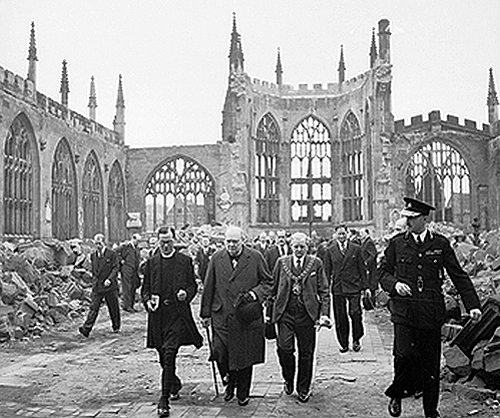
Coventry Cathedral is a particularly inspiring place. You can walk from the still, quiet, grey remains of the old Cathedral (largely destroyed during the Coventry Blitz on 14th November 1940) to the beautifully designed and lit tranquility of the new building, and the feeling when doing so is quite remarkable.
The thoughts of the Spectator’s reviewer are worth quoting at some length:
As I stood just inside the glazed ‘west’ wall of Coventry Cathedral, beneath John Hutton’s gaily engraved angels — running, jumping and standing still — I was stunned by the richness of John Piper’s baptistery window, the absolute rightness of the Sutherland tapestry which fills the whole wall behind the altar and the simplicity and serenity of the ‘great barn’ itself — Sir Basil Spence’s own words — in which, from the main entrance, they are the only immediately visible works of art.
It would have been shattering enough simply to see the live version of the building I had admired in models and drawings for several years; it was much more disturbing to hear it. Just by chance, as I approached the cathedral it had been completed — by being filled with music. I cannot remember a more moving experience. With my hand still on one of the tiny bronze door knobs, sculpted as a child’s head by Epstein, I was hit simultaneously by shapes, colours and sounds — the fourteen slender pillars of reinforced concrete which suspend the timber- and-concrete vaulted canopy beneath the roof; the perpetual sunshine that bursts from the centre of deeper colours in the eighty-four-foot-high Piper window, and the familiar hymn tune which reached me — as I reminded myself in an effort to keep emotion in its place — by courtesy of Mr. David Lepine (performing with four manuals and seventy-three speaking stops) aided by acoustic slabs of cork and Weyroc, placed high above the vaulting, and the sound-absorbent surfaces of Sutherland’s Christ in Glory.
I half hoped that by turning my mind towards technical achievements of this kind I would suppress the urge to go away without having the impertinence to write a single word of adverse criticism about the cathedral. So I tore my thoughts away from the simple beauty of the font (a scooped-out boulder from the Holy Land) and Ralph Beyer’s superbly carved lettering on the white stone panels that flank the nave, and tried very hard to see the cathedral as an elegant box of functional tricks. But I had to give in. This is a great and humbling building — a building in which trivial criticisms merely make the critic himself feel trivial. Of course it is a box of functional tricks; but every trick is inspired and designed to help the real user of the building. This is a machine for Worshipping in — a cathedral built round the Communion service.

I like that phrase, “a machine for worshipping in”. I find that it describes very well the utility and efficiency of the building and its contents, as well as the streamlined, modern beauty of the furnishings and commissioned artworks. To my (very) amateur architecture enthusiast mind, Spence’s design epitomises the very best of mid-century architecture. Given the era in which it was commissioned, designed and built, the new cathedral could so easily have been a drab grey brutalist building (not that I object to all of those, but more on that in another blog post), one of many that were being enthusiastically erected up and down the country.

I will always remember one occasion, one of the first times that I attended evensong at Coventry cathedral. Attendance was particularly light that particular Sunday evening, so one of the Deacons beckoned me from my normal seat in the Nave to sit in the row of seats behind the choir on the raised platform at the front of the church as they sometimes did when there were few attendees. Once I had been guided to my new, front-seat location, however, the Deacon was distracted by some other issue and neglected to tell any of the other arriving congregation members to follow my lead. Soon there was a small gaggle of twenty or so elderly parishioners sitting in their normal places in the Nave, and then me, sitting on the raised section behind the choir, with one of Sir Basil Spence’s soft spotlights gently highlighting my solitude.
And then the organ started to play.
The choir and ministers started to process through to their places from the back of the church, and as they got closer to me, I realised with growing alarm that two of the lead celebrants were walking down the same row that I was sitting on. Was I supposed to move out of their way, or stay there, or acknowledge them or ignore them? I decided to ignore them, and stood there like a lemon while the two men in pointy hats took up position next to me behind the choir. They didn’t seem to be put out at my presence so I figured that maybe I was okay. Not so much.
It wasn’t that anything bad happened; it’s just that in much the same way as you wouldn’t necessarily expect or want to be strapped in next to the pilot for the duration of a commercial flight from London to Paris, neither would you want to be sitting right next to the con-celebrant of a choral evensong service, between him and the congregation, in a large cathedral, when you are not that familiar with the order of service, and haven’t quite mastered the basics of when to stand up and sit down. That’s all I’m saying.
The following week I sat far enough back in the regular seats that the Deacon would not notice me before the service and invite me to “come on down”.
Anyway, enough of rambling anecdotes. I am out of practice at blogging and I’m pretty sure that I need an editor.
But let me close this post by wishing a very happy 50th birthday and a long life ahead to an old friend.


 Semi-Partisan Politics